Key takeaways
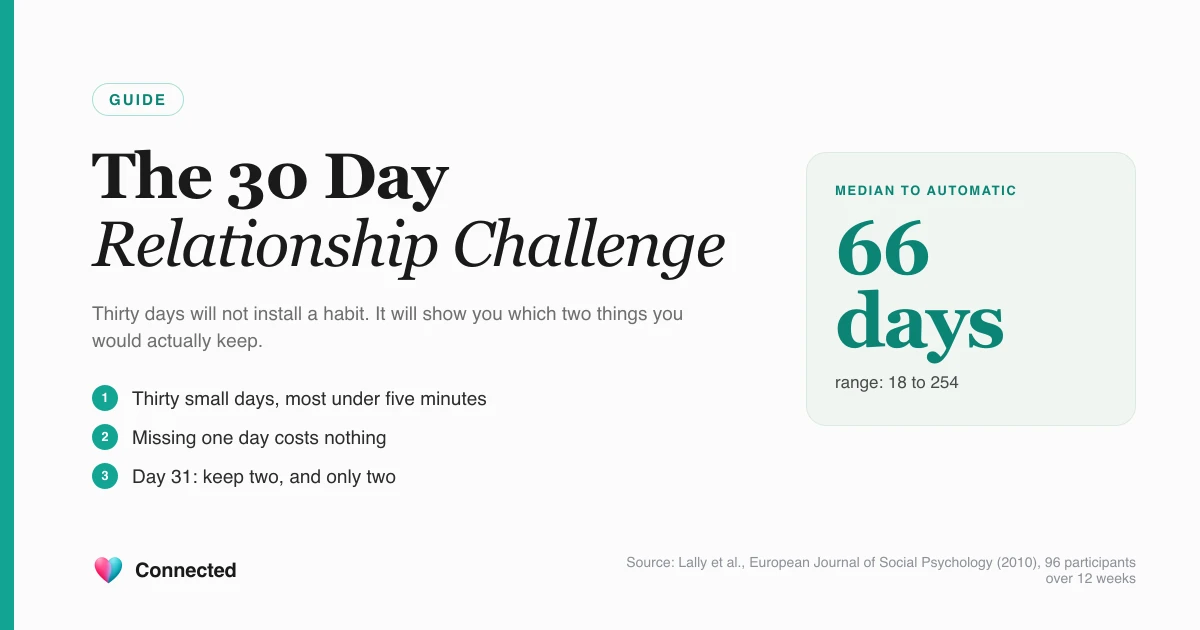
- Thirty days does not install a habit. The median time to reach 95% of automaticity is 66 days, and the observed individual range runs from 18 to 254.
- Missing one day does not reset anything. That was an explicit finding in the habit research, and the belief otherwise is what ends most challenges.
- Treat the month as a filter, not an installation. Twenty-eight of these thirty days are experiments you will discard.
- Day 30 is the real exercise: you both name the two things worth keeping, then do only those for the next two months.
- Alternate who initiates. The most common failure is the challenge becoming one more item on one person's list.
Almost every thirty day relationship challenge makes the same promise, and it is a promise the research does not support: do this for a month and it becomes a habit.
It will not. And knowing that before you start is what makes the month worth doing.
What thirty days can and cannot do
The most careful study of how habits actually form is Phillippa Lally's, which followed 96 people choosing a daily behaviour and tracking how automatic it felt over twelve weeks. The result that gets quoted is the median: 66 days to reach 95% of the plateau in automaticity. The result that matters more is the spread. Individuals ranged from 18 to 254 days.
Source: Lally, van Jaarsveld, Potts and Wardle, How are habits formed, European Journal of Social Psychology (2010), 96 participants over 12 weeks.
So here is the honest framing for this challenge, and the reason it is designed the way it is:
| What a 30 day challenge is sold as | What it actually is |
|---|---|
| A way to install new habits | A way to find out which two things you would actually keep |
| Thirty things you should be doing | Thirty small experiments, twenty-eight of which you will discard |
| A test of commitment | A test of fit. Different couples need completely different things |
| Something you fail by missing a day | Something you fail by stopping, which is a different thing entirely |
The single most useful finding in that study, for anyone doing a challenge: missing one opportunity to perform the behaviour did not materially affect habit formation. Skipping one day does not reset anything. The belief that it does is what turns one missed day into an abandoned month, and it is not supported by the data.
"Couples arrive in January having decided to overhaul the relationship, and by February they have done nothing and feel worse than when they started, because now they have evidence. I would much rather they picked one small thing and did it badly for a month. A month is not long enough to change a relationship. It is long enough to find out what the two of you will actually sustain, and that information is worth more than the month."
Five rules before you start
Both of you know it is happening
Doing this secretly on your partner is a common instinct and a bad one. It turns a shared project into an experiment being run on someone, and they can usually tell something is going on. Show them the list.
Missing a day costs nothing. Skip it and continue
Do not double up the next day, do not restart, do not apologise. The evidence says one miss is irrelevant. Two consecutive misses is worth noticing, not because of the streak but because it usually means the day was too big.
Swap any day you do not like
Several of these will be wrong for you specifically. Physical affection prompts land very differently depending on where a couple is. Substitute rather than skip, and swap in another day from the list.
Do not evaluate until day fourteen
Asking whether it is working in week one is how this dies. The halfway check on day 14 exists precisely so you have somewhere to put that impulse.
Day 30 is the actual exercise
Everything before it is data collection. If you only do one day on this list, do that one.
The thirty days
Several of these come from our couples therapy exercises and check-in questions. Every day is under twenty minutes except two, and most are under five. That is deliberate. A challenge that requires a good week to complete is a challenge you will abandon during a bad one.
| Day | What to do | Why it is on the list | Time |
|---|---|---|---|
| 1 | Tell them one specific thing you appreciate, out loud | Sets the tone. Specific, not general | 1 min |
| 2 | Ask what they are most looking forward to this month | Updates your picture of them | 3 min |
| 3 | Put both phones in another room for thirty minutes | Tests how much of your time is actually divided | 30 min |
| 4 | Ask about something they mentioned last week and you forgot to follow up on | Proves you were listening | 3 min |
| 5 | Do one chore that is normally theirs, without mentioning it | Load, quietly reduced | 10 min |
| 6 | Tell them one thing you find attractive that has nothing to do with looks | Rarely said, disproportionately remembered | 1 min |
| 7 | Ask: what is the most boring thing that happened to you this week? | Ordinary detail is the missing ingredient in most weeks | 5 min |
| 8 | Six second kiss, once, deliberately | Long enough to be a moment rather than punctuation | 10 sec |
| 9 | Ask what they need from you this week, and write it down | Specificity beats general goodwill | 5 min |
| 10 | Name one thing you have been finding hard, before they ask | Volunteering it changes the dynamic entirely | 5 min |
| 11 | Plan something for the two of you that neither has done before | Novelty has the best experimental support of anything here | 10 min |
| 12 | Say thank you for something they do every single week | The reliable invisible work is where appreciation is scarcest | 1 min |
| 13 | Ask what they were like at nineteen | A specific era gets an answer; "your childhood" does not | 10 min |
| 14 | Halfway check: ask which of the last thirteen days they noticed | The answer tells you what to keep | 5 min |
| 15 | Go for a walk with no phones and no agenda | Side by side, no eye contact, is where hard things get said | 20 min |
| 16 | Ask what they are worried about right now, and do not try to fix it | The not-fixing is the whole exercise | 10 min |
| 17 | Tell them about something that went wrong in your day | Most couples share wins and withhold small failures | 5 min |
| 18 | Ask how they want to be comforted when they are upset | Almost nobody knows the answer for their partner | 5 min |
| 19 | Do the thing you have both been putting off, together | Shared friction removed is worth more than a nice evening | 20 min |
| 20 | Ask what you do that irritates them but they never mention | Braver than it sounds, and usually smaller than you fear | 5 min |
| 21 | Reminisce about a specific good memory in detail | Shared recall of good times measurably shifts mood in couples | 10 min |
| 22 | Give them an hour entirely to themselves, unprompted | Time alone is one of the most underrated gifts between partners | 1 hour |
| 23 | Ask: what have you stopped asking me for? | The single highest-yield question on this list | 10 min |
| 24 | Send them something dull about your day, mid-morning | Transmits the unedited version, which is what closeness runs on | 1 min |
| 25 | Repair one small thing you got wrong recently, properly | One clean apology outperforms ten careful weeks | 5 min |
| 26 | Ask what a good next year would look like, in their words | Shorter horizons get honest answers | 10 min |
| 27 | Physical affection with nothing expected to follow | Removes the ambiguity that makes some couples avoid touch entirely | 5 min |
| 28 | Ask what they think you misunderstand about them | Almost always produces something new | 10 min |
| 29 | Do the novel thing you planned on day 11 | The plan is the easy part | Varies |
| 30 | Both name the two things from this month you want to keep | This is the actual point of the whole challenge | 15 min |
The hardest part of any month like this is remembering on day 19. Connected prompts you both daily at a time you choose and keeps a shared streak, which removes the one person who is otherwise responsible for running the whole thing.
The one thing that quietly ruins this
In most couples who try something like this, one person becomes the organiser. They remember the day, they initiate it, they notice when it did not happen. Within two weeks the challenge has turned into one more thing on one person's list, and the other partner is participating rather than choosing.
That is a worse outcome than not doing it, because it reproduces the exact dynamic that most couples doing a challenge are trying to escape. Two fixes, both cheap:
| Fix | How it works |
|---|---|
| Alternate who initiates | Odd days one of you, even days the other. Whoever is on that day chooses whether to swap it |
| Take the remembering out of the relationship entirely | A shared reminder that arrives for both of you at the same time means neither person is the one who nags |
"The question I ask at the end of a month like this is never did it work. It is which two days did you both mention without prompting. Those two are the ones that fit your particular relationship, and they are almost never the two either person would have predicted at the start. That is the whole return on the month."
Day 31: keep two
Not five. Two.
Whatever you keep should end up looking like a ritual of connection: small, anchored and hard to skip. On day 30 you both name the two things you want to keep. Where your lists overlap, that is your first keeper. Where they do not, take one each. Then do those two, and nothing else from this list, for the next two months, which is roughly where the habit research says automaticity actually starts arriving.
Pick the two, on the day
Not later in the week. The recall of which days felt good decays fast, and the ones you remember on day 31 are already filtered by what mattered.
Anchor each one to something that already happens
The first coffee, the walk to the car, the moment the last child goes to bed. Free-floating intentions do not survive a busy month. Anchored ones do.
Shrink them until they are almost too small
The app's daily question is designed as exactly this kind of keeper. Whatever version you did during the challenge, make the permanent version smaller. The permanent one has to survive weeks that the challenge version never met.
Do not add a third for at least two months
The most common way couples lose both keepers is by adding a third before either of the first two was automatic.
Which version should you run?
The short version
Thirty days will not make anything automatic. The median time for a daily behaviour to reach the plateau of automaticity is 66 days, and individuals ranged from 18 to 254. Missing a single day, incidentally, does not undo anything, which is the belief that ends most challenges.
What thirty days will do is show you which two of these thirty things fit your particular relationship. Then you keep those two, shrink them, anchor them to something that already happens, and leave them alone for two months.
Sources
- Lally, van Jaarsveld, Potts and Wardle, How are habits formed: Modelling habit formation in the real world, European Journal of Social Psychology (2010), summarised with the full findings
- The Date Night Opportunity, National Marriage Project and Wheatley Institute (2023), on novelty and shared activity
- Gordon, Impett, Kogan, Oveis and Keltner, gratitude and relationship maintenance, Journal of Personality and Social Psychology (2012)
- The Gottman Institute on turning toward bids for connection
Frequently asked questions
Does a 30 day relationship challenge actually work?
Not in the way it is usually sold. Habit research puts the median time for a daily behaviour to become automatic at 66 days, with an individual range of 18 to 254, so thirty days leaves you partway up the curve. What a month does reliably is show you which small practices fit your relationship, which is why the plan here ends by choosing two to keep rather than thirty to maintain.
What if we miss a day?
Skip it and carry on. In Lally's habit formation study, missing a single opportunity to perform the behaviour did not materially affect the process. Do not double up or restart. Two consecutive misses is worth noticing, though usually as a sign the day was too big rather than as a failure of commitment.
How long does it really take to build a relationship habit?
The best available estimate is a median of 66 days for a simple daily behaviour, with enormous individual variation from 18 to 254 days. The widely repeated 21 day figure has no research basis. For couples this means planning in months rather than weeks, and keeping the number of new practices very small.
Should both partners know about the challenge?
Yes. Running it secretly turns a shared project into an experiment being conducted on someone, and most partners notice something has changed anyway. Showing them the list also lets you swap out days that are wrong for your relationship, which the plan expects you to do.
What should we do on day 31?
Both name the two things from the month you want to keep. Where your choices overlap, that is your first keeper; where they differ, take one each. Then shrink both until they are almost too small, anchor each to something that already happens daily, and add nothing else for at least two months.
What if there is unresolved conflict between us?
A challenge is not the right tool for that, and it can make things worse by adding a layer of performed closeness over something unaddressed. If there is ongoing tension, a small number of the repair-focused days will do more than the full programme, and persistent conflict is worth taking to a couples therapist rather than a thirty day plan.

Kayla Crane is a Licensed Marriage and Family Therapist and the co-founder of Connected. She has spent more than a decade in the room with couples, and she reviews every clinical claim on this blog for accuracy. Connected's frameworks draw on the Gottman Method, Emotionally Focused Therapy, and attachment research.