Key takeaways
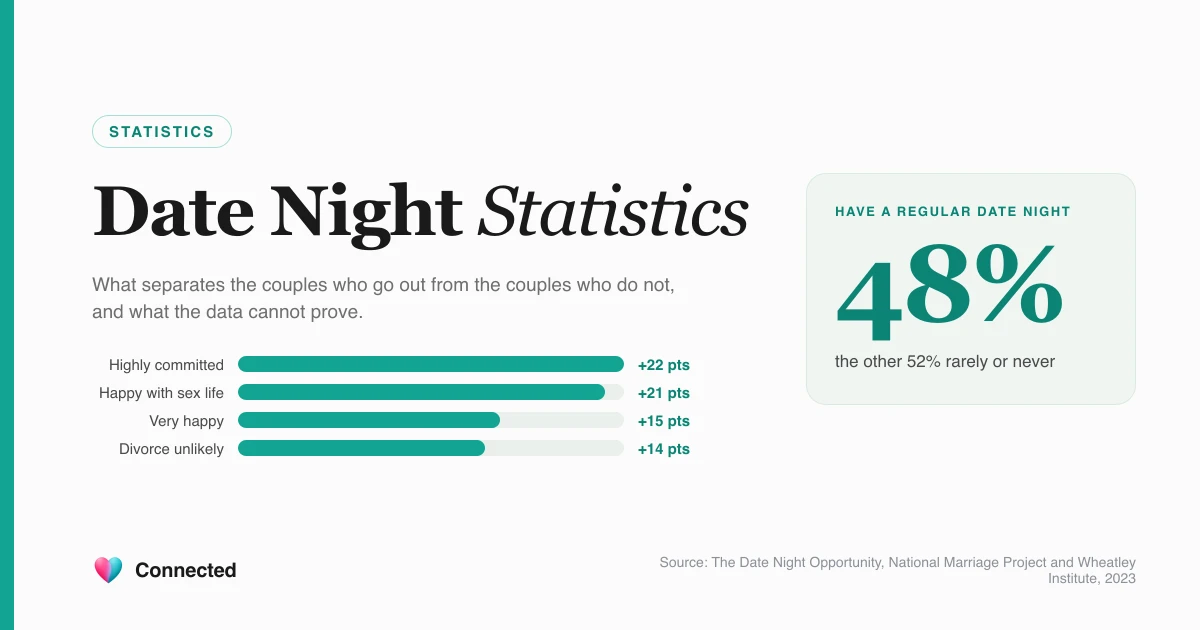
- 48% of married US adults aged 18 to 55 have a date night at least once or twice a month. The other 52% never do, or manage it a few times a year.
- The gaps are large. Frequent daters are about 21 points more likely to be very happy with their sex life, 14 to 15 points happier in the marriage, and around 20 points more likely to call themselves highly committed.
- This is single point in time survey data. It cannot show whether dating improves marriages or happier marriages produce more dates. Both readings fit.
- Novelty is the mechanism with the best experimental support. Something new and cheap beats something familiar and expensive.
- The couples who sustain it made it small. A fixed hour with phones away survives a bad week; an ambitious evening out does not.
Roughly half of married couples in the United States have essentially stopped going out together, and the gap between the half that does and the half that does not is wider than almost anyone expects.
The catch is that the gap is not proof of what most articles claim it proves. Here are the numbers, and an honest account of what they can and cannot tell you.
How many couples actually have date nights
The best dataset on this is The Date Night Opportunity, a report from the National Marriage Project at the University of Virginia and the Wheatley Institute at Brigham Young University, written by Jeffrey Dew and Brad Wilcox. It draws on the State of Our Unions survey, run by YouGov in autumn 2022 with 2,000 married men and women aged 18 to 55.
Source: State of Our Unions survey, YouGov for the Institute for Family Studies and the Wheatley Institute, autumn 2022, n = 2,000.
That is the single most useful statistic here, and not for the reason you might think. Most couples who feel guilty about not dating enough are comparing themselves to an imagined norm in which everyone else manages a fortnightly night out. That norm does not exist. Half of married couples under 55 go out together a handful of times a year at most.
What separates the two halves
Now the differences, and they are large.
Source: The Date Night Opportunity, National Marriage Project and Wheatley Institute (2023), from the 2022 State of Our Unions survey.
| Measure | Frequent date nights | Infrequent or never |
|---|---|---|
| Highly committed to the relationship | 75% of wives, 73% of husbands | 53% of wives, 51% of husbands |
| Very happy with the sexual relationship | 68% of wives, 67% of husbands | 47% of wives, 47% of husbands |
| Very happy in the marriage | about 15 points higher | baseline |
| Say divorce is "not at all likely" | about 14 points higher | baseline |
Source: The Date Night Opportunity (2023). Frequent means at least once or twice a month.
The part nearly every article skips
This is survey data collected at a single point in time. It shows that couples who date are doing better on every measure. It does not show that dating is what made them do better.
There are at least three readings of the same numbers, and all of them are plausible:
Date nights improve the marriage
The one everybody assumes. Time together builds the thing, so more of it produces more of it.
Good marriages produce date nights
Reversed. If you enjoy each other's company, you arrange more of it. If you are in a bad stretch, an evening alone together is the last thing either of you wants to schedule. On this reading, date nights are a symptom of a healthy relationship rather than a cause.
Something else produces both
Money, childcare, flexible work, living near family, no one being seriously ill. Every one of those makes date nights easier and makes marriages happier, entirely independently.
So is it worth doing? Almost certainly yes, but not because of these percentages. The reason to believe date nights do something is that the mechanisms the report identifies have been tested separately, in experiments rather than surveys. The correlation is not the evidence. It is the thing the evidence explains.
"I have never once told a couple to schedule a date night as the fix. If things are tense, an expensive dinner with nothing to talk about is a stress test, not a repair. What I ask instead is when the two of you last did something new together, because novelty is the ingredient that actually seems to do the work, and it costs nothing."
Why it works, when it works
The report names five mechanisms. They are worth separating, because they are not equally supported and they suggest quite different evenings.
| Mechanism | What it means | How strong the evidence is |
|---|---|---|
| Novelty | Doing something new or slightly challenging together, rather than the same restaurant | Strongest. Novel and arousing shared activities have been shown experimentally to raise reported relationship quality, over and above merely pleasant ones |
| Communication | A block of time to talk about something other than logistics and children | Good. Consistent with the wider literature on couples who protect uninterrupted talking time |
| De-stress | Stepping outside the pressures of ordinary life, together | Good. Stress spillover into relationships is well documented |
| Commitment | The act of prioritising each other signals and reinforces commitment | Moderate. Hard to separate from the reverse direction |
| Eros | Romantic and sexual connection getting deliberate time | Moderate, and closely tied to the novelty effect |
Mechanisms as named in The Date Night Opportunity (2023). Strength assessment is our reading of the wider evidence base.
If you need somewhere to start, our date night ideas are sorted by budget and energy level, and there are long distance versions too. The practical upshot of that table is that the single most transferable finding is the least glamorous one: a new cheap thing beats a familiar expensive thing. If your date night is the same restaurant every month, you are getting the communication benefit and very little of the novelty benefit, and novelty is the mechanism with the best experimental support.
Running out of ideas is the most common reason date nights lapse. Connected suggests a date to you both and remembers what you have already done, so the planning stops falling on the same person.
Why the other 52% do not go
The reasons are boring and structural, which is exactly why exhortation does not fix them.
| Barrier | What usually helps |
|---|---|
| Childcare cost and logistics | The at-home version, done properly. After bedtime, phones in another room, something you have not done before. Most of the mechanism survives the venue change; almost none of it survives the phones |
| Money | The report's own conclusion is that date night initiatives should be free or inexpensive. Nothing in the mechanism list requires spending |
| Exhaustion | Shorten it rather than skipping it. Ninety minutes of something novel beats a four hour evening that neither of you has the energy for and both of you resent |
| One person does all the planning | Alternate who plans, and let the planner choose entirely. The most common quiet reason date nights stop is that they became one more item on one person's list |
| Nothing to talk about | This is a symptom rather than a barrier. Couples who only talk logistics at home will only talk logistics in a restaurant. Bring questions, or do something that generates conversation instead of requiring it |
"The couples who keep it going are almost never the ones with the most free time. They are the ones who made it small enough to survive a bad week. An hour, at home, on a fixed night, with a rule about phones. Nobody has ever cancelled that because they were tired, and that is the entire trick."
Is your date night doing anything?
The short version
About 48% of married US adults under 55 have a date night at least once or twice a month, and 52% do not. The couples who do report being roughly 14 to 15 points happier in their marriages, about 21 points more satisfied with their sex lives, and around 20 points more likely to describe themselves as highly committed.
A shared bucket list is one cheap way to keep a supply of new things available. Those gaps are real, but they come from a survey taken at one moment, so they cannot tell you which way the arrow points. What the underlying research does support is narrower and more useful: time together that is protected, phone-free and genuinely new does something that the same dinner every month does not.
The app has a date night planner for exactly this. Which means the useful question is not whether you go out often enough. It is when the two of you last did something you had never done before.
Sources
Frequently asked questions
How often do married couples go on date nights?
About 48% of married US adults aged 18 to 55 go on a date night at least once or twice a month, according to the State of Our Unions survey of 2,000 married adults run by YouGov in autumn 2022. The remaining 52% said they never go on date nights or go only a few times a year.
Do date nights actually improve a marriage?
Couples who date regularly report better outcomes on every measure surveyed, including roughly 21 percentage points higher sexual satisfaction and 14 to 15 points higher marital happiness. Because the data is cross-sectional, it cannot establish direction: happier couples may simply arrange more time together. The mechanisms behind it, particularly shared novel activities, have better experimental support than the raw correlation.
How often should couples have a date night?
The threshold used in the research is once or twice a month, which is where the differences in the data appear. There is no evidence that going more often than weekly adds anything. In practice the couples who sustain it choose a frequency small enough to survive a bad week rather than an ambitious one they abandon.
What makes a date night effective?
Novelty is the ingredient with the strongest experimental backing: doing something new or mildly challenging together outperforms repeating a pleasant familiar activity. Beyond that, uninterrupted time without phones, conversation about something other than logistics, and alternating who plans it all matter more than what the evening costs.
Do date nights at home count?
Yes, for most of the mechanisms. Communication, de-stressing and novelty are all achievable at home once children are asleep, and the report's own recommendation is that date night options should be free or inexpensive. What does not survive the move home is divided attention, so phones in another room matters considerably more than the venue.
Why do couples stop having date nights?
The most common reasons are childcare cost and logistics, money, exhaustion, and one partner carrying all the planning. The last of these is the most underestimated: date nights frequently stop not because the couple stopped wanting them but because they became one more recurring task on one person's list.

Kayla Crane is a Licensed Marriage and Family Therapist and the co-founder of Connected. She has spent more than a decade in the room with couples, and she reviews every clinical claim on this blog for accuracy. Connected's frameworks draw on the Gottman Method, Emotionally Focused Therapy, and attachment research.