Key takeaways
- While partners stay apart, long-distance relationships are about as stable as local ones, and sometimes more so. But roughly half still end during the separation.
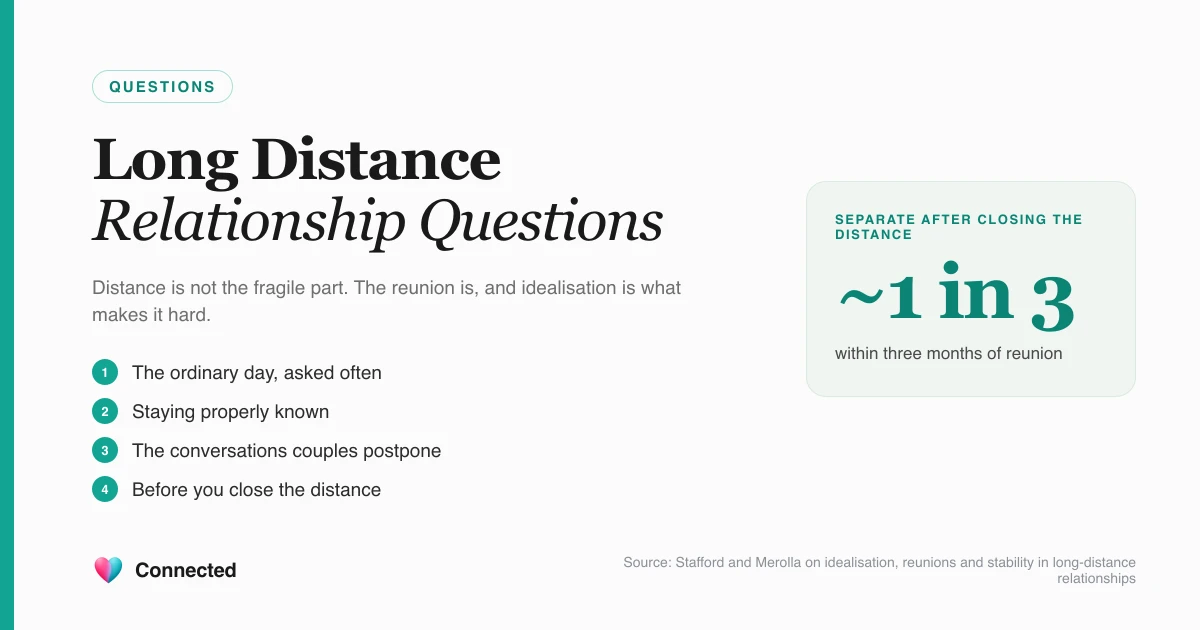
- Of the couples who do reunite, one third separate within three months of it, and idealisation built up during the separation is the mechanism researchers point to.
- So the most valuable questions are the boring ones. Anything that transmits the unedited texture of an ordinary day counters the idealised picture that distance builds by default.
- Four sets below: the ordinary day, staying properly known, the conversations couples postpone, and the ten questions to ask before you finally live together.
- Do not save the hard questions for visits. Postponing them turns scarce time in person into a summit and loads the highest-risk period with a backlog.
Most question lists for long-distance couples are built around the wrong problem. They assume the difficulty is running out of things to say on a video call, so they offer three hundred conversation starters, most of which would be equally at home on a first date.
The research points somewhere else entirely, and it changes which questions are worth asking.
The riskiest moment is the reunion
Laura Stafford, Andy Merolla and Janessa Castle followed long-distance dating relationships through the moment the distance ended. Their starting point was a counterintuitive one from the earlier literature: while partners stay apart, long-distance relationships have been found to be as stable as, or more stable than, relationships between people living in the same city. Not less.
Their own numbers are worth stating precisely, because they cut both ways. About half of these relationships ended during the separation itself. Of the half that survived long enough to reunite, one third terminated within three months of becoming geographically close.
So distance is not harmless. What is striking is where the second wave of endings clusters: not during the hard part, but immediately after it, at the moment both people were working towards. In the companion paper to this one, Stafford and Merolla point to idealisation built up during the separation as a driver of that reversal.
Source: Stafford, Merolla and Castle, When long-distance dating partners become geographically close, Journal of Social and Personal Relationships (2006). Sample is college-student dating relationships, so read the percentages as a pattern rather than as rates for all couples.
Why idealisation happens to careful people
Idealisation in a long-distance relationship is not a failure of judgement. It is a structural consequence of how the communication works.
When you live with someone, you get their entire range without selecting for it. You see them at 7am. You see them dealing with a call from their mother, being unreasonable about a parking space, having a mediocre Tuesday. None of that is chosen. It arrives.
At a distance, almost everything is chosen. You speak at a time you both scheduled, having both had a moment to prepare. You send the photo you picked. You mention the funny thing that happened and not the ninety minutes of nothing either side of it. Neither of you is being dishonest. You are both simply presenting an edit, because the format only transmits edits.
Which flips what these questions are for. If the risk factor is an idealised picture, then the most valuable questions for a long-distance couple are not the deep romantic ones. They are the boring ones. Questions that deliberately transmit the unglamorous, unedited texture of an ordinary day are doing preventative work that no amount of meaningful conversation can substitute for.
"Long-distance couples arrive at the reunion having spent two years being the best version of themselves for an hour a night. Then they are in a kitchen at half past seven in the morning and one of them is not a morning person and neither of them knew. The couples who handle it are the ones who were deliberately unimpressive at each other beforehand. I mean that seriously. Boring each other on purpose is a real intervention."
Set one: the ordinary day
Start here, and use these more often than anything else on this page. For the wider numbers on how long these relationships last, see our long distance relationship statistics. They look trivial. They are the ones doing the actual work.
Twelve questions that transmit the unedited version
Ask two or three of these on an ordinary call rather than saving them for a long conversation.
- What did you actually eat today, not what you meant to eat?
- What is the most boring thing that happened to you this week?
- Which of your colleagues did something mildly irritating today?
- What is currently broken in your flat that you have not fixed?
- What did you do for the twenty minutes before this call?
- What is the last thing you spent money on that you regret slightly?
- How many times did you hit snooze this morning?
- What is the state of your washing up right now, honestly?
- What did you say out loud to yourself today?
- Which app did you waste the most time on this week?
- What is the least flattering thing about how you have been living this week?
- What would I notice first if I walked into your place unannounced right now?
A cheaper version of the same thing: a short unglamorous photo of something genuinely dull, sent without comment. The pile of laundry, the queue you are in, the sandwich. Long-distance couples send each other highlights by default. A stream of low-quality ordinary detail does more for an accurate picture than a weekly deep conversation does.
Set two: staying properly known
These are the questions for the thing long-distance couples worry about most, which is quietly becoming strangers who are fond of each other.
Ten questions about how the distance is actually going
Best used one at a time, not as a session. Any of these will fill an hour.
- What is the hardest hour of the week for you when we are apart?
- When do you most feel like we are actually together?
- What do you do when you miss me that you have never told me about?
- Is there anything you have stopped telling me because it feels too small?
- What do you wish I asked you about more?
- Do you feel more or less known by me than you did six months ago?
- What is something about my life right now that you cannot picture?
- What is the thing you most look forward to about seeing me, that is not the obvious one?
- How do you want me to react when you are having a bad day and I cannot be there?
- What is a small thing I do from a distance that means more than I probably realise?
The hardest part of a long-distance habit is the time zones. Connected gives you both the same question each day and you answer whenever you are awake, so nothing depends on being free at the same moment.
Set three: the conversations couples postpone
Our long distance relationship tips cover the logistics side of this. Every long-distance relationship has a set of questions that both people know are there and neither raises, usually because raising them feels like a threat to a fragile arrangement. Postponing them does not make them go away. It concentrates them into the reunion, which is already the highest-risk period.
Ten questions worth asking before you have to
Do not do all ten at once. One per month is plenty, and each one deserves its own conversation.
- What are you most worried about that you have not said?
- Are we both still working towards the same end date?
- Is there anything you have agreed to that you actually resent?
- What would make you decide this was not worth doing any more?
- Do you feel like you are giving up more than I am?
- What do you do socially that you would not tell me about, and why?
- Are we clear on what counts as crossing a line, or have we assumed it?
- What happens if the plan does not work out on the timeline we said?
- Which of us is going to move, and have we actually decided or just hoped?
- Is there anything you would want to know from me that you have been afraid to ask?
| The question couples avoid | What avoiding it costs |
|---|---|
| Whether you are still working to the same end date | The most common source of resentment in long-distance relationships is one person quietly extending the timeline while the other is still counting down |
| Who is going to move | A decision made by default is made by whoever is less able to resist, and that is remembered for years |
| What actually counts as crossing a line | Assumed rules feel obvious to each person and are frequently different. This is almost never discovered at a convenient time |
| Whether one person is giving up more | Imbalance is survivable when it is acknowledged and corrosive when it is not |
| What happens if the plan slips | Every plan slips. Couples who have talked about the slip handle it as a delay. Couples who have not handle it as a betrayal |
Set four: before you close the distance
Given that the three months after moving in together is the highest-risk window in the whole arrangement, these are worth working through in the weeks before it, not after.
Ten questions to ask before you finally live in the same place
The goal is not reassurance. It is to lower the height of the fall from the idealised version.
- What are you nervous about, specifically, when you think about living together?
- What is a habit of yours I have never seen because you only see the good weeks?
- How much time alone do you need in a normal week?
- What does your worst mood actually look like day to day?
- What do you do when you are annoyed with someone in your house?
- Whose job is it to raise something when it is bothering you?
- What would you want the first month to look like, realistically?
- What are you giving up to make this happen, and how do you feel about it?
- What do you expect will disappoint you slightly, and can we say it now?
- What is one thing about the distance you will genuinely miss?
"Everyone prepares for the reunion emotionally and nobody prepares for it practically. What I ask couples to do is describe their worst week to each other in detail before they are in the same house. Not their fears about the relationship, their actual behaviour. How they are when they are ill, how much silence they need, what they are like on a Sunday with nothing planned. It is the least romantic conversation they will have all year and it is the one that protects them."
Four rules for asking these well
Small and frequent beats long and scheduled
The weekly two hour call carries a lot of pressure and gets cancelled by one bad day. A short daily exchange holds a floor that the weekly call cannot, and it is where the ordinary detail actually fits.
Both answer, always
Long-distance conversations skew easily into one person updating and the other listening, particularly if one of you has the more eventful life. If you ask it, answer it too.
Do not save everything for the visit
Couples routinely postpone hard questions until they are in the same room, on the theory that it is better in person. In practice this loads every visit with the accumulated backlog and turns a scarce three days into a summit. Some things are better in person. Most are better on a Tuesday.
Ask about their week, not about your relationship
Relationships in which the main topic of conversation is the relationship tend to be relationships where something is unresolved. The set one questions are the healthy default, and the set three questions are the occasional maintenance.
How accurate is your picture of each other?
The short version
About half of long-distance dating relationships end during the separation. Of those that make it to reunion, a third end within three months of finally living in the same place. The second number is the surprising one, because it sits right after the hard part rather than during it, and the mechanism the researchers propose is the collapse of an idealised picture built up while apart.
For the visits themselves, we have a separate set of long distance date night ideas. Which means the most useful questions are not the profound ones. They are the ones that transmit the ordinary, unimpressive, unedited texture of your actual life, asked often and casually, so that when you finally close the distance there is much less distance to close.
Sources
Frequently asked questions
What questions should long distance couples ask each other?
More ordinary ones than most lists suggest. Because distance filters out everyday detail, questions like what did you actually eat today, what is the most boring thing that happened this week, or what is currently broken in your flat do more good than deep romantic questions. The research risk in long-distance relationships is an idealised picture, and mundane detail is the direct counter to it.
Are long distance relationships more likely to fail?
It is more specific than that. Long-distance dating relationships have been found to be about as stable as, or more stable than, geographically close ones while the separation lasts, but roughly half still end before any reunion. Of those that do reunite, one third terminated within three months of becoming geographically close, according to Stafford, Merolla and Castle. Note that this research was conducted on college-student dating relationships.
Why do long distance couples break up when they finally live together?
Because both partners have been relating to an edited version of each other. Almost all long-distance communication is chosen and scheduled, so it transmits the composed version and filters out bad moods, dull stretches and ordinary habits. When the full range arrives all at once, the gap has to be absorbed in weeks. Extreme idealisation and long gaps between visits both predicted worse outcomes.
How often should long distance couples talk?
Frequency matters less than whether the contact is scheduled or spontaneous. A short daily exchange that includes unremarkable detail does more than one long weekly call, partly because the long call carries too much pressure and gets cancelled, and partly because ordinary detail never fits into a scheduled significant conversation.
What should you talk about before closing the distance?
The practical, unromantic things: how much time alone each of you needs, what your worst mood actually looks like day to day, who raises an issue when something is bothering them, what you each expect to find mildly disappointing, and what you are each giving up to make the move happen. Emotional preparation is common and practical preparation is rare.
How do you avoid idealising your long distance partner?
Deliberately transmit unimpressive information. Send low-quality photos of dull things, talk at unscheduled times when neither of you has prepared, and ask questions whose honest answers are boring. The aim is not to feel less close, it is to make your picture of each other accurate enough to survive being in the same room.

Kayla Crane is a Licensed Marriage and Family Therapist and the co-founder of Connected. She has spent more than a decade in the room with couples, and she reviews every clinical claim on this blog for accuracy. Connected's frameworks draw on the Gottman Method, Emotionally Focused Therapy, and attachment research.