Key takeaways
- Roughly two thirds of couples report a significant drop in satisfaction within three years of a first baby. The figure comes from the Gottman Institute's wider transition-to-parenthood work, not from a single published result line, so treat it as a well-supported round number.
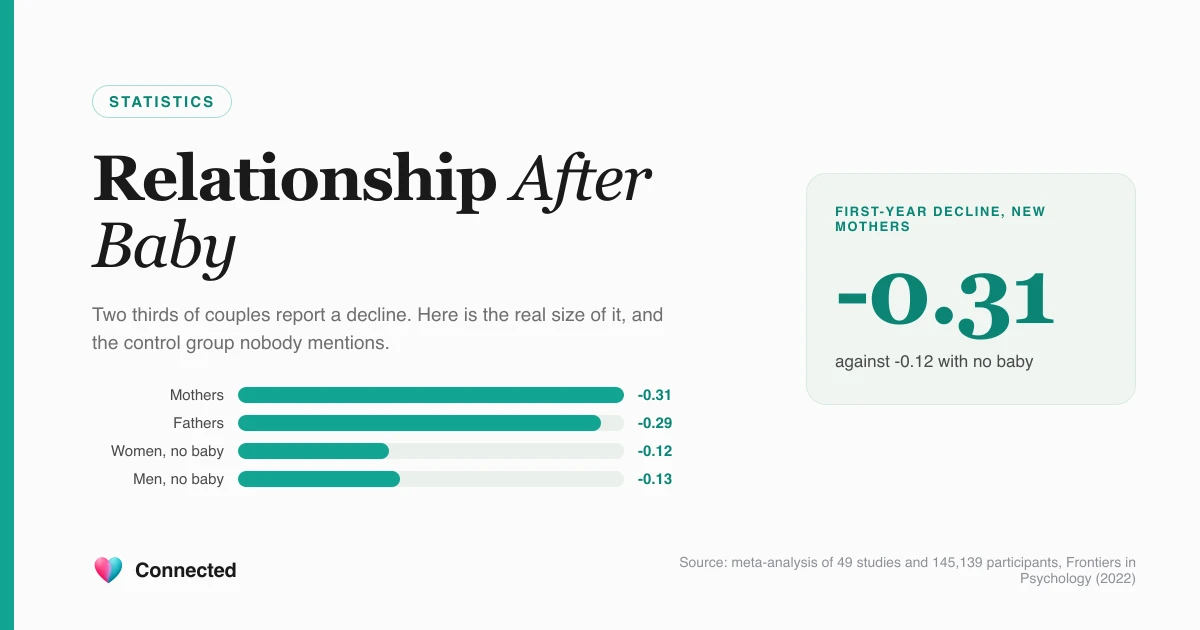
- The pattern is well replicated. A 2022 meta-analysis covering 49 studies and 145,139 participants found a medium first-year decline of about -0.31 for mothers and -0.29 for fathers.
- Couples without a baby declined too, by about -0.12 over the same period, so a meaningful share of the drop is ordinary early-relationship decline rather than the child.
- It eases after year one, falling to a small effect of about -0.15 in the second year. Fathers decline nearly as much as mothers.
- Three things protected couples: the husband's expressed fondness, his awareness of her life, and her awareness of his, all measured before the baby arrived.
You have almost certainly seen the statistic. Around two thirds of couples experience a significant drop in relationship satisfaction after their first baby arrives.
It is broadly true, it is one of the most reliable findings in relationship research, and almost every article that quotes it draws the wrong conclusion from it. Here are the actual numbers, including the one that changes how you should read all the others.
The headline finding
The two-thirds figure comes out of the Gottman Institute's work on the transition to parenthood, and specifically from a longitudinal study by Alyson Shapiro, John Gottman and Sybil Carrere published in the Journal of Family Psychology in 2000. The design is worth knowing, because it is unusually good and unusually small at the same time.
| Study detail | What it was |
|---|---|
| Design | Longitudinal, following couples from before pregnancy through the first years of parenthood |
| Starting sample | 130 newlywed couples, followed for around six years |
| Became parents | 43 couples |
| Control group | 39 couples who remained childless |
| What it actually reported | Which couples held steady and which declined, and what predicted each. The widely quoted two-thirds figure is not a result line in this paper, it comes from the Gottman Institute's reporting of this wider body of work |
Source: Shapiro, Gottman and Carrere, The baby and the marriage, Journal of Family Psychology (2000). The two-thirds figure is attributed to the Gottman Institute's Bringing Baby Home programme rather than to this paper's abstract.
Forty-three couples is a small number to hang a famous statistic on, and it is worth being straight about the fact that the two-thirds number is not something you can read off this paper's abstract. What makes the underlying finding credible is not that study, it is that the pattern has replicated repeatedly for twenty-five years across much larger samples.
The largest synthesis is a 2022 meta-analysis in Frontiers in Psychology by Bogdan, Turliuc and Candel, covering 49 studies, 106 independent samples and 145,139 participants. The decline is real, it holds across cultures, and it is not an artefact of one lab.
The number that reframes everything
That meta-analysis also did something most coverage of this topic ignores. It measured couples who did not have a baby over the same period.
Source: Bogdan, Turliuc and Candel, Frontiers in Psychology (2022), meta-analysis of 49 studies and 145,139 participants.
Why this matters if you are in it. The two-thirds statistic is usually presented as: have a baby, and there is a two in three chance your relationship gets worse. The more accurate version is: relationships tend to decline gradually in their early years, and a first baby makes that decline roughly two to three times steeper for about a year. That is a real and significant effect. It is also considerably less deterministic than the way it is normally reported, and the difference matters when you are the one lying awake at 4am wondering whether this is what you have done to your marriage.
The other useful finding from the meta-analysis: the steep part does not last. In the second year, the decline slowed to about -0.16 for mothers and -0.14 for fathers, which is a small effect. The first twelve months are the acute phase.
| Period | Mothers | Fathers | Size |
|---|---|---|---|
| Pregnancy to 12 months, new parents | -0.31 | -0.29 | Medium |
| Pregnancy to 12 months, non-parents | -0.12 | -0.13 | Small |
| 12 to 24 months, new parents | -0.16 | -0.14 | Small |
Standardised effect sizes from Bogdan, Turliuc and Candel (2022). Negative values indicate a decline in relationship satisfaction.
One more thing that survived the meta-analysis, and it is worth knowing because it contradicts a lot of received wisdom. Gender did not significantly moderate the effect. Neither did age. Neither did how long the couple had been together. Fathers decline almost as much as mothers, which is not the story most people expect and is rarely reflected in the support offered.
"The most damaging belief I encounter in new parents is that a good relationship should not be affected by this. So when it is, both people conclude something is wrong with them specifically. Nothing is wrong with them. They are two exhausted adults running a twenty-four hour operation with no training and no staff. The decline is not a symptom. It is the weather."
What separated the couples who did not decline
Roughly a third of couples in the original study did not show the drop, and identifying what those couples had is arguably more useful than the headline number.
In the Shapiro, Gottman and Carrere data, the strongest predictors of stable or increasing satisfaction for new mothers were two things about their husbands, both measured before the baby arrived:
The husband's expressed fondness towards his wife
Not felt fondness. Expressed. How much affection, admiration and warmth he actually voiced about her. This is measurable in how a person talks about their partner, and it predicted how her satisfaction moved over the transition.
The husband's awareness of what was going on in her life
Whether he knew the details: what she was worried about, who was annoying her, what was happening at her work. This is the Gottman idea of a love map, and it turned out to be protective specifically across the transition to parenthood.
Her awareness of him and of the relationship
The third predictor in the abstract, and the one usually dropped when this study gets summarised. The protective factor was not simply an attentive husband, it was both partners holding an accurate picture of the other.
The same paper names what predicted the opposite. Mothers' satisfaction declined where there was the husband's negativity toward his wife, the husband's disappointment in the marriage, or either partner describing their lives as chaotic. That last one is worth sitting with, because chaos is the one on the list that feels like circumstance rather than a choice, and it is the one most amenable to being reduced on purpose.
The second one is what the Gottman Method calls a love map. Both of those are things that are cheap to maintain before a baby and extremely difficult to build afterwards, which is the practical implication. The couples who did well were not the ones who worked hard once things got difficult. They arrived with something already in place.
Both protective factors come down to knowing what is going on with each other and saying it out loud. Connected takes five minutes a day and both of you answer separately, which is about the most that is realistic in the first year.
The finding nobody mentions: it is contagious
The meta-analysis found cross-partner associations. One partner's satisfaction declined more steeply when the other partner's was also dropping sharply. The two trajectories are coupled, not independent.
That has a straightforward practical reading. In the first year, the most effective thing you can do for your own relationship satisfaction may be to protect your partner's. Not as a sacrifice, as a mechanism. Two people each defending their own position do worse than two people each defending the other's, because the declines feed each other.
"In the first year almost every couple has the same argument, which is a competition about who is more tired. Nobody wins it, because both of you are right. The couples who get through the year well are the ones who work out early that exhaustion is not a scarce resource to be allocated fairly. They stop keeping score, not because it is generous, but because keeping score is what turns two tired people into two lonely ones."
What actually helps
Do the work before, if you still can
The protective factors in the research were measured before the baby existed. If you are expecting, the highest-return thing available to you is not a birth plan. It is building the habit of saying appreciation out loud and staying current on each other's lives, so that it is already running when you have no capacity to start anything.
Expect twelve months, not forever
The acute decline is concentrated in the first year and roughly halves in the second. Knowing the shape of it changes how couples interpret month seven, which is otherwise a very common point to conclude that this is now simply what the relationship is.
Protect their sleep as if it were yours
Given the cross-partner effect and the well-established link between poor sleep and relationship conflict, sleep is the single most leveraged resource in the first year. Trading whole nights rather than splitting every night is what most couples find works, because two half-rested people function worse than one rested and one wrecked.
Keep one very small thing that is not about the baby
Not a date night. See staying connected after kids for what this looks like in practice. Something on the order of ten minutes. Couples who preserve one tiny non-parental ritual through the first year report a much easier re-entry afterwards than couples who suspended everything and planned to resume later.
Say the resentment early, while it is still small
Most of that unfairness lands as mental load rather than as visible tasks. The first year generates a large amount of low-grade unfairness, most of it unavoidable. Unfairness that gets named is survivable. Unfairness that gets filed away is what people are still describing in a therapist's office six years later.
One thing to rule out, separately from all of this. Postnatal depression and anxiety affect a substantial minority of new parents, including fathers, and they look very similar to relationship deterioration from the inside. If low mood, hopelessness or persistent anxiety is present for either of you beyond a couple of weeks, that is a conversation with a doctor rather than a relationship problem to work on. Treating the wrong one costs a lot of time.
How is your transition going?
The short version
Around two thirds of couples report a significant decline in relationship satisfaction in the first years after a first baby. Across 49 studies and more than 145,000 people, the first-year decline for new parents is a medium effect of about -0.30, easing to a small effect in year two.
But couples without a baby declined too, by about -0.12 over the same period, so a meaningful share of what new parents experience is the ordinary early-relationship drift rather than the child. Fathers decline nearly as much as mothers. The declines are contagious between partners. And the couples who came through it flat had two things in place beforehand: they said appreciation out loud, and they knew what was going on in each other's lives.
Connected keeps both of those running on five minutes a day. Free to download.
Sources
- Shapiro, Gottman and Carrere, The baby and the marriage: identifying factors that buffer against decline in marital satisfaction after the first baby arrives, Journal of Family Psychology (2000)
- Bogdan, Turliuc and Candel, Transition to Parenthood and Marital Satisfaction: A Meta-Analysis, Frontiers in Psychology (2022)
- The Gottman Institute on relationship satisfaction after a baby arrives
- The Gottman Institute, the empirical basis for Gottman Method Couples Therapy
Frequently asked questions
What percentage of couples struggle after having a baby?
Around two thirds is the figure usually quoted, and it comes from the Gottman Institute's transition-to-parenthood work rather than from a single published result. The underlying pattern is very well supported: a 2022 meta-analysis of 49 studies and 145,139 participants found a medium-sized decline across the first year for both mothers and fathers.
How long does the decline after a baby last?
The steep part is concentrated in the first twelve months. In the second year the decline slows to a small effect of about -0.16 for mothers and -0.14 for fathers. Knowing the shape matters, because month seven is a common point at which couples wrongly conclude the change is permanent.
Do relationships decline even without a baby?
Yes, and this is the most under-reported finding in the area. In the same meta-analysis, couples who did not have a child declined by about -0.12 for women and -0.13 for men over an equivalent period. So a proportion of what new parents experience is ordinary early-relationship drift, and the baby accounts for the difference rather than the whole decline.
Does the father's relationship satisfaction drop too?
Almost as much. The meta-analysis found -0.29 for fathers against -0.31 for mothers in the first year, and gender did not significantly moderate the effect. This is rarely reflected in the support offered to new parents, and it surprises most couples.
What protects a relationship after a first baby?
In the Shapiro, Gottman and Carrere study, what predicted stable or increasing satisfaction for new mothers was the husband's expressed fondness towards her, the husband's awareness of her life and the relationship, and her own awareness of him and the relationship, all measured before the birth. Predictors of decline were the husband's negativity, his disappointment in the marriage, and either partner describing their life as chaotic.
Is it normal to resent your partner after having a baby?
Very. The first year generates a large amount of low-grade unfairness, much of it unavoidable given that neither person can be fully rested. What matters in the research is whether it gets named. Resentment that is said out loud early tends to be absorbed; resentment that is stored is what couples are still describing years later.
When should new parents seek help?
If low mood, hopelessness or persistent anxiety lasts more than a couple of weeks for either partner, that is a matter for a doctor rather than a relationship problem to work on. Postnatal depression and anxiety affect fathers as well as mothers and look very like relationship deterioration from the inside.

Kayla Crane is a Licensed Marriage and Family Therapist and the co-founder of Connected. She has spent more than a decade in the room with couples, and she reviews every clinical claim on this blog for accuracy. Connected's frameworks draw on the Gottman Method, Emotionally Focused Therapy, and attachment research.