Key takeaways
- Around a third of US adults sleep apart from a partner at least some of the time. The two AASM surveys put it at more than one third (2023) and 31% (2025), but they asked different questions, so the gap is not a trend.
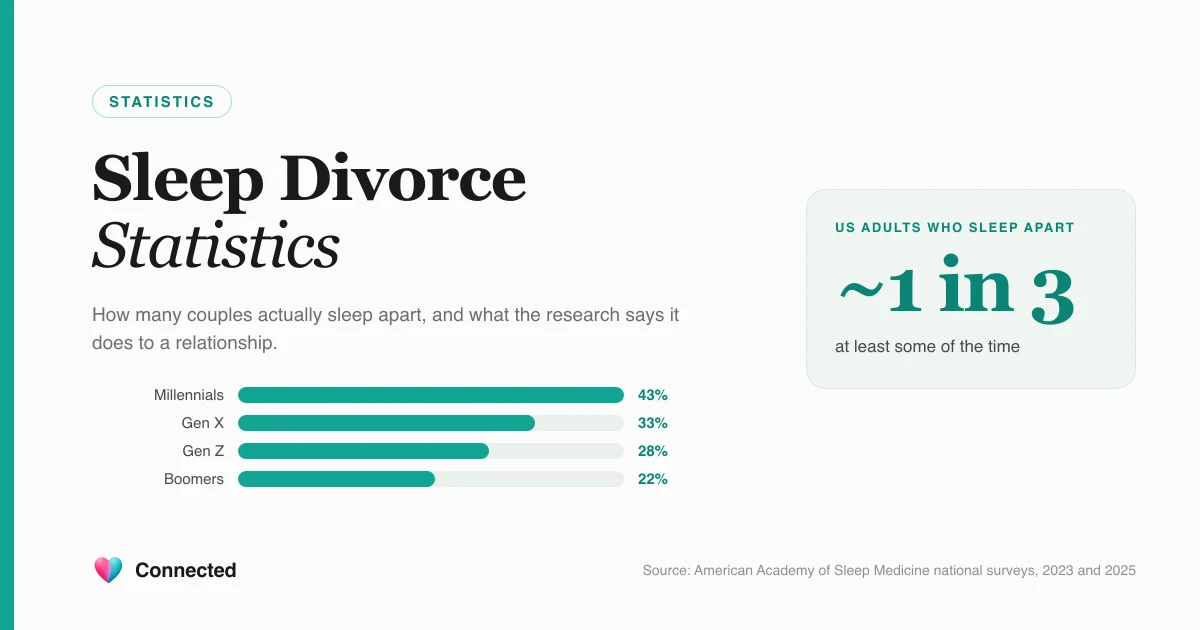
- It peaks in midlife, not old age. 43% of millennials and 39% of 35 to 44 year olds, against 22% of boomers and 18% of over 65s.
- Men leave the bed at nearly twice the rate of women, 45% against 25%, so this is usually one partner relocating rather than a mutual split.
- More people lose sleep accommodating a partner (37%) than sleep apart from one. That cost is invisible because it looks like togetherness.
- No study shows sleeping apart harms relationships. Plenty show poor sleep does. After a bad night, couples fight more and read each other less accurately, and one partner's bad sleep degrades both people's accuracy.
Roughly one in three American adults is not sleeping where you assume they are sleeping.
The phrase is terrible. Nothing is being divorced. But "sleep divorce" is what stuck, and the numbers behind it are more interesting than the label suggests, because the honest reading of the data is not that couples are drifting apart. It is that a large group of people quietly solved a sleep problem years ago and assumed they were the only ones.
Below is what the actual surveys say, what they do not say, and the part almost every article on this topic gets wrong.
The headline numbers
Two national surveys carry most of the weight here. Both were run for the American Academy of Sleep Medicine by Atomik Research, and both used a little over 2,000 US adults with a margin of error of about two percentage points.
| Survey | Question asked | Result |
|---|---|---|
| AASM 2023 n = 2,005, fielded Mar 24 to 29, 2023 | Do you occasionally or consistently sleep in another room to accommodate a bed partner? | More than one third said yes |
| AASM 2025 n = 2,007, fielded Jun 5 to 13, 2025 | Have you opted for a sleep divorce? | 31% said yes |
Both surveys were conducted online by Atomik Research with a margin of error of plus or minus two percentage points at 95% confidence.
Read those two rows carefully before you quote a trend. You will see plenty of articles claiming sleep divorce fell from 35% to 31% between 2023 and 2025. It did not, or at least the data cannot show that. The two surveys asked different questions. "Do you ever sleep in another room to accommodate a partner" is a behaviour. "Have you opted for a sleep divorce" is a label, and a lot of people who do the behaviour would never accept the label. A four point gap between a behaviour question and a label question is what you would expect even if nothing changed at all.
So the defensible statement is the boring one: somewhere around a third of American adults sleep apart from their partner at least some of the time. That is the number to use.
Who does it, by generation and gender
The demographic splits are where this gets genuinely surprising, because they run in the opposite direction to the stereotype. Sleeping apart is not an old-marriage phenomenon.
Source: American Academy of Sleep Medicine survey of 2,005 US adults, fielded March 24 to 29, 2023.
The 2025 survey found the same shape using age bands rather than generations: 39% of adults aged 35 to 44 reported a sleep divorce, the highest of any group, against 18% of those 65 and over, the lowest.
Then there is the gender gap, which is the largest single split in the entire dataset.
Source: American Academy of Sleep Medicine survey of 2,005 US adults, fielded March 24 to 29, 2023.
That asymmetry matters for how it feels. If it is nearly always the same person getting up and walking down the hall, the arrangement carries a meaning it would not carry if you alternated, and the partner left in the bed often reads it as a verdict rather than a logistics fix.
"Almost no couple arrives in my office saying the sleeping arrangement is the problem. It comes out later, usually as an aside. And what I hear underneath it is rarely about sleep. It is one person who has been leaving the bedroom for two years and has never once been asked to come back."
How people actually do it
"Sleep divorce" gets pictured as separate bedrooms at opposite ends of a house. The 2025 survey shows it is more often smaller than that:
| Arrangement | Share of US adults |
|---|---|
| Sleep in another room entirely | 21% |
| Sleep in a separate bed in the same bedroom | 13% |
| Go to sleep at a different time than they want to, to accommodate a partner | 37% |
| Use a silent or vibrating alarm to avoid waking a partner | 15% |
Source: AASM survey of 2,007 US adults, fielded June 5 to 13, 2025. Categories are not mutually exclusive.
Notice the third row, because it is the largest number on this page and it never makes a headline. More people are losing sleep to accommodate a partner than are sleeping apart from one. Going to bed at the wrong time every night for years is a real cost, and it is invisible precisely because it looks like togetherness.
Sleep is one of the things couples silently absorb rather than raise. Connected asks you both the same question each day, which is a low-stakes way for something like this to finally get said out loud.
Why couples do it
The reasons are unglamorous and mostly medical. Snoring leads by a distance, followed by mismatched schedules, temperature preferences, restless movement, and a partner who reads or scrolls in bed.
Snoring is the one worth separating out, and we have a fuller guide on what to do when your partner snores. It is also the one reason on the list that is sometimes a symptom. Loud, habitual snoring with pauses in breathing or daytime exhaustion can indicate obstructive sleep apnea, and a bed partner is usually the first person to notice it. If that describes your household, the sleeping arrangement is the smaller problem. A 2023 study in Cureus followed patients starting treatment for obstructive sleep apnea. Of the 41% who had been sleeping separately from their partner, 72% went back to sharing a bed. That is a better outcome than either of them managing around it forever.
The one thing worth ruling out: if your partner snores loudly most nights, stops breathing at any point, or is exhausted after a full night's sleep, that combination is worth raising with a doctor before you rearrange the bedrooms. Untreated sleep apnea is a cardiovascular risk, not a snoring inconvenience.
Is sleeping apart bad for a relationship?
This is the question people actually want answered, and the honest reply is that there is no good longitudinal study showing that couples who sleep apart end up less happy or more likely to separate. Nobody has run it properly. Anyone telling you sleeping apart predicts divorce is extrapolating well past the evidence.
What there is very solid evidence for is the other direction: bad sleep damages relationships.
Amie Gordon and Serena Chen ran the cleanest test of this. Across a fourteen-day daily diary study and a lab study where couples were recorded working through a real disagreement, they found that after a poor night's sleep, couples reported more conflict, showed a worse ratio of positive to negative emotion, and were measurably worse at reading what their partner was feeling. Crucially, one partner sleeping badly degraded both people's accuracy, not just the tired one's. Conflicts got resolved most reliably when both partners were rested. The effects held after controlling for stress, anxiety, depression, and baseline relationship satisfaction.
Put those two facts next to each other and the practical conclusion writes itself. There is no evidence that separate beds hurt a relationship. There is strong evidence that chronic poor sleep does. If sharing a bed is costing one of you an hour a night, the arrangement is not the romantic option. It is just the one that looks romantic.
"I have watched couples spend a year working on their communication when the actual problem was that one of them had not slept properly since 2019. Sleep is not a relationship issue until it is, and then it is the only one. Fix the sleep first and see what is still broken afterwards. Frequently, less than you thought."
If you do it, do it deliberately
The difference between an arrangement that works and one that quietly corrodes has almost nothing to do with the sleeping and almost everything to do with whether it was decided or defaulted into. Drifting into separate rooms after a bad month, without ever discussing it, is the version that turns into distance.
Name it as a sleep decision, out loud
The conversation takes four minutes and prevents four years of quiet interpretation. Say what the problem is, say that the arrangement is about sleep, and say it is reversible. What you are preventing is the version where one person leaves the bedroom and the other never learns why.
Keep the bed for the two of you, even if you do not sleep in it
Almost every couple who makes this work protects a window of time in one bed with no sleeping attached. Twenty minutes before one of you relocates. A weekend morning. This is the piece that most people skip and then miss without being able to name it.
Decide what still happens at the same time
Going to bed together is a ritual of connection that carries a lot of a relationship's ordinary talk. If you remove it, something has to hold that talk instead: the walk after dinner, the ten minutes before lights out, the first coffee. Pick the replacement on purpose rather than discovering in a year that the talk stopped.
Review it, on an actual date
Set a point three months out to ask whether it is still the right call, ideally inside a regular check-in rather than as a special conversation. Most arrangements that go wrong do so because nobody ever revisited a decision made during one bad stretch. A scheduled review also reassures the partner who did not want this that it is genuinely not permanent.
The reversibility test: ask each other, separately, whether you believe the two of you could go back to sharing a bed next month if you wanted to. If one of you says yes and the other says no, you are not disagreeing about sleep. That gap is the conversation.
Is your arrangement working, or just happening?
Six questions. Answer for the arrangement you actually have, not the one you intended.
The short version
About a third of American adults sleep apart from their partner at least sometimes. It is most common among people in their late thirties and forties, and men leave the bed at nearly twice the rate of women. The most common reason is snoring, which is occasionally worth a doctor rather than a spare room.
There is no evidence that sleeping apart harms a relationship. There is good evidence that not sleeping does. The couples for whom it goes badly are not the ones in separate rooms. They are the ones who never said anything about it.
Sources
- American Academy of Sleep Medicine, sleep divorce survey (2,007 US adults, June 2025)
- American Academy of Sleep Medicine, sleep divorce survey (2,005 US adults, March 2023)
- Gordon and Chen, sleep and interpersonal conflict, reported by UC Berkeley News
- Sleep Foundation, sleep divorce overview
- Impact of Obstructive Sleep Apnea Treatment on Marital Relationships: Sleeping Together Again? Cureus (2023)
Frequently asked questions
How many couples sleep in separate beds?
Around a third of US adults sleep apart from a partner at least some of the time. An American Academy of Sleep Medicine survey of 2,005 adults in March 2023 found more than one third occasionally or consistently sleep in another room, and a follow-up survey of 2,007 adults in June 2025 found 31% had opted for what they called a sleep divorce.
Is a sleep divorce bad for your marriage?
There is no good longitudinal evidence that sleeping apart makes couples less happy or more likely to separate. There is strong evidence that poor sleep harms relationships: after a bad night, couples report more conflict and are measurably worse at reading each other's emotions, and one partner's poor sleep affects both people. Sleeping apart to fix chronic bad sleep is usually the healthier option, provided it is decided together rather than drifted into.
Which generation is most likely to sleep separately?
Millennials. In the 2023 AASM survey, 43% of millennials said they occasionally or consistently sleep in another room, against 33% of Gen X, 28% of Gen Z and 22% of baby boomers. The 2025 survey found the same shape by age, with adults aged 35 to 44 highest at 39%.
Why do more men sleep in a separate room than women?
In the 2023 survey, 45% of men reported sleeping in another room against 25% of women. Snoring is the most common driver of separate sleeping and is more prevalent in men, so in most different-sex couples the snoring partner is the one who relocates.
How do you sleep separately without losing intimacy?
Make it an explicit decision rather than a drift, keep a protected window in one bed that has nothing to do with sleeping, deliberately choose a replacement for the conversation that used to happen at lights out, and set a date a few months ahead to review it. Couples who struggle with the arrangement are almost always the ones who never discussed it.
Should I see a doctor about my partner's snoring?
If the snoring is loud and habitual, involves pauses in breathing or gasping, or your partner wakes up exhausted after a full night, that combination is worth raising with a doctor. It can indicate obstructive sleep apnea, which is a health risk rather than a nuisance, and treating it often lets couples share a bed again.

Kayla Crane is a Licensed Marriage and Family Therapist and the co-founder of Connected. She has spent more than a decade in the room with couples, and she reviews every clinical claim on this blog for accuracy. Connected's frameworks draw on the Gottman Method, Emotionally Focused Therapy, and attachment research.