Key takeaways
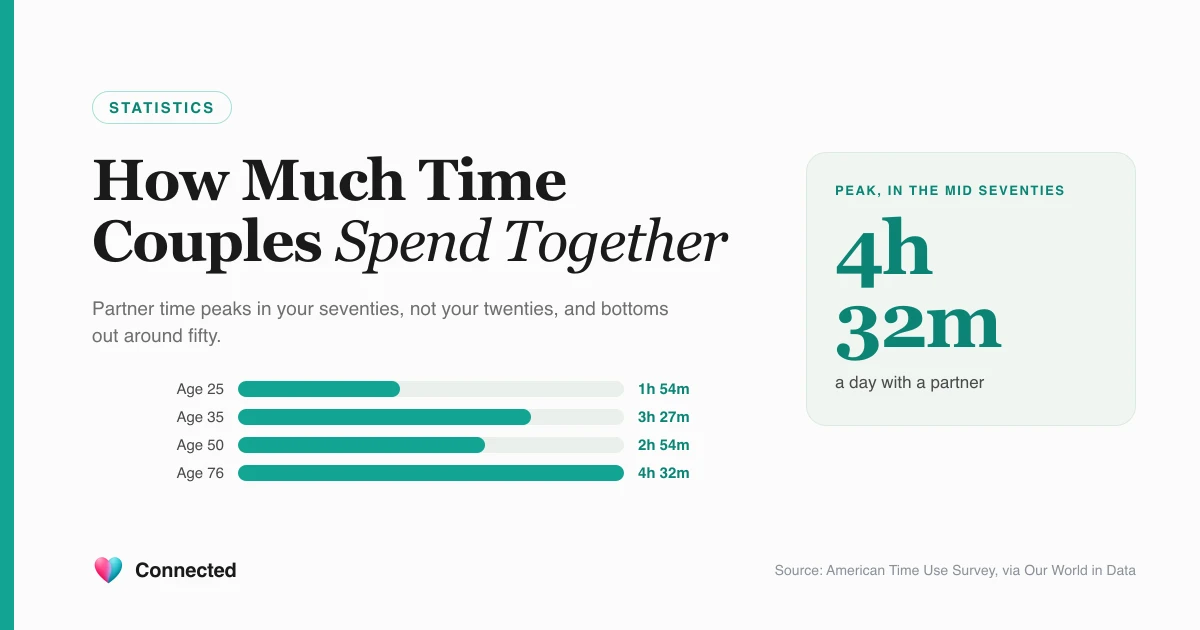
- Average time with a partner peaks at about 4h 32m a day in the mid seventies, not in the early years of a relationship.
- The low point of adult life is around age fifty, at under three hours a day. It sits exactly where time with children and career demands are heaviest.
- The squeeze runs roughly 35 to 50. A slow decline in time together across those years is a life stage, not a verdict on the relationship.
- Time-use data counts co-presence, not attention. Most couples in the squeeze log around three hours together and get ten to thirty minutes that is screen-free and non-logistical.
- These are averages across everyone at each age, including people without a partner, so read the shape from thirty-five onward rather than the rise before it.
Here is a question almost no couple can answer accurately: how many hours a day do the two of you actually spend together?
Most people guess low when they are busy and high when they are not. The American Time Use Survey has the real answer, and when you plot it across a whole life it produces a shape that reframes one of the most common complaints in long relationships.
Time with a partner, across a life
Source: Our World in Data analysis of the American Time Use Survey, US Bureau of Labor Statistics. Figures are averages across all people at each age.
An important caveat, because most write-ups of this chart skip it. These are averages across everyone at a given age, including people who do not have a partner at all. So the curve mixes two things: how much partnered people are together, and how many people are partnered. The rise into the late twenties is mostly people acquiring partners, not couples spending more time together. The shape from about thirty-five onward, where partnership rates are relatively stable, is the part worth reading as a real pattern.
With that caveat in place, the useful numbers:
| Age | Average time with a partner | Average time with children |
|---|---|---|
| 25 | 1h 54m | 1h 43m |
| 30 | 3h 00m | 3h 07m |
| 35 | 3h 27m | 4h 12m |
| 40 | 3h 17m | 3h 54m |
| 45 | 3h 04m | 3h 25m |
| 50 | 2h 54m | 2h 14m |
| 55 | 3h 07m | 1h 26m |
| 60 | 3h 20m | 1h 03m |
| 65 | 3h 57m | 0h 55m |
| 70 | 4h 12m | 0h 52m |
| 76 | 4h 32m | 0h 50m |
Source: American Time Use Survey, via Our World in Data. Averages across all Americans at each age.
The squeeze is a life stage, not a verdict
The single most common thing couples say when they come in worried about drift is some version of: we used to have time for each other and now we do not, and I do not know what happened to us.
What happened is on the chart. Between roughly thirty-five and fifty, the two lines are competing directly for the same waking hours. Time with children peaks at about four hours and twelve minutes a day at thirty-five. Time in paid work is near its maximum across the same stretch. Partner time gets whatever is left, and what is left declines for fifteen years.
This matters because of how couples interpret it. A slow decline in time together, with no obvious cause, is almost always read as a statement about the relationship. The data suggests it is more often a statement about being forty-three.
"I show couples this pattern more often than almost anything else, because the relief in the room is immediate. They came in thinking they had drifted apart and what they actually have is two careers and a nine year old. That distinction matters, because the fixes are completely different. You cannot solve a scheduling problem by working on your feelings about each other."
When the logistics partnership takes over completely, that is the state we describe in feeling like roommates. The corollary is less comfortable. If the squeeze years are structural, then waiting for them to ease is a fifteen year plan, and plenty of relationships do not survive fifteen years of being deprioritised. The couples who come out of that stretch intact are not the ones who found more hours. There are no more hours. They are the ones who changed what the remaining time was used for.
Why the hours are the wrong target
Three hours a day sounds like a lot. Most couples in the middle of the squeeze would say they get nowhere near that, and they are not wrong, because of how the survey counts.
Time-use data records time spent with a person. Being in the same room while one of you answers email and the other watches something counts. So does driving to a family event in silence. So does the twenty minutes of logistics handover between getting home and starting dinner.
| What the data counts as time together | What it is actually doing for the relationship |
|---|---|
| Watching television side by side, both on phones | Close to nothing, though it is not harmful |
| Driving somewhere while discussing schedules | Coordination. Necessary, not connective |
| Cooking and eating together, talking | Real, and the most common form of it in most households |
| A walk with no screens | Disproportionately valuable per minute, which is why it keeps showing up in relationship advice |
| Lying in bed, both asleep | Not counted, and not nothing either |
The survey measures co-presence. The relationship responds to attention, and those two things overlap far less than couples assume.
Which means the honest reading of the chart is not "you have three hours, use them better". It is that co-presence and connection are different quantities, and only one of them is scarce in the way people think it is.
The squeeze years are exactly when a small daily habit outperforms an occasional long conversation. Connected takes about five minutes a day and both of you answer separately, which works even when you are in different rooms.
So how much time do couples need?
If you are in the thick of it with young children, staying connected after kids is the practical companion to this piece. There is no research-backed number, and anyone quoting one is inventing it. What the evidence does support is more useful than a threshold anyway:
Protected beats abundant
An hour that reliably happens does more than four hours that get cancelled twice a month. Predictability is doing a lot of the work here, because it removes the negotiation that stops most couples before they start.
Undivided beats long
Twenty minutes with no screens is worth more than an evening of parallel scrolling. This is the finding that lets busy couples off the hook, and it is also the one they most resist, because parallel time feels like togetherness while it is happening.
Novel beats familiar, occasionally
Shared new experiences have better experimental support than shared pleasant ones. You do not need many. A few times a year appears to be enough to matter.
Daily beats weekly
A small daily contact point, what the Gottman Method calls a ritual of connection, holds a floor that a weekly slot does not, because the daily one survives the week the weekly one gets cancelled.
A more useful measurement than hours: for one week, note the minutes you spend with your partner where neither of you is looking at a screen and neither of you is discussing logistics. Most couples in the squeeze years find it is between ten and thirty minutes a day, against a co-presence figure of about three hours. That gap, not the total, is the thing you can move.
What happens after fifty
The right hand side of the chart is the part nobody talks about, and it is genuinely large. From the trough around fifty, average partner time climbs by more than an hour and a half a day, reaching its lifetime maximum in the mid seventies. Children leave. Work ends. Whoever you are with at that point, you are about to spend considerably more time with them than you ever have.
That is worth knowing in both directions. It is the reason the empty nest and retirement transitions are such reliable pressure points: two people who have spent fifteen years operating as a logistics partnership are suddenly handed the most unstructured time of their adult lives. Couples who kept a thread of genuine contact through the squeeze tend to find that stretch a relief. Couples who did not tend to find out, quite abruptly, what they have and have not been maintaining.
"The couples who struggle at retirement are almost never the ones who fought their way through the middle years. They are the ones who ran a very efficient household and never had to talk about anything else. Once the household stops needing running, they are in a room with someone they have not properly spoken to in a decade, and both of them are polite about it."
How much of your time together is actually together?
The short version
Average time with a partner rises through the twenties, plateaus around three and a half hours a day in the mid thirties, drops to a low of under three hours around age fifty, and then climbs steadily to a lifetime peak of about four and a half hours in the mid seventies.
The dip is not evidence that a relationship is failing. It sits exactly where children and careers are most demanding, and it lasts roughly fifteen years. What separates the couples who come through it is not that they found more hours, because nobody finds more hours. It is that a small amount of their remaining time stayed undivided.
Sources
Frequently asked questions
How many hours a day do couples spend together on average?
American time-use data puts the average at around three to three and a half hours a day through the thirties and forties, dipping to under three hours around age fifty and rising to about four and a half hours a day by the mid seventies. These are averages across everyone at each age, including people without a partner.
At what age do couples spend the most time together?
The mid seventies, at roughly four and a half hours a day. Partner time climbs steadily from around age fifty as children leave home and work ends. The common assumption that couples spend the most time together early on does not hold in the data.
Why do couples spend less time together in their forties?
Because children and careers are competing for the same hours. Time with children peaks at about four hours a day around age thirty-five, and paid work is near its lifetime maximum across the same period. Partner time takes whatever is left, and what is left declines for roughly fifteen years.
How much quality time should couples spend together?
There is no research-backed number, and any specific figure you see quoted is invented. What the evidence supports is that protected time beats abundant time, undivided time beats long time, and a small daily contact point holds up better than a weekly slot that gets cancelled.
Does watching TV together count as quality time?
It counts in the time-use statistics, because those measure being in the same place. Whether it does anything for the relationship depends on attention. Watching something together and talking about it is different from sitting on the same sofa while both of you are on phones, and the survey cannot tell those apart.
Why do some couples struggle after retirement?
Because time together roughly doubles from the midlife low, and it arrives all at once. Couples who spent the squeeze years operating as an efficient logistics partnership can find themselves with a great deal of unstructured time and no established habit of talking about anything else. Couples who kept some genuine contact through those years tend to experience the same transition as a relief.

Kayla Crane is a Licensed Marriage and Family Therapist and the co-founder of Connected. She has spent more than a decade in the room with couples, and she reviews every clinical claim on this blog for accuracy. Connected's frameworks draw on the Gottman Method, Emotionally Focused Therapy, and attachment research.