Play the free online game together — no signup needed. Or browse all 10 couples games.
Key takeaways
- The order matters more than the questions. The research mechanism is escalating, reciprocal disclosure, so a shuffled list of good questions underperforms a sequenced list of ordinary ones.
- Both of you answer every question. If only one person is answering, it is an interview, and the effect disappears.
- Three decks of exactly 21 below: a classic set for any stage, one for new relationships, and one built for couples who already know each other.
- Give each person one pass. An escape hatch makes people more honest, not less, and most couples never use it.
- Allow forty-five minutes. Finishing in fifteen means you are giving one-line answers, which is the most common way this falls flat.
The 21 questions game is the simplest structure in the world: you take turns, you ask twenty-one questions, you both answer honestly. It costs nothing, needs no cards, and works in a car, on a couch, or over a bad phone connection.
It is also the couples game that most people play wrong, and there is a specific reason why.
Search for questions and you get lists of a hundred and eighty. Then you sit down together, work through fifteen random ones, feel like you are being interviewed, and quietly stop. The problem was never the questions. It was that they were in no particular order.
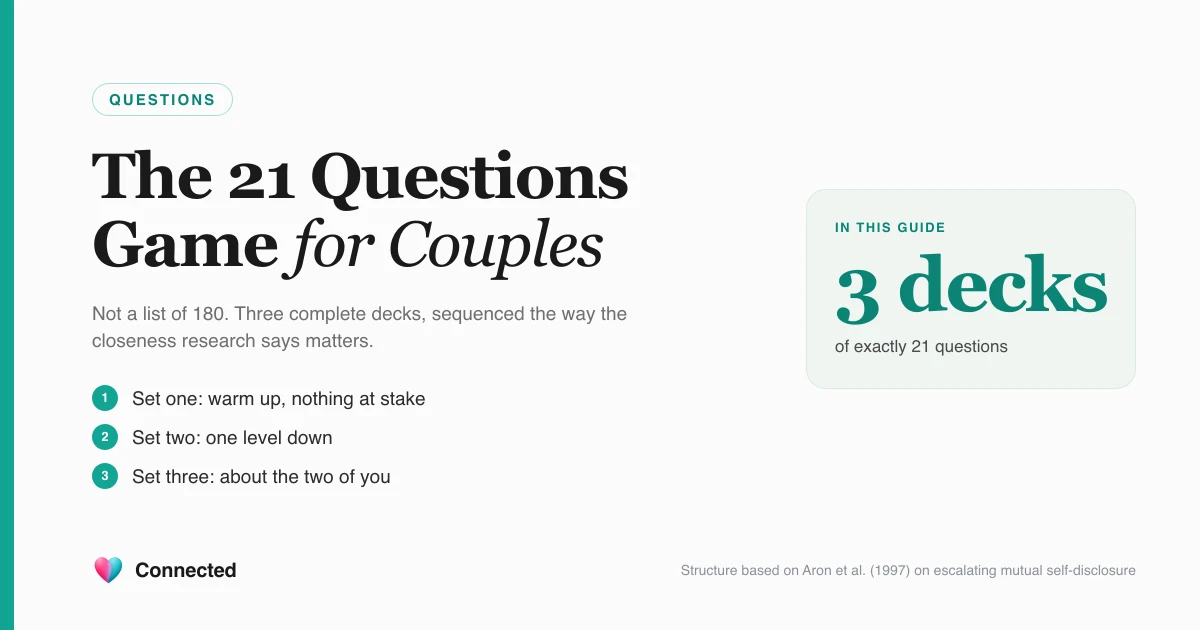
What follows is three complete decks of exactly twenty-one, built in the sequence the research says actually matters, plus the rules for playing it so it feels like a game rather than a questionnaire.
The rules, in thirty seconds
Take turns, one question at a time
One of you asks question one and you both answer it. Then the other asks question two and you both answer that. Alternating who asks matters more than it sounds: it stops the game turning into one person interviewing the other, which is how most attempts at this quietly go wrong.
Both of you answer every question
This is the rule people skip. In the original research, the effect comes from reciprocal disclosure, meaning you both give up roughly the same amount at roughly the same time. If only one of you is answering, you are not playing the game, you are conducting one.
You may pass, once
Give each person one pass for the whole game. Knowing you have an escape hatch makes people answer more honestly, not less, because nothing feels compulsory. Most couples never use it.
Ask one follow-up, then move on
One follow-up per question. It is the follow-up where the real information lives, and the two-question limit stops any single answer eating the whole evening.
Go in order
The decks below are sequenced deliberately, from light to significant. Shuffling them removes the only thing that makes this work.
Why the order is the whole game
The best-known study on this is Arthur Aron's 1997 closeness-generating experiment, the one that became famous as the 36 questions to fall in love. Pairs of strangers worked through questions for about forty-five minutes and reported significantly more closeness afterwards than pairs given small talk for the same length of time.
The detail that gets left out of most write-ups is what the researchers said the mechanism was. In their words, the pattern behind closeness is sustained, escalating, reciprocal, personalistic self-disclosure. Four conditions. The questions were arranged in three sets that each asked for more than the one before, and both people had to keep matching the level.
Worth knowing, since almost nobody mentions it: Aron's paper reported three studies, and only the first found the closeness effect. Studies 2 and 3 tested whether matching people on attitudes, or telling them they would like each other, or naming closeness as the goal, made any additional difference. None of them did. So the honest claim is narrower than the internet version: a structured, escalating exchange beats small talk. It is not a love potion, and it was never tested on couples who already know each other.
"Couples come to me having tried a list of questions off the internet and reporting that it did not do much. It usually turns out they picked whichever ones looked interesting, which means they opened with the heaviest one in the list. Nobody can answer a serious question cold. You have to walk down the stairs. The first seven questions are not filler, they are what makes the last seven possible."
Deck one: the classic 21
Use this if you are not sure which deck you want. It works at any stage, from a third date to a twentieth anniversary. If you want longer answers from fewer prompts, our deep relationship questions go further per question. Three sets of seven, light to significant.
Set one: warm up
Questions 1 to 7. Easy, specific, nothing at stake.
- What is something you were really into as a kid that you would be a little embarrassed to admit now?
- If you had a completely free Saturday with no obligations, what would you actually do with it?
- What is the best thing that happened to you this week that you have not told anyone about?
- Which meal from your childhood would you want if you were having a terrible day?
- What is a small thing that instantly puts you in a good mood?
- Are you more yourself in the morning or at night?
- What is something you own that you would grab first if the house was on fire?
Set two: go a level down
Questions 8 to 14. Still about them, but asking for something they would not tell a colleague.
- What is something you have changed your mind about in the last few years?
- When you picture your life in five years, what part of it is clearest?
- What is a compliment you got once that you still think about?
- Which of your parents are you more like, and how do you feel about that?
- What is something you are better at than you let on?
- When was the last time you felt genuinely proud of yourself?
- What is a fear you have that you know is not entirely rational?
If set two is where it gets good, that is the level Connected runs at daily. One question a day, both of you answer, and you only see their answer once you have written yours.
Set three: about us
Questions 15 to 21. These are the ones people remember. Do not start here.
- What is something you wish I asked you about more often?
- When do you feel most loved by me, specifically?
- Is there anything you have been wanting to tell me but have not found the moment for?
- What do you think I misunderstand about you?
- What is the hardest thing you have been through, and what got you out of it?
- What do you worry about when it comes to us?
- What is one thing you hope is still true about us in twenty years?
Deck two: early days
For the first few months, when you are still assembling a picture of each other. These lean towards how someone operates rather than what they like, because compatibility shows up in the former and almost never in the latter.
Twenty-one questions for a new relationship
Sequenced from easy to real. Question 21 is deliberately last.
- What made you say yes to a first date with me?
- What is your read on me so far, and what are you still not sure about?
- What does a good week look like for you?
- Who is the most important person in your life right now?
- What is something you do not want in a relationship, based on experience?
- How do you usually act when you are upset with someone?
- What is your relationship with your family like?
- What is something you are working on about yourself?
- What do you do when you need to recharge?
- How do you feel about being alone?
- What is the nicest thing anyone has done for you?
- What is something you have always wanted to try but have not?
- Are you a planner or do you like things open?
- What is a dealbreaker for you?
- What did you think you wanted at twenty that you no longer want?
- How do you know when you trust someone?
- What does support look like to you when you are struggling?
- What is something people get wrong about you at first?
- What are you most looking forward to in the next year?
- Is there anything you would want me to know early rather than later?
- What do you want to ask me that I have not given you a chance to ask?
Deck three: long-term couples
This is the hardest deck to write, because the standard advice for established couples is to ask each other fun trivia, and fun trivia is not the problem. After a few years the missing information is not what your partner's favourite film is. It is what has quietly changed and never got mentioned.
Twenty-one questions for couples who already know each other
Designed for the specific failure of long relationships: you stopped updating.
- What is something about our life right now that you would not change for anything?
- When did you last feel like a team with me?
- What is a version of a Saturday together that we have never actually done?
- What do you miss from an earlier phase of us?
- What have I gotten better at since we met?
- What is something you have stopped asking me for?
- When you have a bad day, what do you actually want from me, and do you get it?
- What is a decision we made together that you are glad we made?
- Is there anything you have quietly given up on?
- What would you want more of in the next year, if it cost us nothing?
- What do I do that makes you feel like a priority?
- What do I do that makes you feel like an item on a list?
- What is a conversation we keep having that never resolves?
- What do you think I need right now that I have not asked for?
- What is something you find attractive about me that has nothing to do with how I look?
- If we had a free month, where would we go and what would we do?
- What are you proudest of about us?
- What is a habit of ours you would quietly like to break?
- What do you want our life to feel like in ten years?
- What is something you want to do together before we are too old to enjoy it?
- What is the thing you would most want me to remember about you?
"The questions that do the most work in a long relationship are the ones that assume something has changed. Not what do you love about me, which gets you a rehearsed answer, but what have you stopped asking me for. That one lands in almost every session I have ever used it in, and it is usually followed by a long pause and something true."
Once you have played all three, the natural next games are would you rather and never have I ever, which trade depth for laughter and work better late at night.
Five variations that keep it interesting
| Variation | How it works | Best for |
|---|---|---|
| Guess first | Before your partner answers, say what you think they will say. Then they answer. Points are irrelevant, the gap is the interesting part. | Couples who think they know everything already |
| Truth or pass | Whoever passes owes the other one question of their choosing at the end, no pass allowed. | Playful couples, later sets |
| Three a day | Do not play twenty-one in one sitting. Do three a day for a week. | Anyone who finds long conversations draining |
| The drive | Play it in the car. No eye contact makes people answer harder questions more easily, which is why difficult conversations often happen while driving. | Anxious or avoidant partners, long journeys |
| Write it | Both write your answers to all 21 before either of you reads the other's. | Long distance, or when one of you talks more than the other |
Four ways couples ruin it
Opening with a heavy question
Starting on "what is your biggest fear" makes the whole thing feel like a test. Nobody performs well cold. Start where nothing is at stake.
One person answering
If you asked it, you answer it too. Reciprocity is not a courtesy here, it is the mechanism.
Turning an answer into a discussion
Something will come up that deserves a real conversation. Note it and keep playing. Coming back to it tomorrow with a whole evening is better than derailing at question nine and never reaching twenty-one.
Treating a surprising answer as a problem
You will learn something you did not know. That is the game working, not a warning sign. React to it the way you would want them to react to yours.
How long it takes: allow forty-five minutes for twenty-one questions with both people answering and one follow-up each. If you are finishing in fifteen, you are giving one-line answers and the game will not do anything. If you are still on question six after an hour, that is not a failure either. Some couples never finish a deck and get more out of it than the ones who do.
What to do the day after
The most common outcome of a night like this is a good evening followed by nothing. That is not a small loss. The thing that made it work was not the depth, it was that you both spent an hour genuinely curious about each other, and curiosity is a habit rather than an event.
The couples who get lasting value from this do one of two things. They keep the deck and play a set every few weeks, or they move the habit somewhere it happens without being scheduled. If a full deck is too much on a weeknight, a single conversation starter or the app's daily question covers the same ground in five minutes.
Sources
Frequently asked questions
How do you play the 21 questions game with your partner?
Take turns asking, one question at a time, and both of you answer every question. Allow one follow-up per question, give each person a single pass for the whole game, and go through the questions in order rather than picking at random. Twenty-one questions with both people answering takes around forty-five minutes.
What are good 21 questions to ask your partner?
The best sets start light and get deeper. Open with easy, specific questions like what small thing instantly puts you in a good mood, move to questions about how they see themselves, such as what have you changed your mind about recently, and finish with questions about the relationship, like what have you stopped asking me for. This article has three complete decks of twenty-one built in that order.
Does the 21 questions game actually work?
A structured, escalating exchange of questions does produce more closeness than small talk. That was the finding of Arthur Aron's 1997 closeness study. It is worth knowing that only the first of the three studies in that paper found the effect, and it was run on strangers rather than established couples, so treat it as a good structure for a conversation rather than a guaranteed result.
Is 21 questions good for a new relationship?
Yes, and it is arguably better early than late, because the information you gain is genuinely new. Use questions about how someone operates rather than what they like. Preferences rarely predict compatibility, whereas how a person handles conflict, disappointment or being alone tends to.
What is the difference between 21 questions and the 36 questions?
The 36 questions come from a specific 1997 psychology experiment and are fixed in wording and order. The 21 questions game is an informal format with no canonical list, which makes it more flexible and easier to fit into an evening. Both work on the same principle of escalating mutual disclosure.
Can you play 21 questions over text or long distance?
Yes, and the written version has an advantage: both partners can answer all twenty-one before either reads the other's replies, which removes the risk of one person's answer shaping the other's. It also suits couples where one person talks considerably more than the other.

Kayla Crane is a Licensed Marriage and Family Therapist and the co-founder of Connected. She has spent more than a decade in the room with couples, and she reviews every clinical claim on this blog for accuracy. Connected's frameworks draw on the Gottman Method, Emotionally Focused Therapy, and attachment research.