 Connected
In a bilingual or multilingual relationship, clarify the intended meaning before responding to a phrase that feels confusing or unusually harsh. Agree which language and format help each of you express yourselves, allow time to find words, and check what the listener understood. Fluency in everyday conversation does not tell you exactly how someone experiences emotional language.
You might handle shopping, jokes, and travel easily in your shared language, then struggle to explain why a small moment hurt. Or a familiar phrase might carry a different emotional weight for each of you. You do not need to assume the relationship lacks depth. You need room to make the meaning explicit.
Start with your partner's experience. Language can contribute to a misunderstanding without explaining every disagreement.
Evidence, with the context kept in
Many U.S. homes use a language other than English.

What this does and doesn't tell us: This five-year U.S. population estimate is not the share of bilingual couples and does not measure fluency or relationship quality.
Put it to use: Ask how language works for your particular partner. A national language statistic cannot tell you which words feel safe, warm or precise to them.
Get the chart, data and citation
The numbers come from the source linked above; Connected created the chart. These are published statistics, not an original Connected study.
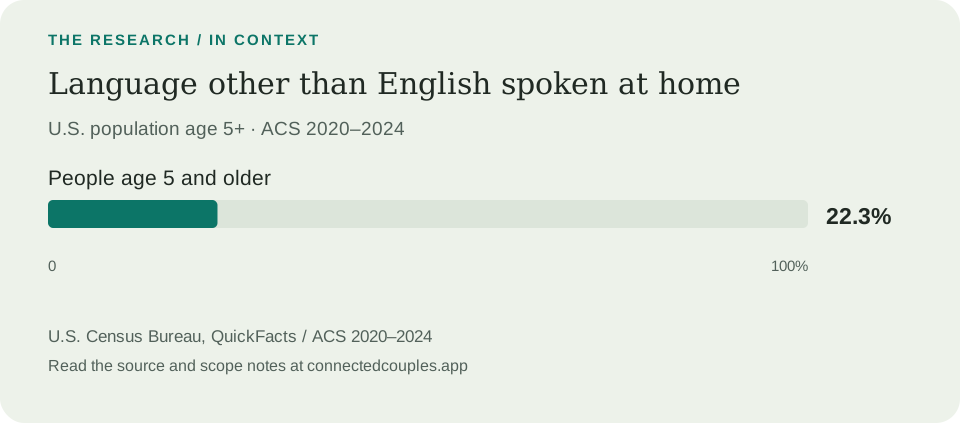
U.S. Census Bureau, QuickFacts / ACS 2020–2024. U.S. population age 5+ · ACS 2020–2024. Chart by Connected Editorial Team, October 2, 2026. Please retain the source, date and scope when sharing.
Ask how language feels for this person
Start with your partner's experience rather than a general rule about first and additional languages. Ask:
- Which language feels easiest for describing something painful?
- Which words of affection feel natural, awkward, or especially meaningful?
- Does speaking, writing, or a mixture help when the topic is complicated?
- When do you want help finding a word, and when would you rather finish independently?
A study by Jean-Marc Dewaele and Lora Salomidou used questionnaires and written interviews to explore emotional communication in cross-cultural couples. Participants reported varied experiences, including difficulty expressing some feelings in an additional language and changes over time. Those varied accounts leave room for your own experience: an additional language may feel awkward, familiar, or especially intimate. Read Loving a Partner in a Foreign Language.
Someone may prefer their first language for a memory and your shared language for an apology. Let them tell you what feels right for this conversation.
Use a pause clarify confirm sequence
When a sentence lands badly, try slowing that one exchange down. You can use these steps without turning the whole conversation into an exercise.

Read the graphic as text
When words do not land
A multilingual clarification loop
01: Pause. “I’m not sure I understood that as you meant it.”
02: Name the language need. Ask for a slower pace, different words, or another language.
03: Say the meaning another way. Explain the idea; do not just repeat it louder.
04: Check what landed. “Do you mean … ?” Make room for correction.
05: Choose the next step. Continue, switch languages, write it down, or return later.
Fluency, speed, and accent are not measures of care or intelligence.
Pause
Notice that you may be responding to different meanings. Say, “That sounded stronger than I expected. Can we check what you meant?” You are asking a question, not declaring that your partner did not know what they said.
Name the language need
The speaker might say, “I know the feeling but cannot find the word,” or “I need to write this first.” The listener might say, “I understand the words, but I do not understand whether you are asking for a change or describing how you feel.”
Say the meaning another way
Use a concrete event, a short example, or simpler words. Replace an idiom with a description. If you switch languages, add enough explanation for the other person to remain included. You do not need a perfect one-word translation to describe an experience.
Check what landed
The listener summarizes: “I hear that you felt left out when I made the plan without you. Have I understood?” The speaker can correct it. This checks shared meaning without asking the listener to agree with every conclusion.
Choose the next step
Once you understand each other, decide what the actual issue needs: an apology, a different plan, more information, or a return to the topic later. Clarification can reveal that a disagreement remains. That is still useful; now you can discuss the disagreement you actually have.
Make a small shared meaning sheet
Choose phrases that have caused confusion in your relationship. Use a private note or paper, and revise it together. You are recording personal meaning, not defining an entire language.
| Phrase or situation | What I might mean | What helps you check |
|---|---|---|
| “I need space” | I need quiet before continuing this conversation | “Are we returning to this later today?” |
| “It is fine” | It may mean agreement, uncertainty, or wanting to stop talking | “Are you comfortable with the plan, or do we need more time?” |
| A word with no satisfying translation | A feeling I can describe through an example | “Can you tell me about a moment when you felt it?” |
| Going quiet while searching for words | I may still be working out how to say it | “Would you like time, a written version, or help?” |
Ask rather than assuming these meanings fit. Give the speaker time to explain their intention.
The guide to improving communication in a relationship offers more ways to listen and respond once the meaning is clear.
“Before you answer the sentence that hurt, ask what your partner was trying to say. Once the meaning is clear, you can still say, ‘I understand what you meant, and I want us to find a gentler way to say it.’”
Kayla Crane, LMFT
When disappointed sounds like a judgment
In this fictional example, Mika and Jo use a shared additional language. After Jo changes a weekend plan, Mika says, “I am disappointed in you.” Jo hears a judgment about their character and replies defensively.
Mika asks to pause and explains: “I meant that I was looking forward to our plan and feel sad it changed. I also wanted you to ask me before confirming the new one.” Jo checks: “You are upset about what happened, and you want us to decide changes together?” Mika agrees.
Jo can now acknowledge the change without arguing against a broader accusation Mika did not intend. They also discuss how the original phrase affected Jo. Clarifying intent does not require Jo to pretend the words did not hurt.
Next time, Mika tries a more precise description: “I am disappointed that our plan changed.” This is a change in their own communication, not a rule that people who speak Mika's other languages use the phrase incorrectly.
Make room for both people in the conversation
If one partner is more fluent in the language you are using, take care that speed does not determine the outcome. Let the other person complete their thought. Avoid stacking several objections before they have answered the first.
Ask before correcting grammar during an emotional conversation. A correction may be welcome when learning together and distracting when someone is trying to express hurt. You can agree to revisit language questions later.
A small qualitative study by Agnieszka Stępkowska examined accounts from four bilingual couples and described different emotional uses of language switching, including self-regulation and hostile interaction. With only four couples, the findings are examples to think with, rather than a rule for interpreting your partner. Read the bilingual couples study.
Ask: “Will changing languages help us both understand?” You might combine short written explanations with spoken clarification. Check that neither person is left unable to participate or doing all the translation.
Use translation tools as a starting point
A dictionary or translation tool may suggest vocabulary, but the output still needs checking with the speaker. Ask whether a translation captures intensity, politeness, and the intended request. Avoid declaring that a tool has proved your partner's feelings or intentions.
Before using a translation service, consider who can access what you upload and whether both people agree to share it. A generic phrase may be enough; avoid uploading private conversations unnecessarily.
For important medical, legal, or other high-stakes communication, seek appropriately qualified language support rather than relying on an informal couple exercise. Do not ask a partner to carry a high-stakes interpretation task simply because they speak the language.
When clarification does not resolve the problem
We understand the words but still disagree. Move on to the underlying choice or need. Repeating that it is a translation problem can prevent a real disagreement from being addressed.
One person uses language differences to dismiss hurt. Intent deserves explanation, and impact deserves attention. “You misunderstood” should not automatically end the conversation. Use the guide to difficult conversations with your partner to discuss the behavior and what needs to change.
One person feels embarrassed asking for clarification. Agree that either person can ask, including the more fluent speaker. Respond to the question without mockery or a test of language ability.
Language is used to humiliate or exclude. Persistent ridicule, deliberate confusion, or threats are not solved by a vocabulary sheet. Seek independent, confidential support if speaking up does not feel safe.
Try it on a difficult day
When the translation is accurate but the message still hurts
Fictional example
A translation tool returns the same phrase both times. The speaker says it is technically correct. The listener still hears a rejection. Repeating the translation is not resolving the emotional meaning.
- Ask for the intended message in a different form: a short example, simpler wording or writing. Let the speaker finish before correcting grammar.
- Have the listener describe what they understood, then let the speaker confirm or revise it. Agreement about meaning can come before agreement about the issue.
- If the meaning is now clear and the behavior remains hurtful, discuss the behavior directly. A language difference should not excuse insults, threats or repeated disregard for a boundary.
The useful review: Keep only the phrases both people find useful. A shared meaning sheet should help you understand each other, not become a list of words one person is forbidden to use.
Make it yours
Make a shared meaning note
Choose a word or phrase that recently caused confusion. Record each person's intended meaning without making one language the judge of the other.
Your entries stay in this tab and are not sent by this worksheet. Download your draft before closing or reloading; it is not saved automatically.
Your draft to discuss together
Check that both people agree before treating this as a commitment. Blank items remain open questions.
Common questions
Should we always use the more fluent partner's language?
No single rule fits every couple. Choose an arrangement that allows both people to understand and contribute. Topic, tiredness, and whether you are speaking or writing may change what works.
Do we need to translate every emotional word exactly?
No. A description and a concrete example may communicate more than a single translated label. Check the meaning together rather than forcing a one-to-one match.
What can we practice when we are not arguing?
Take a low-stakes phrase, such as how each of you asks for quiet time, and compare what it means. For another opening to conversation, try Connected, which offers daily questions and weekly check-ins. Discuss prompts in the language or format you both prefer.
Sources & editorial notes
Published by the Connected Editorial Team, with a quote from Kayla Crane, LMFT. Examples are fictional. The worksheets and graphics are original editorial planning aids, not validated assessments or a substitute for professional care.
- U.S. Census Bureau, QuickFacts / ACS 2020–2024
U.S. population age 5+ · ACS 2020–2024. This five-year U.S. population estimate is not the share of bilingual couples and does not measure fluency or relationship quality.
- Dewaele and Salomidou Loving a Partner in a Foreign Language
Questionnaire/written-interview research reports varied emotional language experiences and changes over time; no universal first-language assumption.
- Stepkowska Emotional impact on language practices of bilingual couples
Qualitative accounts of four bilingual couples illustrate varied emotional language-switching uses; not generalized prevalence.