Quick answer
Emotional intimacy is not simply “telling each other everything.” It is the experience of sharing something real and being met with understanding, validation, and care. Choose one question at the right depth, both answer, and respond before you advise.
The internet treats intimacy like a vault that opens when you enter the correct 75-digit code. Real conversations are less mechanical. A revealing answer can increase closeness, do nothing, or leave someone feeling exposed. The difference is often what happens next.
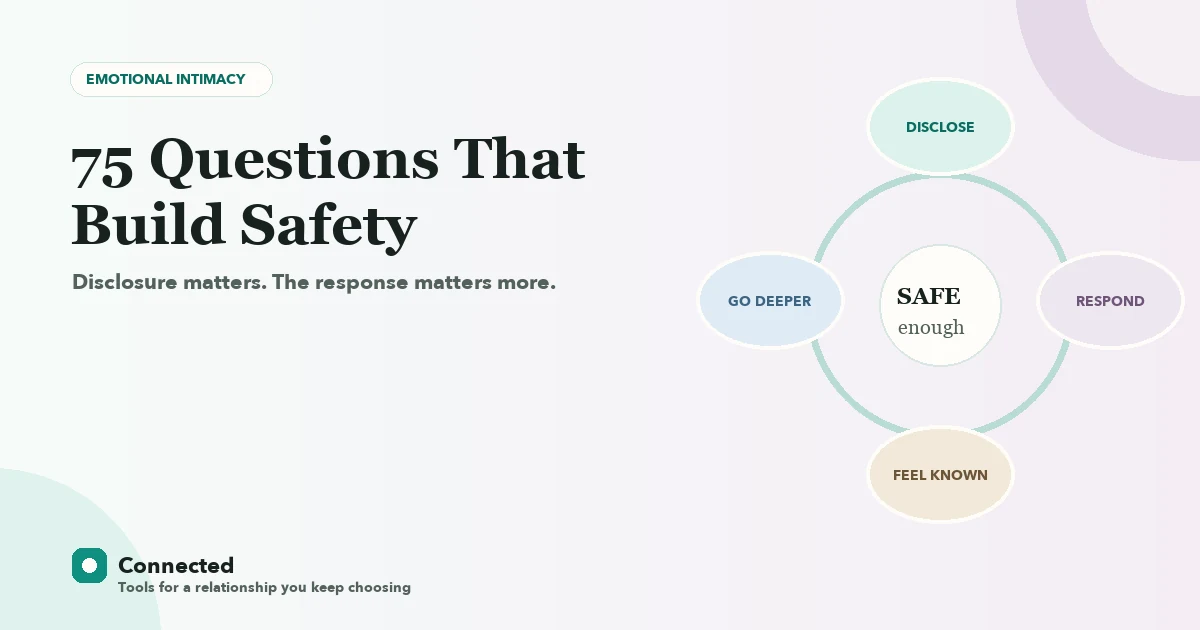
Relationship researchers describe intimacy as an interpersonal process: one person discloses, the other responds, and the first person decides whether they feel understood and cared for. That loop is the organizing idea for every question below.
A question opens the door. The response decides whether it stays open.
Intimacy develops through repeated cycles, not a one-time disclosure.
Based on the interpersonal process model tested in daily interaction research by Laurenceau and colleagues.
Four agreements before you ask
A pass is complete
No explanation, persuasion, or visible disappointment. Safety requires a real way to decline.
Both people answer
Mutual disclosure feels different from one partner being examined. The asker can go first.
No later ammunition
Do not reuse a vulnerable answer to win a future argument. If confidentiality between partners has exceptions, name them beforehand.
Advice is opt-in
Ask whether your partner wants listening, comfort, or help thinking. An accurate solution can still be an unresponsive answer.
The deepest question is rarely the most useful place to start. I want couples to have a successful experience of being known, even if the topic is ordinary. Once your partner trusts that you will not fix, cross-examine, or store the answer for later, deeper conversations stop requiring so much courage.Kayla Crane, LMFT, licensed marriage and family therapist and co-founder of Connected
75 emotional intimacy questions in five levels
These levels describe emotional demand, not relationship quality. Stay where the conversation feels alive. Long-term couples often need the first level most because the everyday inner world changes faster than their picture of each other.
The everyday inner world Level 1
- What emotion has visited you most often this week?
- What part of your day do you usually edit out when you tell me about it?
- Where have you felt energized lately?
- What are you carrying that looks small from the outside?
- What has made you feel appreciated recently?
- Which current worry needs company rather than a solution?
- What do you wish people asked you about?
- Where are you being harder on yourself than I realize?
- What feels unfinished in your week?
- When did you feel most relaxed today?
- What has surprised you about yourself lately?
- Which need has been easiest to ignore?
- What moment from this week do you want me to understand better?
- What are you looking forward to that we have not celebrated yet?
- What would help you feel accompanied tonight?
History and the person you became Level 2
- What did comfort look like in your family growing up?
- Which childhood rule still follows you into adult relationships?
- Who first made you feel understood?
- What did conflict teach you when you were young?
- Which part of your younger self still needs protection?
- What kind of praise did you receive most, and what was missing?
- When did you learn to hide a feeling?
- What family strength do you want to carry forward?
- What family pattern do you want us to interrupt?
- Which past friendship changed how you trust people?
- What early experience shaped your relationship with money?
- What did affection look like in the home where you grew up?
- When did independence become especially important to you?
- What did you need during adolescence that adults missed?
- Which old story about yourself are you ready to revise?
Needs, comfort, and boundaries Level 3
- What makes a request feel safe for you to hear?
- How can I tell when you want empathy instead of ideas?
- What kind of reassurance works, and what kind feels empty?
- Where do you need more autonomy inside our relationship?
- What helps you come back after conflict?
- How do you want me to respond when you are overwhelmed?
- Which boundary helps you stay connected rather than pull away?
- What shared responsibility needs a clearer owner?
- When does closeness start to feel like pressure?
- What kind of apology helps you trust the repair?
- What are you tired of having to translate about yourself?
- Which need feels embarrassing even though it is reasonable?
- What helps you believe that I am on your side?
- What would make our home feel more emotionally restful?
- How can I support you without managing you?
Tender fears and repair Level 4
- What are you afraid could quietly grow between us?
- Where do you feel least understood by me?
- What do you worry I might judge you for?
- Which recurring argument is protecting a deeper fear?
- When have you felt lonely while we were together?
- What is hardest for you to forgive in yourself?
- What do you fear asking from me because I might say no?
- Which part of our relationship feels most fragile right now?
- What loss are you still learning to live alongside?
- When do you question whether you are enough?
- What would you want me to remember if you were shutting down?
- What have you stopped bringing up?
- Which repair do we keep attempting in the wrong way?
- What pain do you want witnessed without being compared?
- What would gentleness look like around this topic?
Meaning, values, and a shared life Level 5
- What makes our relationship worth protecting?
- Which version of yourself do you hope this relationship helps you become?
- What do you hope we teach each other over a lifetime?
- Where do love and responsibility meet for you?
- What do you want us to remember about this season?
- Which values should guide our hardest decisions?
- What does commitment mean when feelings fluctuate?
- How do you want us to make room for each other to change?
- What kind of legacy can a relationship leave?
- What do you hope remains playful between us?
- When do you feel part of something larger than yourself?
- What would growing old together require from each of us?
- Which shared dream reflects who we are, not who we should impress?
- What does a well-lived ordinary life look like to you?
- What do you want the next chapter of us to be about?
Keep learning the person you are with
Connected’s Love Maps and daily questions make room for both partners’ inner worlds without turning one person into the interviewer.
How to respond so an answer creates closeness
Perceived partner responsiveness is the felt sense that a partner understands, validates, and cares. It is not agreement. You can understand why something matters without reaching the same conclusion.
| Move | Try this | Avoid this |
|---|---|---|
| Understand | “The part I am hearing most is…” | Repeating only the facts while missing the feeling |
| Validate | “Given what you expected, that reaction makes sense.” | “You should not feel that way.” |
| Care | “I am glad you told me. What would feel supportive?” | Jumping to a plan before checking what is wanted |
| Check | “Did I understand, or did I miss something important?” | Assuming one paraphrase proves you got it |
One follow-up is often enough: “What was that like for you?” “Has that always been true?” or “What do you wish I understood about it?” Follow curiosity, not the numbered list.
When to pause or get support
Do not use vulnerability as a test
Pause if either partner is pressured, mocked, threatened, monitored, punished for an answer, or unable to decline. Structured intimacy questions are not appropriate where there is coercive control or abuse. Seek confidential individual support and prioritize safety.
For non-abusive couples, repeated shutdown or escalation can still signal that the container is too small for the topic. A therapist can slow the cycle and help each partner translate the protection underneath pursuit, withdrawal, anger, or numbness. You can also begin with a lower-demand relationship check-in or practice active listening before returning to the tender questions.
Research and sources
We favored peer-reviewed research, professional associations, and primary clinical guidance. Source notes describe what each reference does and does not establish.
- Laurenceau, Barrett, and Pietromonaco, Intimacy as an Interpersonal Process (1998). A bibliographic record for two event-contingent diary studies testing self-disclosure, partner disclosure, perceived responsiveness, and experienced intimacy.
- Aron et al., The Experimental Generation of Interpersonal Closeness (1997). The foundational reciprocal-disclosure procedure. It supports gradual, mutual sharing, with important limits on what the experiments established.
- Debrot et al., Perceived Partner Responsiveness Forecasts Affectionate Touch (2021). Multi-study evidence that feeling understood, validated, and cared for predicts later affectionate touch in couples.
- The Gottman Institute, The Sound Relationship House: Build Love Maps. Professional guidance on continuing to learn a partner’s evolving inner world.
Frequently asked questions
What questions build emotional intimacy?
Questions build emotional intimacy when they invite authentic disclosure and the answer is met with understanding, validation, and care. The response matters at least as much as the prompt.
How do you deepen emotional intimacy with your partner?
Use small, repeated moments of mutual disclosure. Ask about the current inner world, listen without correcting, and follow up later. Depth grows through responsiveness and reliability, not one marathon conversation.
Can deep questions make a relationship closer?
They can create an opportunity for closeness, but they do not guarantee it. The original structured-disclosure research found greater closeness than small talk in one experiment; the method was reciprocal, gradual, and conducted under controlled conditions.
What if my partner does not want to answer intimate questions?
Respect the no. Offer a lighter prompt, answer first, or connect through a shared activity instead. Pressuring someone to disclose undermines the safety emotional intimacy requires.
How often should couples ask intimacy questions?
One meaningful question once or twice a week can be more useful than a long list every few months. Consistency and follow-up matter more than volume.
Are emotional intimacy questions a substitute for couples therapy?
No. They are educational conversation tools. If discussions repeatedly become unsafe, contemptuous, coercive, or impossible to repair, a qualified couples therapist can assess the pattern and guide the process.
Kayla is a licensed marriage and family therapist and co-founder of Connected. This educational guide is not a diagnosis or a substitute for therapy.