 Connected
The quick answer
Before a first vacation together, agree on an affordable total cost, the pace of the trip, sleep and privacy needs, and who handles each booking. Give each person one priority and leave room for changes. There is no universal number of months you must date first; practical trust and the freedom to say no matter more than a milestone.
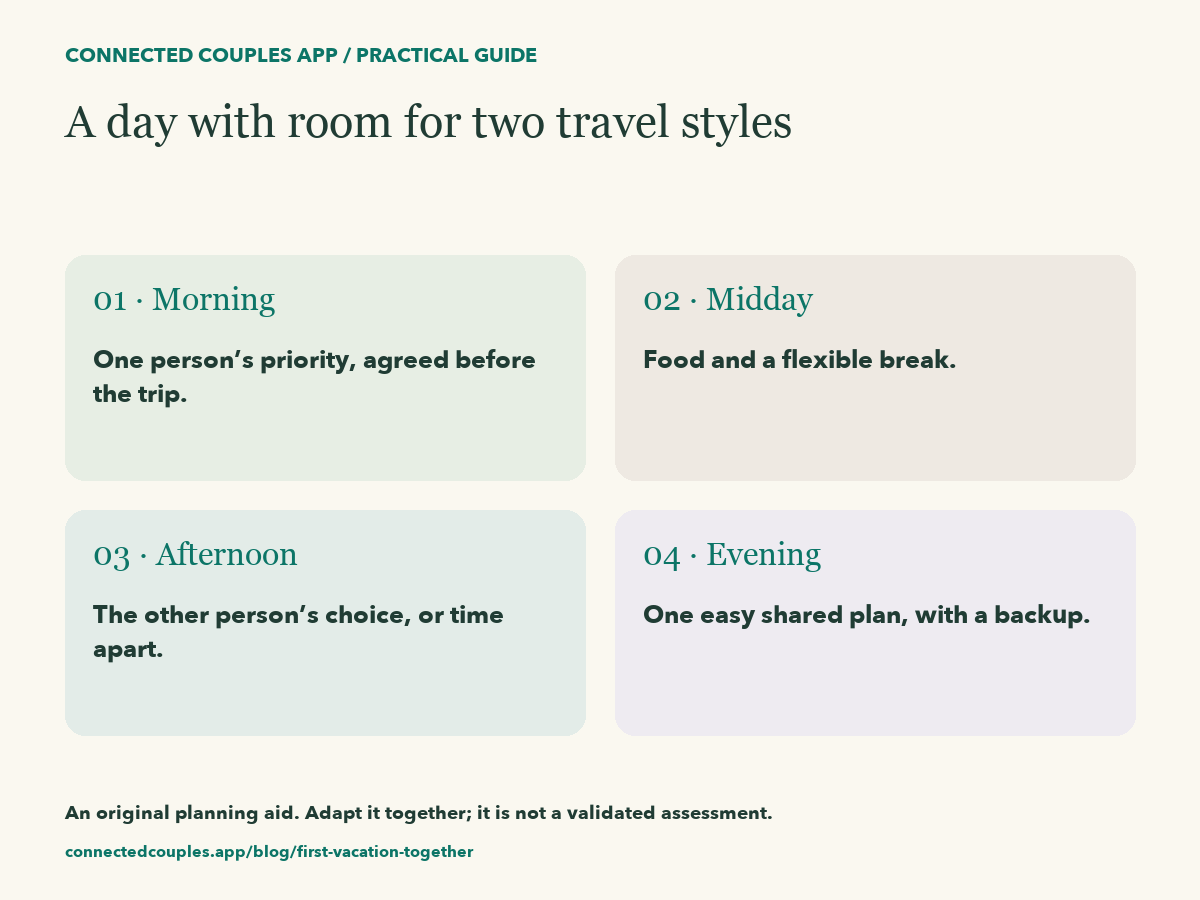
A day with room for two travel styles
- Morning
One person’s priority, agreed before the trip.
- Midday
Food and a flexible break.
- Afternoon
The other person’s choice, or time apart.
- Evening
One easy shared plan, with a backup.
Try it together · Free tool
Build your first-day agreement
Choose a pace and one priority each. This makes a discussion draft, not a booking or a destination recommendation.
Your answers stay in this page. They are not saved by us or sent to your partner. Refreshing clears the draft; download it if you want to keep it. Basic tool-use analytics contain no answers.
Your conversation draft
Have the awkward conversation while it is still free
One of you sees a weekend away as a chance to wake up slowly. The other has already saved twelve restaurants and an itinerary that begins at sunrise. That difference is manageable. Discovering it after a nonrefundable booking is less pleasant.
Before choosing accommodation, each finish this sentence: “I would come home happy if we got to…” Name one experience, not an entire list. Then finish: “The thing that would make this trip stressful for me is…”
You might discover that the real conflict is not adventurous versus boring. It is one person wanting to feel they used rare vacation time well while the other needs relief from decisions. Build the trip around those needs instead of trying to win an itinerary argument.
Make the price comfortable for the person with less room
A hotel rate is not the trip cost. Write down transport, accommodation, meals, activities, local travel and a buffer for changes. Then each privately work out what you can comfortably afford before comparing numbers. Do not use the amount someone is willing to stretch as their actual budget.
If one person wants a more expensive option, discuss exactly what the offer means: “I would like this hotel and can cover the difference as a gift. There is no expectation attached.” The other person still gets to decline.
| Decision | A clear version |
|---|---|
| Shared spending | “We will agree before adding any activity that costs more than our chosen limit.” |
| Who books | “You book the room after we both check the dates and cancellation terms.” |
| Reimbursement | “I will send my agreed share on Friday, before the balance is due.” |
| If plans change | “We will check the actual refund terms and discuss remaining costs before making another booking.” |
Keep confirmations accessible to both travelers. Discuss cancellation terms rather than assuming travel insurance covers a changed mind or a breakup. For international travel, consult official destination and preparation guidance appropriate to your nationality and circumstances.
Discuss the details that rarely make an itinerary
- Sleep: room temperature, lights, alarms and whether either person needs quiet downtime.
- Food: dietary needs, regular meal times and how you will choose when both are hungry.
- Privacy: bathroom arrangements, changing space and time alone. Sharing a room is not an obligation to have sex.
- Photos: whether you are happy being posted online, and how much of the day you want to spend getting a picture.
- Alcohol and spending: preferences and limits without assuming vacation cancels them.
- Accessibility: what each person needs to enjoy the day and what the venue actually provides.
These questions are not unromantic. They are what let you relax after arriving. Someone who dismisses a reasonable privacy or accessibility need before booking is giving you useful information.
Plan one day before planning the whole trip
Illustrative example: Jo wants a museum visit. Casey wants a slow lunch and time near the water. They choose the museum for the morning, lunch afterward and an open afternoon. Jo can explore another gallery alone while Casey rests, with a clear meeting time for dinner.
The plan includes a rainy-day alternative and a low-cost dinner option. It does not require both people to be delighted by every activity. It gives each a reason to look forward to the day.
Try the planner above, then ask whether the draft fits the actual opening hours, travel distances, cost and your bodies. A tool can arrange your preferences; it cannot know whether two places are on opposite sides of a city.
When a small travel problem becomes a couple problem
You miss a train. Someone says, “I told you we should have left earlier.” The train is still gone, and now you are fighting.
Handle the immediate problem first. “We need the next route and somewhere to sit. I will check departures; can you find food?” Save the conversation about timing until neither person is trying to solve an urgent problem.
Later, be specific: “When we left later than agreed, I felt rushed. Tomorrow I want us ready ten minutes before our planned departure.” Avoid turning one mistake into “This is what traveling with you is always going to be like.”
If an argument heats up, take a pause with a practical reunion plan. Do not strand each other, disappear in an unfamiliar place or withhold documents, money or room access. A first trip should preserve each person’s ability to make independent choices.
Bring home information, not a compatibility score
After the trip, name one thing you would repeat, one you would change and one thing your partner did that you appreciated. Maybe you learned that two nights is plenty, separate beds improve sleep, or booking fewer activities leaves you both happier.
That is useful knowledge for the next trip. You do not need the first one to become a perfect story. You need to be able to talk honestly about the trip you actually had.
Common questions
How soon is too soon for a first vacation together?
There is no date-based rule that makes a trip safe or compatible. Consider whether you can discuss money, decline plans, handle disagreement and make your own arrangements if necessary. A short, simple trip can limit the cost of discovering different habits.
Should couples split vacation expenses 50/50?
Only if that works for both budgets. Agree before booking whether costs will be equal, proportional, gifted or separate. Paying more does not buy control over activities, privacy or sex.
Is it okay to do things separately on vacation?
Yes, when the arrangements are mutually understood and practical. Agree where and when to reconnect and make sure each person has transport, access to accommodation and any information they need.
Does fighting on a first trip mean we should break up?
One disagreement is not a compatibility test. Notice whether you can repair it and whether each person feels safe saying no. Threats, intimidation or controlling access to money and documents are more serious than ordinary travel friction.
Sources & editorial notes
Written by the Connected Editorial Team. The examples are illustrative, and the scripts, visual guide and planning tool are original editorial resources. They are not validated assessments, individualized advice or a substitute for professional care. Source notes explain the scope of the supporting material.
- UK Foreign, Commonwealth & Development Office: Foreign travel checklist
Official preparation guidance, including destination advice and insurance; entry rules depend on the traveler and destination.
- U.S. Department of State: Smart Traveler Enrollment Program
Official service for eligible U.S. travelers abroad. Not a guarantee of safety.
Published September 7, 2026. Send a correction or tell us what would make this guide more useful.