Put this into practice: Download the free 30-Day Couples Gratitude Journal, with practical exercises and space to use together.
Key takeaways
- The research effect runs through expression, not feeling. What starts the loop is a partner being told, which is also the only part you control.
- Feeling appreciated makes people more appreciative, more appreciative partners behave more responsively, and those couples were more committed and more likely to still be together at follow-up.
- Specificity is the mechanism, not a nicety. Gratitude fires when someone detects that you were paying attention, so a sentence that proves you noticed works and a generic thanks does not.
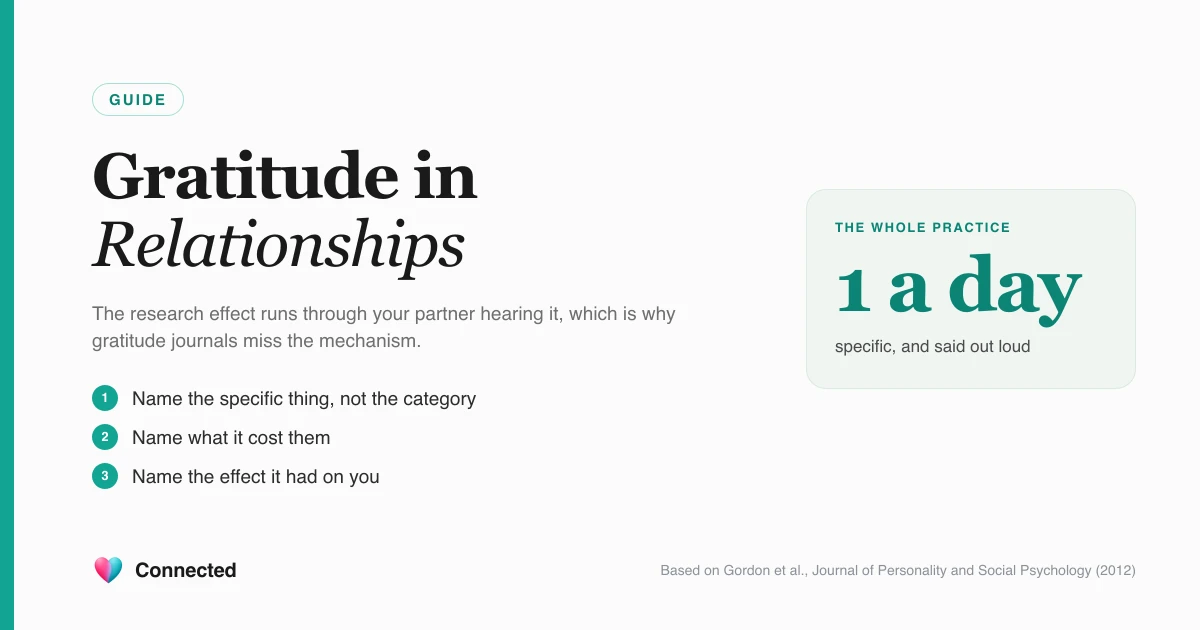
- Use the three-part shape: the specific thing, what it cost them, and the effect on you.
- Appreciation is not a substitute for fixing an unfair split. Being thanked for a burden that will not change reads as a bribe.
Almost every piece of advice about gratitude in relationships tells you to feel more of it. Keep a journal. List three things you appreciate about your partner. Notice the good.
The research says something different, and the difference changes what you should actually do.
In the studies, the thing that reliably starts the process is not one person privately feeling grateful. It is one person being told. The whole mechanism runs on expression, which is fortunate, because expression is the only part of it you can control.
What the research found
The central study here is Gordon, Impett, Kogan, Oveis and Keltner's To Have and To Hold, published in the Journal of Personality and Social Psychology in 2012. It is worth taking seriously because it did not rely on one method: the authors used cross-sectional surveys, daily experience diaries, recorded observations of couples, and a longitudinal follow-up.
The sequence they found runs like this:
People who felt more appreciated by their partner became more appreciative of that partner
Gratitude turns out to be contagious within a couple, and it travels in a specific direction. Being on the receiving end of appreciation is what makes someone appreciative in return.
People who were more appreciative behaved more responsively
They paid more attention to what their partner needed and did more about it. This is the step where a feeling turns into something the other person can actually detect.
Those couples were more committed, and more likely to still be together later
The longitudinal arm followed couples over the following months. Higher appreciation predicted staying in the relationship, not just feeling better about it at the time.
This is closely related to what the Gottman Method calls bids for connection, where the unit is smaller but the mechanism is the same. The wider theory behind this is Sara Algoe's find, remind and bind account.
Gratitude, on this view, is not politeness. It is a detection system. It fires when someone does something that reveals they were paying attention to you, and its job is to flag that person as worth keeping close. Gratitude finds people worth investing in, reminds you of the value of ones you already have, and binds you closer to them.
Why this matters practically: if gratitude is a response to detecting that someone was paying attention to you, then the content of what you say is not interchangeable. Thanking your partner in a way that shows you noticed the effort behind something works. Thanking them for the object that appeared works much less well, because it does not signal that anything was detected.
"The couples who lose this are rarely ungrateful. They are usually grateful and silent. One of them has been quietly appreciating the other for years without saying it, on the assumption that it is obvious. It is never obvious. I have sat with people who were genuinely stunned to hear that their partner had noticed, and they had been living in the same house the entire time."
What to actually say
Most appreciation between long-term partners is thin, in a specific and fixable way. Compare these four, which all describe the same event.
| What you say | What it signals | Effect |
|---|---|---|
| "Thanks" | A transaction was completed | Almost none. It is punctuation |
| "Thanks for doing the bins" | You noticed the task | Small. Better than nothing |
| "Thanks for doing the bins, I completely forgot" | You noticed the task and admitted it was yours | Real, but still about the task |
| "You do the bins without being asked, every week, and I have never once had to think about it" | You noticed the pattern, the reliability, and the mental work it saves you | This is the one the research is describing |
The difference is not warmth or length. It is whether the sentence proves you were paying attention.
The pattern in the fourth row has three parts, and it is worth learning as a shape rather than a script:
Name the specific thing, not the category
Not "you are so supportive". "You stayed up with me on Tuesday when I was spiralling about the meeting." Categories are compliments. Specifics are evidence.
Name what it cost them or what it revealed
"You were exhausted and you did it anyway." "You remembered something I mentioned once." This is the part that signals you detected the effort rather than just the outcome.
Name the effect on you
"It meant I slept." "I walked into that meeting feeling like someone was on my side." Without this, they know you noticed but not that it landed.
The hard part is remembering to say it on an ordinary Tuesday. Connected prompts you both for one appreciation at a time you choose, which is the smallest reliable version of this habit.
Four ways this goes wrong
| Trap | What it looks like | The fix |
|---|---|---|
| The gratitude journal | Writing three things you appreciate about your partner in a private notebook | Not useless, but it skips the mechanism entirely. The effect in the research runs through the partner hearing it. Say one of the three out loud |
| Thanking only for the unusual | Appreciation for the grand gesture, silence for the ten things that happen every week | The reliable invisible work is exactly where appreciation is scarcest and most valuable. Thank someone for something they have done a hundred times |
| The transactional thank you | "Thanks for cooking" said while looking at a phone, as receipt of delivery | Stop, look at them, use one specific detail. It takes four seconds longer and it is a different act |
| Keeping score | Appreciating in order to be appreciated back, and noticing when you are not | This corrodes fast, because it is detectable. The loop only works when box one is unconditional. If you need it reciprocated to keep going, say that directly instead |
"There is a version of this that backfires and it is worth naming. If one partner has been carrying far more than their share for years, appreciation without redistribution reads as a bribe. Being thanked for a burden that is not going to change is worse than silence. Gratitude is not a substitute for fixing the split. It works alongside it, not instead of it."
A practice that survives a bad week
For where this sits alongside everything else, see our ten daily habits. The failure mode of every gratitude habit is that it works for eleven days and then a hard week arrives and it never resumes. Design for the hard week.
One thing, once a day, out loud
Not three. Not written. One, spoken, to their face or in a message. The bar has to be low enough that you would still do it on your worst day, because your worst day is when it counts most.
Attach it to something that already happens
The first coffee, the walk to the car, the moment before lights out. Free-floating intentions do not survive. Anchored ones do.
Once a week, make one of them heavier
Use the three-part shape. Specific thing, what it cost them, what it did for you. Once a week is enough. Every day would make it a performance.
Do not evaluate it for a month
Checking whether it is working is how habits die. It also makes the appreciation conditional, which the other person can feel.
If you have been silent for years, do not open with a speech. A sudden burst of intense appreciation from a partner who has said nothing for a decade tends to be read as a warning sign rather than a gift. Start with something small and ordinary, and let the frequency do the work rather than the intensity.
How much of this is reaching your partner?
The short version
Gratitude between partners is not a mood, it is a signal, and it only functions when it is transmitted. Feeling appreciated makes people more appreciative, more appreciative people behave more responsively, and couples in that loop are more committed and more likely to stay together.
And if the split of work in your house is genuinely unfair, deal with the mental load first. You cannot start that loop by feeling more. You start it by saying one specific thing out loud, ideally about something so ordinary and so reliable that neither of you has ever mentioned it.
Connected prompts you both for one appreciation a day, at a time you pick. Free to download.
Sources
- Gordon, Impett, Kogan, Oveis and Keltner, To have and to hold: gratitude promotes relationship maintenance in intimate bonds, Journal of Personality and Social Psychology (2012)
- Greater Good Science Center, University of California Berkeley, on what gratitude is and how it works
- Psychology Today on gratitude and relationship stability
- The Gottman Institute on turning toward bids for connection
Frequently asked questions
Does gratitude actually improve relationships?
The evidence is reasonably strong. Gordon and colleagues, using survey, daily diary, observational and longitudinal methods, found that people who felt more appreciated became more appreciative of their partners, that more appreciative partners behaved more responsively, and that those couples were more committed and more likely to remain together at follow-up.
Do gratitude journals work for couples?
They are not useless, but they skip the part that carries the effect. The mechanism in the research runs through the partner hearing the appreciation, so a private list does very little for the relationship even if it improves your own mood. If you keep one, say at least one item out loud.
What is the find, remind and bind theory of gratitude?
It is Sara Algoe's account of what gratitude is for. Gratitude fires when someone does something that reveals they were paying attention to you, and its function is to flag that person as worth staying close to. It helps you find good relationship partners, reminds you of the value of the ones you have, and binds you more tightly to them.
How do you express appreciation so it actually lands?
Use three parts. Name the specific thing rather than the category, name what it cost them or what it revealed about their attention, and name the effect it had on you. "You do the bins every week without being asked and I have never once had to think about it" does something that "thanks" does not.
Can too much gratitude feel fake?
Yes, in two situations. If it is intense and sudden after years of silence, it reads as a warning sign rather than a gift, so start small and let frequency do the work. And if it is offered in exchange for appreciation back, it becomes detectable as a transaction, which corrodes quickly.
What if I appreciate my partner but they still feel unappreciated?
Two likely causes. Either the appreciation is happening in your head rather than out loud, which is extremely common in long relationships, or it is being aimed at unusual events while the reliable everyday work goes unnamed. There is also a third possibility worth checking: if the division of labour is genuinely unfair, appreciation will not resolve it and may make it worse.

Kayla Crane is a Licensed Marriage and Family Therapist and the co-founder of Connected. She has spent more than a decade in the room with couples, and she reviews every clinical claim on this blog for accuracy. Connected's frameworks draw on the Gottman Method, Emotionally Focused Therapy, and attachment research.