Key takeaways
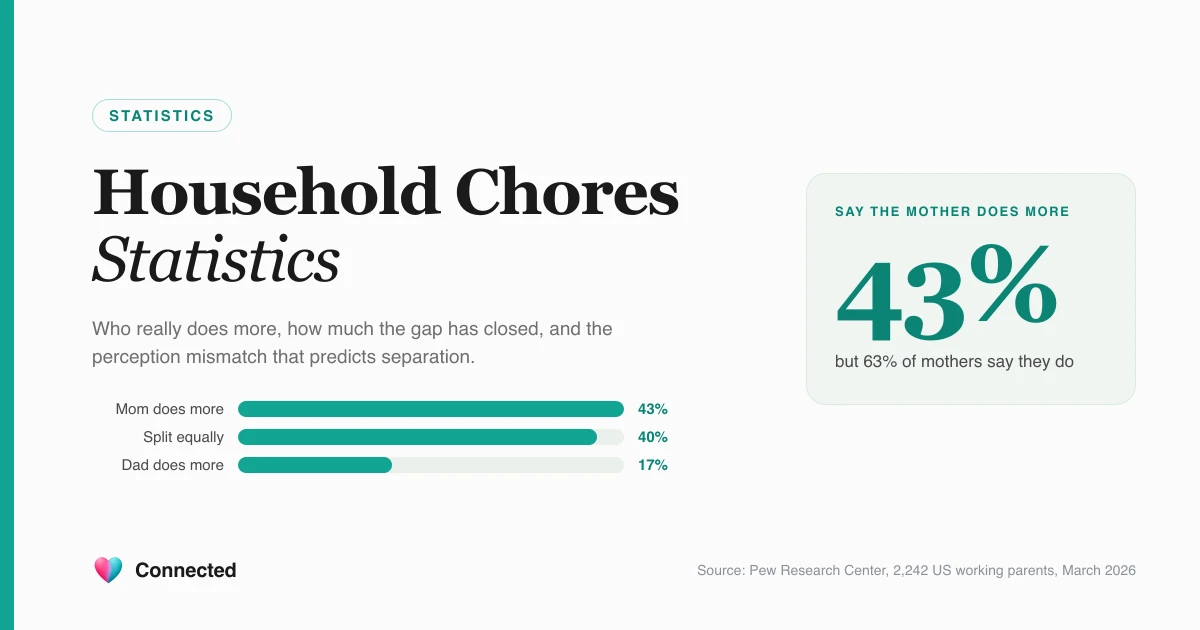
- Among US couples where both work full time, 43% say the mother does more of the chores and 52% say she does more of the day-to-day parenting (Pew, March 2026).
- The gap has narrowed about 40% in twenty years. Women did 4.2 times as many hours of core chores as men in 2003 to 2005, and 2.5 times in 2022 to 2023.
- 63% of mothers say they personally do more, while fathers are far more likely to call the same households equal. Both partners are usually being honest.
- That mismatch, not the workload itself, is what research links to separation. Where men report sharing and women report doing more, satisfaction falls and unions are more likely to dissolve.
- Equal splits close the satisfaction gap. Where the work is genuinely even, 65% of mothers and 71% of fathers are satisfied, against 26% and 49% overall.
There is a version of the household chores conversation that every couple has had, and it goes nowhere. One person says they do more. The other says it is basically even. Both are being honest. Both have evidence. Nobody moves.
The national data explains why that conversation stalls, and it points at something more useful than a chore chart. The most reliable finding in this whole literature is not about who does the dishes. It is about the size of the gap between what each partner believes is happening.
Who does more, according to the latest data
The freshest US figures come from a Pew Research Center survey of 2,242 working parents, fielded 2 to 15 March 2026. It focuses on different-sex couples where both parents work full time, which is the hardest case for the traditional explanation that whoever earns less does more at home.
| Among couples where both parents work full time | Mom does more | Split about equally | Dad does more |
|---|---|---|---|
| Household chores | 43% | 40% | 17% |
| Day-to-day parenting tasks | 52% | 39% | 10% |
| Time spent on paid work | 21% | 39% | 41% |
Source: Pew Research Center survey of 2,242 US working parents, fielded 2 to 15 March 2026. Rows may not total 100% due to rounding.
The third row is the one to hold on to. In these households both parents work full time, and paid work is still tilted towards fathers, which is a real thing and not nothing. But the tilt on paid work (41% against 21%) is considerably smaller than the tilt on parenting (52% against 10%).
The longer-run picture is genuinely encouraging, and it does not get said often enough. Analysis of two decades of US time-use data found that women spent 4.2 times as many hours as men on core household chores in 2003 to 2005, falling to 2.5 times in 2022 to 2023. That is roughly a 40% narrowing of the gap in twenty years.
Source: Milkie, Sayer, Nomaguchi and Yan, analysis of American Time Use Survey data, Socius (2025).
The finding that actually matters
Now put two numbers from the same Pew survey next to each other.
43% of working parents say the mother does more of the household chores. But when you ask mothers about their own household, 63% say they do more. Fathers, meanwhile, are considerably more likely than mothers to describe the same responsibilities as divided about equally.
Source: Pew Research Center survey of 2,242 US working parents, fielded 2 to 15 March 2026.
Here is why that matters more than the raw split. A study of Swedish couples by Leah Ruppanner and colleagues looked at what actually predicts a relationship ending, and found that the mismatch in how partners report the division, particularly when men discount women's contributions, raised the risk of divorce. Where the man said housework was shared and the woman said she did more, both partners were less satisfied, women were more likely to consider breaking up, and those unions were more likely to dissolve.
Read that alongside the Pew numbers and you get an uncomfortable but useful conclusion. The pattern that the research flags as a stability risk is not "unequal chores". It is unequal chores plus a partner who believes they are equal, which is precisely the pattern the 2026 US data describes.
"When a couple sits in my office arguing about the dishwasher, they are not arguing about the dishwasher. One of them is saying I am carrying something you cannot see, and the other is hearing you are not a good partner. Until the invisible part gets counted out loud, no schedule will hold, because you are solving a workload problem when what you have is a recognition problem."
Why both of you can be right
The perception gap is not mostly about dishonesty. There are three mechanisms behind it, and all three are well documented.
You remember your own work better than you observe theirs
This is a general feature of memory rather than anything about gender. Ask any two people who share a project what proportion each contributed and the totals will exceed one hundred per cent. You have first-hand access to every load of laundry you did and second-hand access to theirs.
The mental load leaves no trace
The mental load: noticing that the school forms are due, that you are nearly out of the specific medicine, that your mother-in-law's birthday is in nine days. This work has no visible output, so it cannot be observed by the partner not doing it, and it cannot be pointed at afterwards. It is also the part most consistently carried by one person.
Different standards look like different effort
Whoever has the lower tolerance for mess does the task first, every time. Over years this hardens into an arrangement neither person chose, and it genuinely does look to the other partner like a preference rather than a burden.
The mental load is the part that is hardest to see and hardest to raise without it sounding like an accusation. Connected gives you both a weekly check-in that surfaces it as a question rather than a complaint.
The satisfaction gap, and the number that fixes it
Unsurprisingly, mothers are much less content with the arrangement than fathers.
Source: Pew Research Center survey of 2,242 US working parents, fielded 2 to 15 March 2026.
That convergence is the most hopeful figure on this page. Mothers in equal-split households are not slightly happier, they are dramatically happier, and the gap between mothers and fathers nearly closes. Whatever else is going on, this is a solvable problem rather than an inevitable cost of having children.
"The equal-split couples are not better people and they are not less busy. What they nearly all have in common is that one of them owns an entire area rather than a list of jobs. The moment a partner is doing tasks that someone else assigns, the person assigning is still carrying the whole thing, and both of them can feel it even if neither can name it."
Who absorbs the emergencies
One more split, because it is the one that quietly shapes careers. When childcare falls through unexpectedly, 48% of working parents say the mother is more likely to take time off, against 22% for the father, with 29% saying both are equally likely.
The reasons parents gave are worth reading closely, because they sound neutral and are not:
| Reason given a major role in deciding who takes time off | Share citing it |
|---|---|
| Who has more flexibility at work | 70% |
| Who is less busy that day | 41% |
| Who works fewer hours | 19% |
| Who does a better job caring for the children | 16% |
Source: Pew Research Center survey of 2,242 US working parents, fielded 2 to 15 March 2026.
If this conversation keeps going nowhere in your house, we have a separate guide on what to do when your partner does not help around the house. "Who has more flexibility at work" is doing enormous work in that list, and it is not the neutral tiebreaker it appears to be. Flexibility is frequently the thing one parent already traded salary or advancement for, precisely because they expected to be the one absorbing this. The reason given is downstream of a decision made years earlier.
A better question than "who does more?": ask each other who would notice first if a given thing stopped being done. The person who would notice is usually the person carrying it, whether or not they are the one physically doing it. That question tends to surface the mental load without anyone having to defend a number.
What to do with this if you are the couple in the data
Both list it separately, then compare
Each of you writes down everything that has to happen in a normal week, including the noticing and remembering, and marks who does it. Do this alone, then swap. The value is entirely in the discrepancies. Expect the lists to disagree, and treat that as information rather than a scoreboard.
Hand over whole categories, not tasks
Delegating a task keeps the mental load with the person delegating, which is why "just tell me what to do" does not help and is frequently experienced as one more thing to manage. Handing over an entire domain (all of school admin, all of the car, all of meals on these days) is what actually transfers the load.
Say the recognition part out loud, separately from the logistics
Given what the divorce-risk research found, the acknowledgement is not a nice extra alongside the redistribution, it may be the more load-bearing half. "I think you have been carrying more than I realised" resolves something that a rota cannot.
Re-check it every few months
Divisions drift, especially after a job change, a new baby, or a school year starting. The couples who stay even are not the ones who found the perfect split once. They are the ones who look at it again.
Where does your household sit?
The short version
Among US couples where both parents work full time, 43% say the mother does more of the chores and 52% say she does more of the parenting. The gap has narrowed by about 40% in twenty years, which is real progress. But 63% of mothers say they personally do more, while fathers are far more likely to call it equal, and that mismatch is the specific pattern associated with lower satisfaction and higher separation risk.
Which means the most useful thing most couples can do is not build a better chore chart. It is get to a shared account of what is actually happening first.
Sources
- Pew Research Center, How working parents divide family responsibilities (2,242 US working parents, March 2026)
- Milkie, Sayer, Nomaguchi and Yan, Who's Doing the Housework and Childcare in America Now? Socius (2025), doi:10.1177/23780231251314667
- Pew Research Center, Gender gaps in sharing household responsibilities persist amid pandemic (2021)
- Ruppanner, Branden and Turunen, Does Unequal Housework Lead to Divorce? Evidence from Sweden, Sociology (2018)
- Pew Research Center, In a growing share of US marriages, husbands and wives earn about the same (2023)
Frequently asked questions
What percentage of household chores do women do?
Among US couples where both parents work full time, 43% of working parents say the mother does more of the household chores, 40% say it is split about equally and 17% say the father does more, according to a Pew Research Center survey of 2,242 working parents in March 2026. Measured in hours rather than perceptions, women did about 2.5 times as many hours of core chores as men in 2022 to 2023.
Has the housework gender gap actually improved?
Yes, substantially. Analysis of two decades of American Time Use Survey data found women spent 4.2 times as many hours as men on core household chores in 2003 to 2005, falling to 2.5 times in 2022 to 2023. That is roughly a 40% narrowing of the gap, though it has not closed.
Why do couples disagree about who does more housework?
Three reasons. People recall their own contributions in far more detail than they observe their partner's, so both totals inflate. Much of the work is mental rather than physical, such as noticing what is running low or remembering deadlines, which leaves no visible trace. And whoever has the lower tolerance for mess does the task first every time, which looks like preference from the outside.
Does unequal housework cause divorce?
Research on Swedish couples found that unequal housework is associated with lower satisfaction and higher separation risk, and that the mismatch between partners' reports matters specifically. Where the man reported sharing the work but the woman reported doing more, both partners were less satisfied, women were more likely to consider ending the relationship, and those unions were more likely to dissolve.
Who takes time off when childcare falls through?
48% of US working parents say the mother is more likely to take time off, 22% say the father and 29% say both are equally likely. The most cited reason, given by 70%, is who has more flexibility at work, though that flexibility is often itself the result of an earlier career trade-off by the same parent.
What is the mental load in a relationship?
The mental load is the cognitive and planning work of running a household: noticing what needs doing, remembering deadlines, anticipating needs and holding the schedule. It is not captured by chore lists because it has no visible output, which is a large part of why partners disagree about the split. Handing over whole categories rather than individual tasks is the practical way to transfer it.

Kayla Crane is a Licensed Marriage and Family Therapist and the co-founder of Connected. She has spent more than a decade in the room with couples, and she reviews every clinical claim on this blog for accuracy. Connected's frameworks draw on the Gottman Method, Emotionally Focused Therapy, and attachment research.