Quick answer
Marriage counseling questions should reveal the repeating pattern, not crown a winner. Prepare one example of the cycle, two or three shared priorities, one strength, and questions about the therapist’s couples training, safety screening, policies, and way of measuring progress.
Most lists of marriage counseling questions are really long arguments written as question marks. “Do you even care about this family?” is not a question a therapist can build with. It is a verdict inviting a defense.
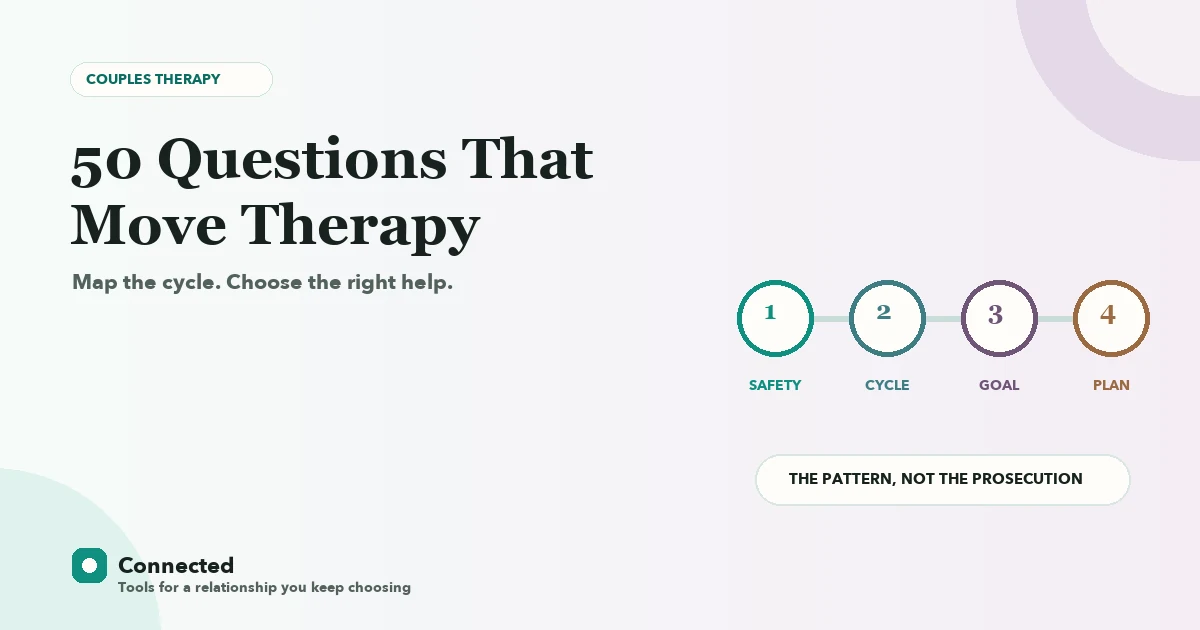
A strong first session does something different. It maps the cycle that keeps recruiting both people, clarifies safety, identifies strengths, and turns “fix our marriage” into observable aims. The 50 questions below are divided by who is asking and what the answer is for.
Build a balanced first-session brief
Each partner chooses up to three priorities separately, then compare. This is not a diagnosis.
Your selections stay in this browser and are not saved or sent.
A therapist listens for the system around the problem
The order varies, but these are common jobs of an early assessment.
A first session is an assessment and relationship-building process, not a courtroom verdict or instant treatment.
Those averages are encouraging, not predictive for one couple. The meta-analysis also notes that its studies involved exclusively different-sex couples, an important limit when applying the estimate more broadly.
I am not listening for the partner who tells the most convincing story. I am listening for the sequence. Who reaches, who protects, what each person thinks the other move means, and how both end up proving the fear they started with. Once the cycle is visible, the couple has something they can change together.Kayla Crane, LMFT, licensed marriage and family therapist and co-founder of Connected
50 marriage counseling questions, organized by job
Questions a couples therapist may ask 1–20
- What made now the right time to come in?
- When did each of you first notice this pattern?
- What happens just before the conversation goes wrong?
- What does each of you do next?
- How does the cycle end, and how long does it last?
- What have you already tried?
- When is the problem less powerful?
- What do you still admire in your partner?
- What would feel meaningfully different after six sessions?
- Which topics feel safe to discuss at home?
- Which topics reliably lead to shutdown or escalation?
- How did your families handle closeness, anger, and repair?
- What outside stress is entering the relationship?
- How are sleep, health, substances, or mental health affecting the pattern?
- What does each of you fear will happen if nothing changes?
- How do you know when your partner is trying to repair?
- What helps each of you regulate during conflict?
- Are there secrets, safety concerns, or coercion the therapist needs to assess?
- What would make therapy feel fair to both of you?
- What strengths can we use while working on the problem?
Questions to discuss before the first session 21–35
- What do I most want the therapist to understand about us?
- What do I hope changes, stated as a behavior rather than a personality?
- What am I willing to practice between sessions?
- What do I not want therapy to become?
- Where can I take responsibility without accepting all the blame?
- What do I think you are protecting when you withdraw or pursue?
- Which issue feels urgent, and which is merely loud?
- What is one recent moment when we handled something well?
- What would help me stay open in the first session?
- What topic needs a therapist present before we discuss it?
- How will we handle the car ride home after a difficult session?
- What does progress look like in daily life?
- What do we agree is worth protecting?
- What am I afraid the therapist might say?
- What would make us both willing to return for session two?
Questions to ask a prospective counselor 36–45
- What percentage of your practice is couples work?
- Which couples-therapy approaches are you trained to use?
- How do you assess for coercion, violence, or unsafe joint sessions?
- How do you handle individual secrets disclosed during couples work?
- Will you meet with us individually, together, or both?
- How do you define goals and measure progress?
- What happens if one partner wants to leave the relationship?
- How do you keep sessions from becoming debates about who is right?
- What are your fees, cancellation policy, and insurance arrangements?
- How will we know whether the fit is working after the first few sessions?
Questions for reviewing progress 46–50
- Are we interrupting the cycle earlier than we did last month?
- Can each of us name our own part without collapsing into blame?
- Do difficult conversations recover faster?
- Are changes appearing at home, not only in the therapy room?
- What should we adjust in the treatment plan now?
Arrive with patterns, not perfect recall
Connected’s therapist reports can summarize shared check-in patterns and topics you choose to bring into care.
How to choose a counselor, not just a convenient appointment
Many mental-health licenses permit clinicians to see couples, but amount of couples-specific training varies. An LMFT is trained in relational and family systems; other psychologists, counselors, and social workers may also have extensive couples expertise. Ask about actual training and caseload, not only the letters after a name.
| Listen for | Why it matters | Possible concern |
|---|---|---|
| A clear couples model | Models give the therapist a theory of change beyond refereeing | “I just help you communicate” with no process |
| A safety-screening process | Joint work requires freedom to speak without retaliation | Treating violence or coercion as mutual conflict |
| A written secrets policy | Partners should know how individual disclosures are handled | Ambiguity discovered after a major disclosure |
| Observable goals | You can review whether home life is changing | Sessions continue without a shared direction |
| Comfort with your identities and relationship structure | Competence includes the lives actually in the room | You are asked to educate the therapist while seeking help |
There is no correct session count for every couple. Complexity, safety, betrayal, trauma, substance use, progress, and treatment goals can make the course much shorter or longer. Ask how the therapist measures change and decides when to taper or conclude.
When joint counseling is not the safe next step
Abuse is not a communication problem shared equally
The National Domestic Violence Hotline does not recommend couples counseling with an abusive partner. Disclosure in session can lead to retaliation, and an abusive partner may manipulate the process or use what is said later. Seek confidential individual support from a domestic-violence professional. In the United States, call 800-799-SAFE or text START to 88788. If you are in immediate danger, call emergency services.
Safety screening can include physical violence, threats, stalking, sexual coercion, financial control, monitoring, fear about what can be said, and consequences after sessions. A competent therapist may recommend separate services, a specialized intervention, or a different sequence of care.
For non-abusive couples, a difficult first session is not automatically a bad sign. You may feel exposed or tired. A more useful question is whether both people felt accurately represented, whether the therapist maintained structure, and whether the next step makes sense. Plan a low-demand hour after the appointment rather than a parking-lot debrief of who “looked worse.”
Research and sources
We favored peer-reviewed research, professional associations, and primary clinical guidance. Source notes describe what each reference does and does not establish.
- Roddy et al., Meta-analysis of Couple Therapy (2020). A synthesis of 58 studies and 2,092 couples finding large average pre-to-post gains in relationship satisfaction, with maintained gains and sample limitations.
- American Psychological Association, Relationship Advice From a Couple Psychologist. Expert guidance on choosing a clinician with supervised couples training and a substantial couples caseload; credentials alone do not establish fit.
- Lebow et al., Couple Therapy in the 2020s: Current Status and Emerging Developments (2023). A broad review of current couple-therapy evidence, common processes, access, diversity gaps, and emerging delivery models.
- The National Domestic Violence Hotline, Should I Go to Couples Therapy With My Abusive Partner?. Safety guidance on the risks of joint therapy when abuse or coercive control is present.
Frequently asked questions
What questions are asked in marriage counseling?
Therapists commonly ask why you came now, how the conflict cycle begins and ends, what each partner does to protect themselves, what you have tried, what strengths remain, and what observable changes would make therapy useful.
How do we prepare for our first couples therapy session?
Each partner should choose two or three priorities, one strength, one example of the cycle, and one hope for change. Avoid creating a complete evidence file against your partner.
What should I ask a marriage counselor before booking?
Ask how much of their practice is couples work, which models they are trained in, how they screen for safety, how they handle individual disclosures, and how goals and progress are reviewed.
How long does marriage counseling take?
There is no universal session count. Treatment length varies with the concern, severity, goals, safety, model, frequency, progress, and whether other mental health or substance issues are present. Ask how the therapist reviews progress and decides when to taper or conclude.
Does couples therapy work?
A 2020 meta-analysis of 58 studies found large average improvements in relationship satisfaction for treated couples and significant improvements in communication and intimacy. Results vary, and the evidence base has diversity limitations.
When is couples counseling not recommended?
Joint counseling is not recommended when one partner is abusive or coercively controlling because disclosure can increase risk and the session can be manipulated. Seek confidential individual support from a domestic-violence professional.
Kayla is a licensed marriage and family therapist and co-founder of Connected. This educational guide is not a diagnosis or a substitute for therapy.