 Connected
To handle renovation stress as a couple, agree who gathers information, which decisions need both of you, and how changes will be approved. Protect some time and space from project talk, and name the extra household work the disruption creates. A clearer process will not make every delay disappear, but it gives you fewer decisions to fight about twice.
You chose a kitchen together. Now one person is answering messages at work, the other is comparing finishes at midnight, and a question about handles sounds like a criticism of everything already done. The project has acquired a second workload: keeping each other informed.
Here, we are focusing on decisions and the work of keeping each other informed. Take construction safety, contracts, financing, and technical questions to appropriately qualified professionals.
Evidence, with the context kept in
A change rule matters before a renovation exceeds the plan.

What this does and doesn't tell us: These findings come from Houzz survey respondents, not a probability sample of every U.S. renovation. They do not show that a decision log prevents overruns.
Put it to use: Agree who can approve a change and what information both people need before shared spending or the project scope increases.
Get the chart, data and citation
The numbers come from the source linked above; Connected created the chart. These are published statistics, not an original Connected study.
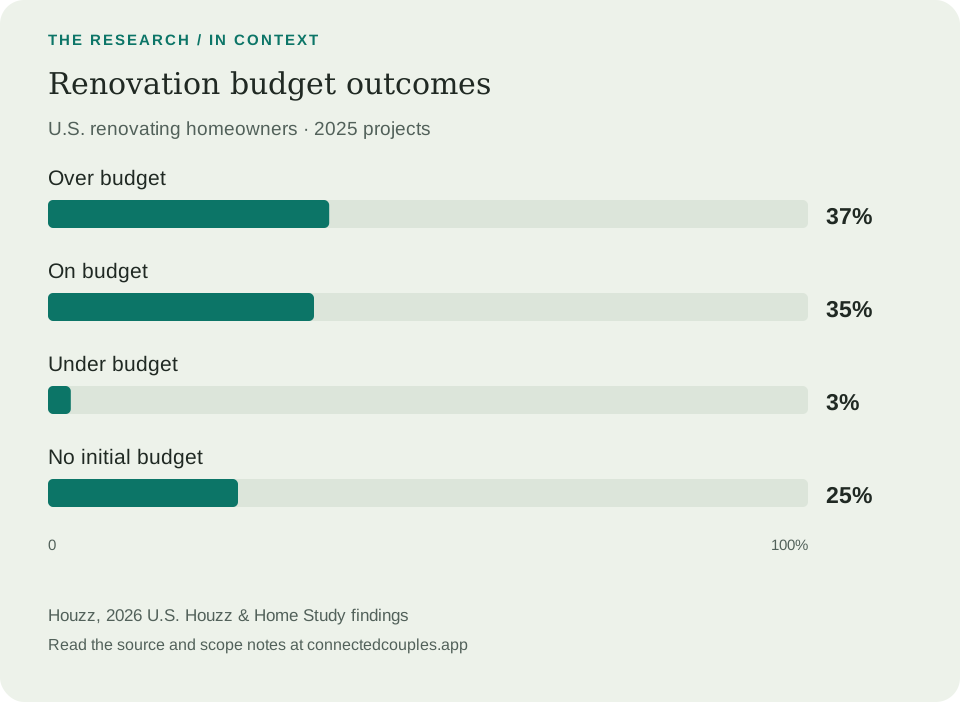
Houzz, 2026 U.S. Houzz & Home Study findings. U.S. renovating homeowners · 2025 projects. Chart by Connected Editorial Team, October 2, 2026. Please retain the source, date and scope when sharing.
Find the disagreement underneath the design choice
Before comparing another sample, finish this sentence separately: “The part of this renovation that is hardest for me is…”
The answers might be noise, lost privacy, unpredictable visitors, constant questions, or fear of making an irreversible choice. Someone who keeps researching may be trying to regain certainty. Someone who wants an answer today may be exhausted by managing the decision. Ask rather than assuming either explanation fits.
In a 2025 survey of registered Houzz users, choosing products, materials, and finishes was among the reported sources of tension. That is a useful glimpse of other renovators' experiences, though this group cannot represent every couple. Read the Houzz remodeling and relationships report.
Try a concrete opening: “I am struggling with being available for questions throughout the day. Can we change how decisions reach us?” That gives you something to fix. “You never care about the house” asks your partner to defend their character.
Give each decision an owner and an approval rule
A decision owner gathers the agreed information and brings the question back. Ownership does not automatically mean permission to make every final choice.
Use three categories:
- One person can decide: A clearly delegated choice within limits you already agreed
- Both people must agree: Choices affecting how you both use the home, or changes to shared commitments
- A professional must advise: Questions involving safety, feasibility, compliance, or specialist knowledge
A question can occupy the last two categories at once. Both of you may need to agree after getting professional advice. Avoid turning the more confident partner into the default technical authority.
Write down what “I do not mind” means. Does it mean “choose either of these two finishes” or “you can choose anything”? If someone wants no involvement in the selection, they still need a clear opportunity to name practical requirements before delegating it.
“When you argue about a finish for the third time, ask what was never agreed about the decision. Who was choosing, who was checking, and when was it meant to be final?”
Kayla Crane, LMFT
Keep a decision log you can both understand
Start with the next three decisions. There is no need to reconstruct the whole project before you can make tomorrow easier.

Read the graphic as text
Keep renovation decisions visible
One decision, one owner, one written record
DECISION: What exactly needs deciding?. Example: cabinet handles
LEAD: Who owns the research and coordination?. Example: Rae
NEEDS BOTH: Which part needs both partners’ agreement?. Example: both approve the visible finish
REVISIT WHEN: What change would reopen the decision?. Example: the agreed options become unavailable
Keep technical, safety, and contract questions with the appropriate professional.
| Decision | Lead | Needs both | Revisit when |
|---|---|---|---|
| Cabinet handles | Rae | Both approve the visible finish | The chosen option is unavailable |
| Where everyday belongings will go | Jordan | Both confirm access to what they need | A room becomes unavailable |
| Appointment availability | Rae | Check the other person's time before committing it | The appointment changes |
Add the actual choice and date beneath each row when you decide. A link or photo can prevent two similarly named products from getting confused.
The “revisit when” field matters. Without it, a finished choice can reopen every time someone sees a new picture. Agree which new facts justify reconsideration, such as unavailability, a professional's advice, or a newly recognized access need. A different preference can still be discussed; it should not quietly become a new instruction to the contractor.
If you cannot agree, record the unresolved question and the next information needed. “We need to know whether both options meet our requirements” is more useful than “Jordan is being difficult.”
Have one communication route without making one person do everything
Agree who sends the consolidated response to the project professional. Both partners should be able to see the relevant information. Avoid separate, conflicting instructions or asking a professional to settle a relationship disagreement.
The point person needs support and limits. Decide who tracks messages, who researches an answer, and who handles the ordinary tasks displaced by that work. “Rae talks to the contractor” should not secretly mean Rae schedules, researches, remembers, follows up, and absorbs every interruption.
Connected's guide to the mental load in relationships can help you name the planning work as well as the visible tasks. For this project, count chasing an answer and keeping the decision log up to date as work.
When a question arrives unexpectedly, ask what the real response deadline is. If joint approval is needed, say so clearly. Do not turn a message marked urgent into assumed permission to commit your partner.
Protect ordinary life while the home changes
List what the project is disrupting: meals, getting dressed, rest, remote work, visitors, or access to belongings. For each disruption, choose a temporary arrangement and its owner. Revise it when the project changes.
Where feasible and safe, keep a usable place for ordinary downtime. If no such space exists at home, think about an accessible alternative you both actually like. A walk or time at a familiar public place can be enough; another elaborate plan may create more work.
Choose some project-free moments. You might agree to save nonurgent design links for your next review rather than sending them during dinner. Treat the timing as adjustable. There is no research-backed number of renovation conversations a couple should have.
The American Psychological Association includes sleep, restorative activities, and supportive relationships in its guidance on managing stress. They are worth protecting while the house is disrupted, even if your temporary routine looks different from normal. Read APA's stress guidance.
The handles were chosen until they were not
Consider this fictional example. Rae and Jordan agree on cabinet handles. Two days later, Jordan sends six alternatives. Rae responds, “Then why did I waste Saturday researching?” Jordan replies, “Apparently I am not allowed an opinion.”
They pause the selection conversation and identify the process failure. Jordan thought the choice was provisional. Rae thought it was complete and had been preparing the final response.
They put the choice in the log as “awaiting both approvals,” review the two options that meet their requirements, and mark the decision complete together. They also agree that new inspiration alone will go into a later-project folder. If either person has a practical concern, they will name it directly.
Rae remains the contact for this decision. Jordan takes responsibility for collecting the remaining information and for the temporary meal arrangements that week. The improvement is specific: fewer surprise reversals and a more visible division of effort.
When the plan still feels unfair
One person says yes and resents the choice later. Ask whether there was enough information and a real chance to disagree. Check whether “yes” meant approval or simply exhaustion. Make room to revisit a concern without making every decision permanently provisional.
One person keeps changing instructions alone. Stop adding new instructions until you have clarified the approval rule. Discuss the effect of the change on the other person, rather than arguing only about the finish.
The project dominates every conversation. Keep two separate lists: decisions needing action and feelings needing attention. “I need you to listen to how hard this week was” deserves a different conversation from “Which appointment works?”
You are both too upset to talk constructively. Pause and agree when to return. The guide to difficult conversations with your partner offers more help with preparing the conversation. A pause should not become an indefinite refusal to address the problem.
If disagreement includes threats, intimidation, or fear of saying no, do not rely on a joint worksheet to make it safe. Seek confidential support independently.
Try it on a difficult day
When the contractor needs an answer while your partner is unavailable
Fictional example
An item is out of stock. The substitute costs more, and the contractor asks for an immediate answer. One partner has the message; the other is in a meeting.
- Check the authority already agreed. A request for speed does not automatically increase one person's spending authority.
- Ask what waiting would actually affect: labor, delivery, safety or only convenience. Get the cost and schedule implications in writing where possible.
- Use a preapproved alternative if one exists. Otherwise arrange the earliest joint decision and communicate the hold clearly, acknowledging any real delay cost.
The useful review: Afterward, add a substitute rule for similar items. Keep a record of changed cost, scope and who approved it, not just a screenshot of the latest product.
Make it yours
Create a renovation decision entry
Keep the current decision in one place both people can access. Confirm contractual or technical requirements with the relevant professional.
Your entries stay in this tab and are not sent by this worksheet. Download your draft before closing or reloading; it is not saved automatically.
Your draft to discuss together
Check that both people agree before treating this as a commitment. Blank items remain open questions.
Common questions
Should one partner make all the renovation decisions?
That can work for genuinely delegated choices when both people understand the limits. It becomes a problem if the arrangement gives one person all the labor, removes the other's voice, or permits changes to shared commitments without agreement.
What if we have completely different tastes?
Begin with what the space needs to do for both of you. Then identify a small set of acceptable options. You do not need identical favorites, but neither person should have to pretend a meaningful requirement does not matter.
How do we reconnect before the renovation is finished?
Choose contact that does not depend on a finished home: a conversation about something else, a familiar outing, or quiet company. For a prompt to talk about yourselves beyond the project, try Connected, which offers daily questions and weekly check-ins. Keep renovation approvals in the separate log.
Sources & editorial notes
Published by the Connected Editorial Team, with a quote from Kayla Crane, LMFT. Examples are fictional. The worksheets and graphics are original editorial planning aids, not validated assessments or a substitute for professional care.
- Houzz, 2026 U.S. Houzz & Home Study findings
U.S. renovating homeowners · 2025 projects. These findings come from Houzz survey respondents, not a probability sample of every U.S. renovation. They do not show that a decision log prevents overruns.
- 2025 U.S. Houzz Remodeling and Relationships Report
Products/materials/finishes were reported conflict points among surveyed registered Houzz users; nonrepresentative n541 survey fielded January2025. No prevalence generalized.
- APA Healthy ways to handle life stressors
General stress-management guidance including sleep, restorative activities, support; no renovation protocol efficacy claim.