 Connected
The quick answer
Support a grieving partner by acknowledging the person who died, listening without requiring them to talk, and offering specific practical help they can accept or decline. Follow their preferences about touch, company and remembrance. Continue checking in after the immediate rush of support, and make room for your own needs and outside help too.
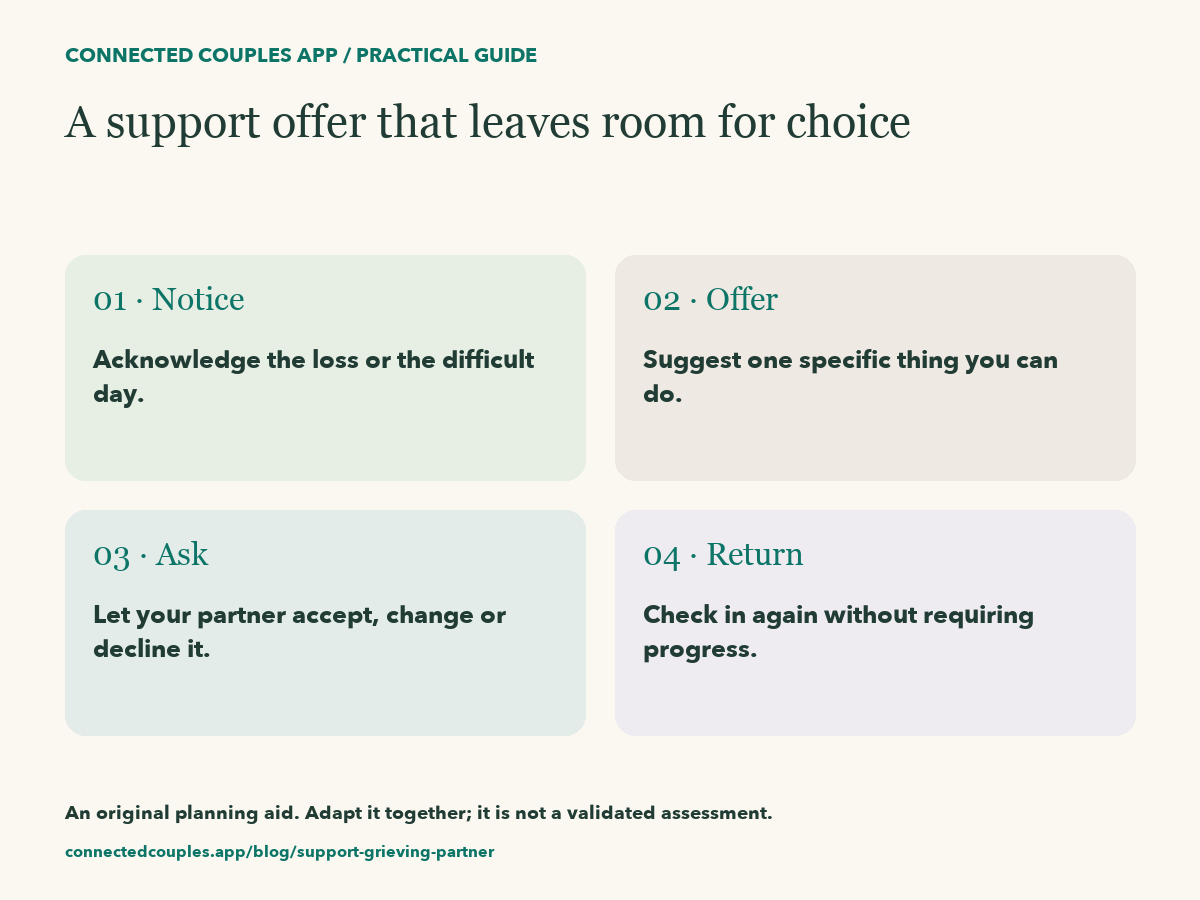
A support offer that leaves room for choice
- Notice
Acknowledge the loss or the difficult day.
- Offer
Suggest one specific thing you can do.
- Ask
Let your partner accept, change or decline it.
- Return
Check in again without requiring progress.
Try it together · Free tool
Make one gentle support offer
Choose what your partner has indicated they might want. If you do not know, choose ‘I am unsure’ and ask. This tool does not assess grief or replace professional support.
Your answers stay in this page. They are not saved by us or sent to your partner. Refreshing clears the draft; download it if you want to keep it. Basic tool-use analytics contain no answers.
Your conversation draft
Start with a sentence that does not explain the loss
You want to say something comforting. Everything you try sounds too small. It is okay for the sentence to be small: “I am so sorry. I am here.”
Avoid giving the death a meaning your partner has not chosen. “They lived a long life,” “You need to be strong,” or “At least they are not suffering” may move past the pain your partner is trying to express. Even when you share beliefs, ask rather than assuming which words will comfort them today.
The NIH Clinical Center’s bereavement guidance recommends acknowledging the loss, listening and being consistent. You do not need to solve the feeling. You can make it less lonely to have it.
Offer help that does not create another job
“Let me know if you need anything” is kind, but it asks a grieving person to identify a task, decide whether it is reasonable to ask, and delegate it. Offer something specific that you can actually do.
| Situation | An offer they can answer |
|---|---|
| Meals are becoming difficult | “I can make soup tonight or pick up something familiar. Would either help?” |
| Messages feel overwhelming | “Would you like me to help draft one update? You can approve it before anything is sent.” |
| The house is busy with visitors | “Would you like me to tell people we are having a quiet afternoon?” |
| A practical task has piled up | “I have time to do the laundry today. Is there anything you do not want moved?” |
| They want to talk | “I can stay and listen. You do not need to tell the story differently because I have heard it.” |
Wait for consent around personal possessions, messages, visitors and arrangements. Do not clear away clothing, photos or belongings because you think it will help someone move on. Offer help with decisions without making them yourself.
Follow preferences that may change
Your partner may want to talk one day and watch an ordinary show the next. They may welcome a hug or find touch too much. Asking “Would company help, or would you prefer some quiet?” gives them a way to choose without having to reject you personally.
Talk Grief’s guidance for partners emphasizes following the person’s pace. Use that as permission to adapt. A helpful offer last week is not a standing instruction for this week.
If the relationship with the person who died was painful or complicated, leave room for mixed feelings. Do not demand a positive memory or forgiveness. “You do not have to make this simpler for me” may be more supportive than asking them to focus on the good.
Keep showing up after the funeral
The public part of the loss ends sooner than the private part. Visitors leave. Work resumes. A routine errand can still bring a sudden reminder.
Ask whether your partner would welcome a check-in around birthdays, holidays or the anniversary of the death. They might want a familiar meal, a story, a visit, a quiet day or no special activity. Put a reminder in your own calendar if they welcome that attention; do not make them manage your remembering.
Using the person’s name can be welcome, but follow your partner’s response. “I remembered the way your mum always…” opens a door. It does not require them to walk through it.
When your offer misses
Illustrative example: Avery books a restaurant to cheer Jamie up after a difficult week. Jamie says they cannot face a public evening. Avery feels rejected and nearly says, “I am trying to help.”
Instead, Avery says, “I guessed what might help and got it wrong. Would staying home together feel better, or would you rather have space?” They cancel the plan if possible and ask before arranging another one.
The repair is not persuading Jamie to appreciate the intention. It is giving Jamie back a choice and learning what support looks like today.
Make room for the supporting partner too
You may miss closeness, feel helpless or be grieving the same person. Those feelings deserve care. Try a specific, gentle conversation about capacity: “I want to keep helping with the arrangements, and I need someone else to take one task tomorrow.”
Look for support beyond the two of you, with appropriate respect for privacy. Friends, family, a bereavement service or a mental-health professional may each offer something different. Neither partner should have to carry every emotional and practical need alone.
Grief can explain a difficult period without making threats or mistreatment acceptable. You can remain compassionate and maintain limits on how you are treated.
When to seek more support
Professional support can help when distress feels unmanageable, daily functioning is seriously affected, or your partner wants a place to talk beyond family. You do not need to wait for a particular anniversary.
If you are worried about suicide or immediate safety, seek urgent help. In the U.S., call or text 988 for crisis support, including when you are concerned about someone else; contact emergency services for immediate danger. Elsewhere, use local crisis or emergency services.
Common questions
What should I say to a partner whose parent died?
Acknowledge the loss simply: ‘I am so sorry about your dad. I am here with you.’ Use the person’s name if that feels welcome, and let your partner decide whether to talk. Avoid telling them how they should feel about a complicated relationship.
Why is my grieving partner distant?
You cannot know from distance alone. They may need quiet, have little energy or find talking difficult. Ask gently what company or space would help, without requiring reassurance on demand.
How long should I keep checking in?
Do not stop solely because the funeral has passed or a certain number of months has elapsed. Keep offering contact in ways your partner welcomes, including around significant dates. There is no required progress schedule.
What if we are both grieving?
Name what each person can offer and where you need others. You may want different kinds of support on the same day. Neither person has to become the sole source of care for the other.
Sources & editorial notes
Written by the Connected Editorial Team. The examples are illustrative, and the scripts, visual guide and planning tool are original editorial resources. They are not validated assessments, individualized advice or a substitute for professional care. Source notes explain the scope of the supporting material.
- NIH Clinical Center: Kind ways to support someone who is grieving
Bereavement guidance on listening, consistency, remembrance and practical support.
- Talk Grief / Child Bereavement UK: Supporting your grieving partner
Bereavement-support guidance that follows the grieving person’s pace and preferences.
- 988 Lifeline: Help someone else
U.S. crisis-support information for people worried about someone else.
Published September 7, 2026. Send a correction or tell us what would make this guide more useful.