 Connected
To reduce wedding-planning stress as a couple, agree on your priorities, give each task a clear owner, and decide which choices need both people's approval. Set limits on relatives' involvement before making promises, and keep some time together free of wedding administration. When an argument starts, identify the actual decision underneath it rather than trying to resolve the entire wedding at once.
You can be excited to get married and tired of planning the event. A difficult planning week is worth addressing, but it isn't enough information to predict your marriage. Look at how you treat each other and what needs to change in the process.
Evidence, with the context kept in
Wedding administration takes real time.

What this does and doesn't tell us: The Knot and WeddingWire recruited their members by email. This platform sample is not all couples, and six hours is not a recommended workload or a minimum to meet.
Put it to use: Divide the full job, including research, messages and follow-up. Sharing the final choice does not automatically share the planning labor.
Get the chart, data and citation
The numbers come from the source linked above; Connected created the chart. These are published statistics, not an original Connected study.
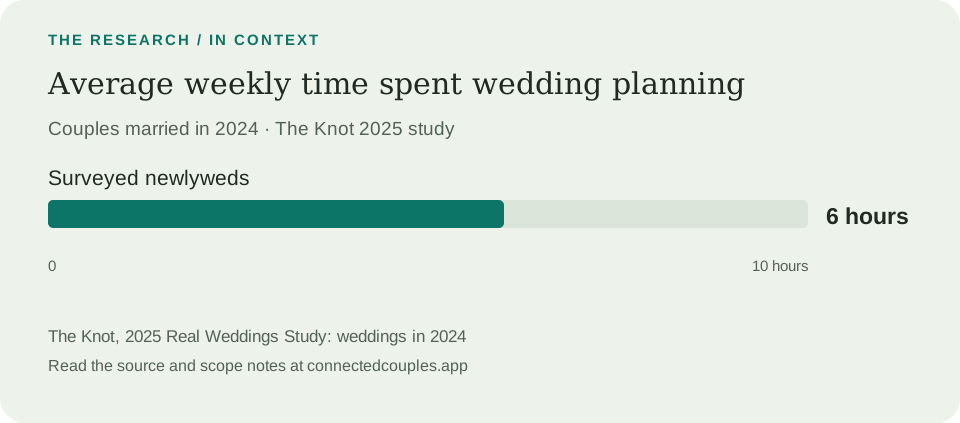
The Knot, 2025 Real Weddings Study: weddings in 2024. Couples married in 2024 · The Knot 2025 study. Chart by Connected Editorial Team, October 2, 2026. Please retain the source, date and scope when sharing.
What are you really arguing about?
A disagreement about invitations can contain several different problems: the price, the guest list, a family expectation, or the feeling that one person is doing all the work. Ask, “Which part of this is bothering you most?” before sending another design option.
Try naming the issue in one sentence:
- “We have not agreed how many guests we can host.”
- “I have researched every option and need you to own a whole task.”
- “I said yes to a relative before checking with you.”
- “We keep reopening choices that already fit our priorities.”
Each sentence suggests a different next step. More options will not solve an unclear spending limit. A better spreadsheet will not solve a promise made without agreement.
The American Psychological Association's stress guidance recommends checking whether a stressful situation can be changed by reducing responsibilities, adjusting expectations or asking for help. Applied to a wedding, that might mean removing an optional event or simplifying a detail rather than trying to plan the same workload more efficiently. APA guidance on managing stress
Choose what matters before choosing another supplier
Each person can privately write a short list of what matters most, then compare. Use concrete descriptions: “Guests can hear the ceremony,” “We have time to speak with the people attending,” or “We don't commit to costs beyond the amount we have agreed.”
Distinguish a need from a preference. Accessibility, meaningful religious requirements and a firm financial limit may have different weight from a favorite flower or a particular shade of linen. Ask why a preference matters before dismissing it as superficial; it may represent a family connection or something the person has looked forward to for years.
Then name what you're willing to simplify or omit. Optional favors, extra gatherings, elaborate decorations or multiple outfit changes might stay or go depending on your priorities. No particular wedding style is the correct one.
Keep those decisions somewhere both of you can see. When a new idea arrives, ask whether it supports the priorities and fits the available time and resources.
“When every choice starts an argument, stop asking each other to react to more options. First decide who owns the decision, which limits matter, and when it is settled enough to leave alone.”
Kayla Crane, LMFT
Which decisions need both of you?
Not every choice needs a joint meeting. Not every delegated task gives someone authority to exceed a limit. Write down who gets to decide before the next round of emails.

Read the graphic as text
Wedding pressure triage
Decide what deserves your attention
LANE 1: Decide together. Use for choices affecting both partners’ priorities or limits.
LANE 2: One owner, within agreed limits. Delegate a clear choice, with a budget and deadline.
LANE 3: Advice welcome; no decision authority. Hear other people’s ideas without handing over the decision.
Before saying yes: is this our priority, our constraint, or someone else’s wish?
| Decision lane | What belongs here | What agreement looks like |
|---|---|---|
| Decide together | Overall spending limit, event size, major commitments, meaningful ceremony choices | Both people understand and agree before a commitment |
| One owner within agreed limits | A defined supplier search, transport arrangement or design choice | One person owns the work within named requirements and a spending ceiling |
| Advice welcome with no decision authority | Suggestions from relatives or friends who are not assigned the decision | Input is considered without becoming a promise |
The examples are starting points. You may want different choices in each lane. A parent funding a particular element may expect involvement; clarify what that involvement means before accepting the offer rather than assuming everyone understands it the same way.
For each open decision, record the owner, actual deadline, required information and what would justify reopening it. A changed venue constraint is a reason to revisit. A new image on social media doesn't have to be.
Hand over the job including the follow up
“Tell me what to do” still leaves the other partner managing the plan. Whole-task ownership includes finding options, checking requirements, communicating, tracking the deadline and reporting the result.
For example: “Please handle transport from research through confirmation. Our requirements are accessibility for these guests, these times and this spending limit. Come back to me if an option falls outside them.” Confirm the details with the relevant people and supplier rather than assuming accessibility needs have been met.
The other partner must also leave room for a different acceptable choice. If you delegate and then redo every decision because it differs from your taste, the ownership isn't very real. Agree on the requirements first and distinguish “doesn't meet them” from “not the one I would have chosen.”
For help discussing responsibility beyond wedding tasks, Connected's guide to the mental load in relationships explains how planning and remembering can become uneven.
When a relative starts expanding the guest list
Consider this fictional situation. Quinn and Taylor agree on a small welcome dinner. A relative offers to contribute money, then begins inviting additional people. Taylor feels grateful and finds it hard to say no. Quinn feels that their agreement has disappeared.
They pause further invitations and separate three questions: What size dinner do they want? What can the venue actually accommodate? What expectations came with the contribution?
They confirm the venue's limits, then decide together on a guest cap and a plan they could manage without extra funding. Taylor contacts the relative: “We appreciate the offer. We can host this number of people and need to approve invitations ourselves. Does your contribution still work with that arrangement?”
They recognize that the relative can decline. They don't promise additional places while waiting for an answer. Taylor owns the conversation and shares the outcome; Quinn owns updating the final headcount once it is settled.
Quinn and Taylor now have a decision to communicate and someone responsible for the conversation. They can stop debating whose family is being difficult and deal with the actual invitation list.
Let dinner be dinner again
Choose a planning window that suits your workload and deadlines. You might start with a short meeting, a small agenda and a stopping point. A simple agenda could be: one decision to make, one update each and anything with a real deadline.
Outside that window, put non-urgent ideas on a shared list instead of interrupting dinner with each new possibility. Agree on what counts as urgent, such as a supplier deadline that genuinely can't wait.
You still deserve time together when nobody asks for an opinion on a menu. Writing for the Gottman Institute, therapist Liz Higgins recommends quality time without wedding talk during the engagement period. Set the guest list aside for a while and ask how the rest of your day went. Gottman Institute guidance on wedding-planning conflict
A walk, familiar meal or quiet evening can count. You don't need another elaborate date to organize. If you want a small prompt for conversation about your lives beyond the guest list, try Connected and choose a daily question or weekly check-in together.
If you're already in an argument
The conversation gets personal. Stop adding decisions. Acknowledge the specific behavior: “I snapped at you about the deadline. I am sorry. I want to discuss the task without speaking to you that way.” Stress can explain the context without excusing insults.
One person says they don't care about the details. Ask them to own suitable tasks anyway. Indifference to color choices doesn't remove responsibility for a shared event.
Relatives keep reopening a decision. Repeat the decision and name what input is still useful: “The venue is booked. We would welcome help with these transport options.” For the broader relationship, see Connected's boundaries with in-laws guide.
There is more work than you can manage. Reduce scope, seek help where available, or revisit timing and commitments. Before changing bookings, check applicable contract terms and get qualified advice if needed.
You feel afraid to disagree. Threats, intimidation, coercion and control over access to money or support need attention beyond a planning worksheet. Seek private support. Money already spent isn't a reason to ignore concerns about safety or freely choosing marriage.
Try it on a difficult day
When a contribution arrives with a new guest list
Fictional example
A relative offers money, then assumes it gives them control over invitations. The couple appreciates the help but did not agree to expand the wedding.
- Clarify the conditions before accepting or spending the contribution. Ask whether it is a gift or conditional support.
- Compare the conditions with the wedding both partners chose. Include capacity, total cost and whose invitations would be displaced.
- If the conditions do not fit, discuss a smaller plan or declining the contribution. Agree on the message together before one partner becomes the messenger for a decision they did not share.
The useful review: Reopen a decision when the agreed facts or limits change. Reopen it deliberately, with the new information named, instead of restarting every choice whenever another suggestion arrives.
Make it yours
Assign one wedding decision completely
Choose a decision that is currently consuming too much conversation. Name the approval limit before anyone books or pays.
Your entries stay in this tab and are not sent by this worksheet. Download your draft before closing or reloading; it is not saved automatically.
Your draft to discuss together
Check that both people agree before treating this as a commitment. Blank items remain open questions.
Common questions
Is fighting during wedding planning a bad sign?
A disagreement by itself can't tell you what the marriage will be like. Pay attention to whether both people can speak freely, take responsibility and make changes. Persistent harmful behavior deserves attention even if everyone calls it wedding stress.
How do we split planning fairly?
Divide complete areas of responsibility and compare the real work involved, including research and follow-up. Review the plan when one person's workload changes rather than assuming an equal number of tasks means an equal burden.
What if we keep disagreeing on one decision?
Name the need each person is trying to protect, identify the real constraints and consider a simpler option. If the disagreement reflects a serious unresolved concern about getting married, give that concern its own space and appropriate support before making further commitments.
Sources & editorial notes
Published by the Connected Editorial Team, with a quote from Kayla Crane, LMFT. Examples are fictional. The worksheets and graphics are original editorial planning aids, not validated assessments or a substitute for professional care.
- The Knot, 2025 Real Weddings Study: weddings in 2024
Couples married in 2024 · The Knot 2025 study. The Knot and WeddingWire recruited their members by email. This platform sample is not all couples, and six hours is not a recommended workload or a minimum to meet.
- APA guidance on managing stress
APA recommends changing avoidable stressors by reducing responsibilities, changing expectations and asking for help. Wedding application is original editorial guidance.
- Gottman Institute guidance on wedding-planning conflict
Direct guidance by therapist Liz Higgins recommends protected quality time without wedding talk. Presented as advice, not a trial finding.