Communication02
Weekly Relationship Check-In Worksheet
A repeatable check-in for sharing an appreciation, naming one concern, and choosing a realistic plan for the coming week.
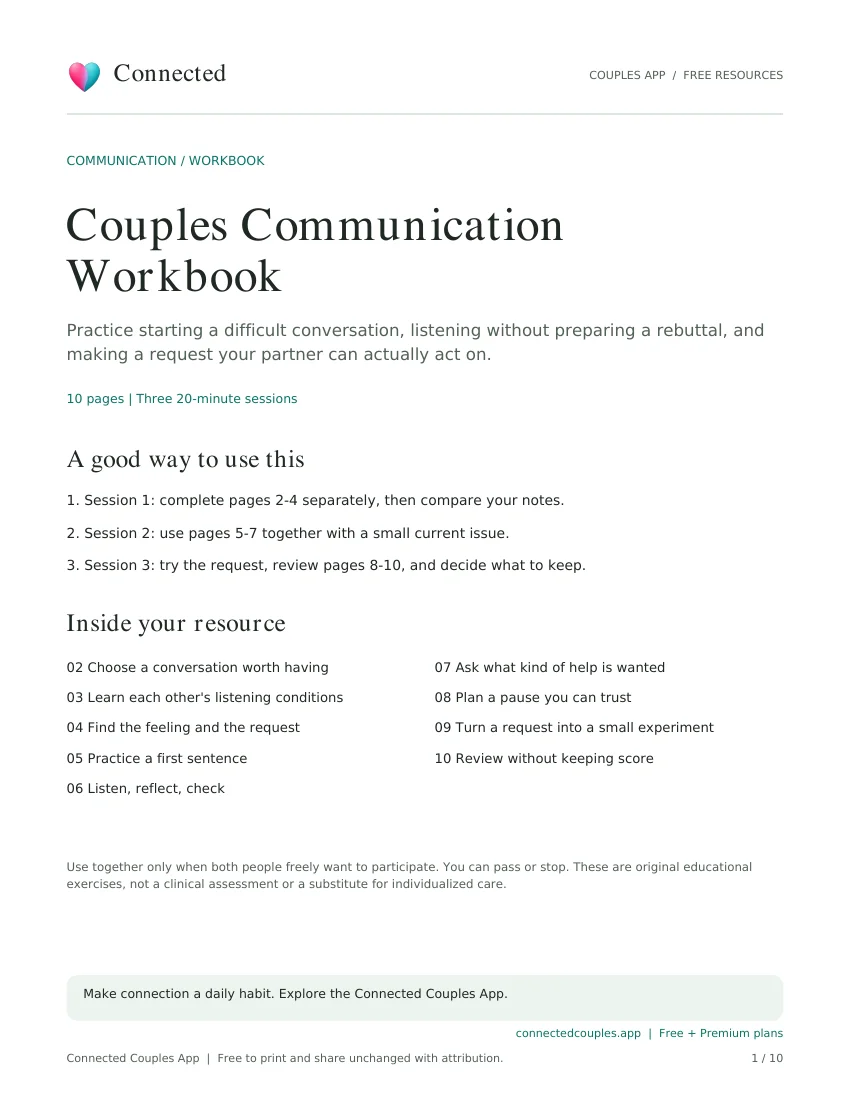
Preview & downloadPractice starting a difficult conversation, listening without preparing a rebuttal, and making a request your partner can actually act on.
10 pages · Printable PDF · 361 KB
No signup. Three 20-minute sessions. Read the exercises below.
It is easy to agree that you should communicate better and still have no idea what to say at 7 p.m. when dinner is late and both of you are tired. This workbook works through one ordinary disagreement, from your first sentence to a small follow-through plan. Use a manageable topic for practice; save the most painful issue for a time when you have the support you need.
Original educational resource by Connected Couples App. Published September 7, 2026.
Open a section to read it comfortably on your phone. The PDF includes the same exercises with space to write or printable cards.
Pick one specific situation from the last week. Describe what happened without guessing what your partner intended. You can each choose a different moment; agree on just one to practice with.
ExampleObservation: "We had not decided who was making dinner by 6:30." Assumption: "You expected me to handle it." The observation is a starting point; the assumption is a question.
Answer separately, then take turns sharing. The PDF has writing space for Partner A and Partner B.
Small changes to timing or surroundings can make it easier to listen. These are preferences to discuss, not rules one person imposes. A partner can be unavailable now and still care about the conversation.
Example"I want to hear this. I am still in work mode. Could we sit down after dinner at 7:30?" Agree on a time that works for both of you.
Answer separately, then take turns sharing. The PDF has writing space for Partner A and Partner B.
A feeling describes your experience. A request names an action. Keep them separate from a verdict about your partner's character. The other person may have a different feeling about the same event.
Example"I felt overwhelmed because I needed a clearer plan. Could we decide dinner by 5 p.m.?" is easier to respond to than "You never help."
Answer separately, then take turns sharing. The PDF has writing space for Partner A and Partner B.
Write a version you could say in your own voice. Start with one situation, explain its effect on you, and make room for your partner's perspective. This is an invitation, not a script you must perform perfectly.
Example"When the plans changed and I did not hear, I felt left out. What happened on your side? Could we agree how to update each other next time?"
Answer separately, then take turns sharing. The PDF has writing space for Partner A and Partner B.
Take two minutes each. The speaker describes the chosen situation. The listener waits, summarizes the meaning, and checks their understanding. Switch roles before brainstorming solutions.
ExampleListener: "You were not asking me to guess what you needed. You wanted us to decide who was doing what. Have I got that right?" Speaker: "Mostly. I also wanted to know you noticed I was tired."
Answer separately, then take turns sharing. The PDF has writing space for Partner A and Partner B.
Sometimes a person wants company in a feeling; sometimes they want an idea or practical help. Ask rather than assume. A request for listening does not mean the issue can never be solved.
Example"Would you like me to listen for a few minutes, help think through options, or take something off your list?" Allow an answer of "I am not sure yet."
Answer separately, then take turns sharing. The PDF has writing space for Partner A and Partner B.
Make this plan while you are calm. A pause should reduce pressure and include a proposed return time. Do not follow someone who has asked for space or use silence to punish them.
Example"I am getting too worked up to listen. Can we pause and try again at 8?" If either person still feels unable to continue, agree on another time or outside support.
Use the writing space in the PDF for your shared notes or the named person’s response.
Choose a change that is specific enough to try for one week. Either partner may suggest an alternative. Agreement under pressure is not a useful agreement.
Example"On workdays, we will send one dinner-plan message by 5. If neither of us has capacity, we will choose a simple backup meal together."
Use the writing space in the PDF for your shared notes or the named person’s response.
After a week, return to the experiment. Separate noticing effort from deciding whether the plan worked. A missed day is information about the plan, not a judgment about the relationship.
Example"The earlier message helped me relax. Friday was still confusing. Could our backup be written down so neither of us has to decide while tired?"
Answer separately, then take turns sharing. The PDF has writing space for Partner A and Partner B.
10 pages. Free to print and use together. Print at Actual Size on US Letter or Fit on A4.
It is a printable PDF with writing space or cards, not an interactive form. Print it or use the annotation tools in a PDF reader. The webpage version is available above for reading on smaller screens.
No. Share only what you freely choose. Either person can skip a prompt, stop, or suggest another time. These exercises are invitations to talk, not tests of commitment.
There are no answer forms on this page. Downloaded worksheets stay wherever you choose to save them. Website analytics measure resource-link and app-link clicks, not worksheet answers. See our privacy policy.
A repeatable check-in for sharing an appreciation, naming one concern, and choosing a realistic plan for the coming week.
Preview & downloadWork through one disagreement with a pause plan, two perspectives, and a repair that names what will change.
Preview & downloadForty original conversation cards, from easy everyday questions to stories about care, change, and the future.
Preview & download