Put this into practice: Download the free Couples Communication Workbook, with practical exercises and space to use together.
Quick answer
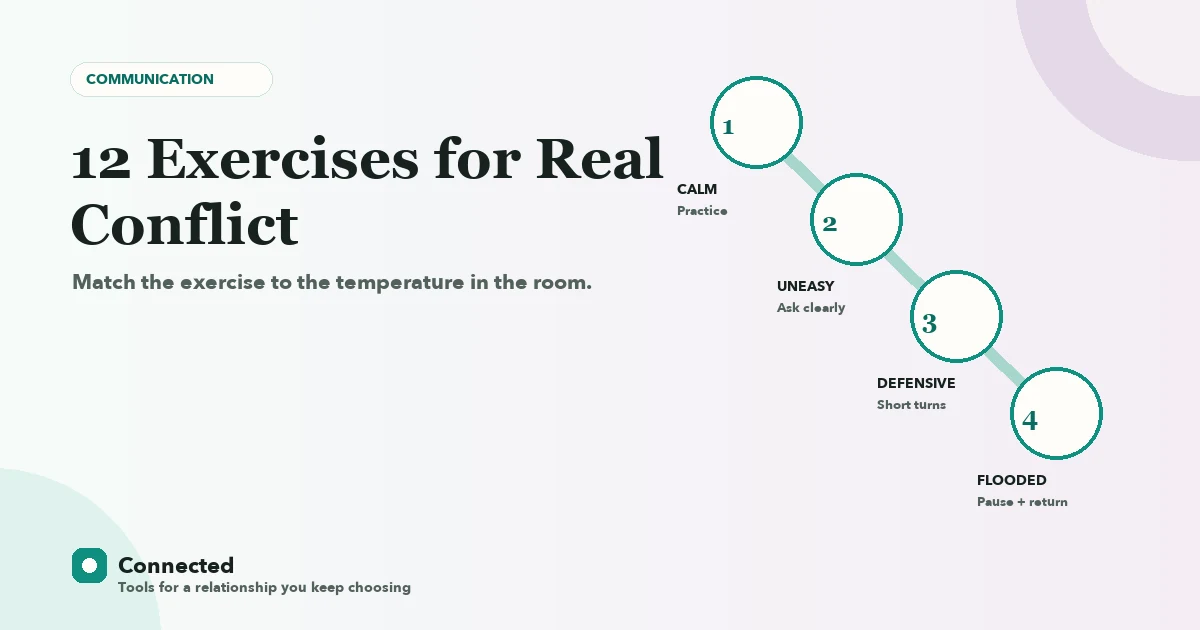
Start with the exercise your nervous systems can actually do. When calm, practice listening and clear requests. When tense, regulate first, shorten turns, and use a soft start. These 12 exercises include timing, scripts, common mistakes, and a chooser.
“We need to communicate better” is a diagnosis without a treatment plan. Better can mean slower, kinder, more specific, less defensive, more honest, or simply more frequent. Each requires a different repetition.
The exercises below are not miniature therapy sessions. They are drills. Like a musical scale, a drill isolates one move so it is more available during a real conversation. Practice on something that matters a little before trying it on the argument that has defeated you for five years.
Which exercise fits right now?
Choose your available time and the emotional temperature in the room.
This chooser runs only in your browser and does not save or send your selections.
Three rules before you practice
One topic, one example
“Yesterday at dinner” is workable. “Every time we go anywhere with your family” is a case file.
The listener is not on trial
Listening is not agreeing. The task is to understand the speaker’s experience before adding your own.
A pause includes a return
Name when you will come back: “I need 30 minutes. Can we return at 7:30?” A vague exit often intensifies pursuit.
Most couples do not need a more sophisticated sentence. They need a conversation small enough to stay inside. One topic, two-minute turns, and a real pause can look almost too simple, but simplicity is what keeps two activated nervous systems from turning the issue into a verdict on the whole relationship.Kayla Crane, LMFT, licensed marriage and family therapist and co-founder of Connected
12 couples communication exercises
Open only one or two. Repeating the same structure is more useful than sampling the whole list.
1. The two-minute mirror Listening · 6 minutes
- Partner A speaks for two minutes about one event.
- Partner B says, “What I heard was…” and paraphrases without rebuttal.
- Partner A answers only, “Yes, and…” or corrects one missing part.
- Switch roles.
Common mistake: the listener explains intent. Save intent for the listener’s turn.
2. The one-sentence soft start Request · 5 minutes
Use: “When [specific observable event], I felt [emotion], and I need or request [specific action].” Example: “When plans changed after I had left work, I felt unimportant. Next time, would you text me before confirming?”
Common mistake: “I feel like you do not care” is a conclusion about your partner, not a feeling.
3. Stress-reducing conversation Support · 15 minutes
Discuss a stressor outside the relationship. The listener asks whether empathy, encouragement, or brainstorming is wanted. Do not turn it into feedback about how the speaker created the problem.
4. The assumption check Clarity · 10 minutes
Each person writes: “The story I am telling myself is…” Read the stories, then ask what the other actually intended or feared. Treat both stories as hypotheses, not evidence.
5. Complaint to request Specificity · 8 minutes
Turn “I want you to help more” into one observable request with a time and owner. The partner can say yes, no, or offer a counterproposal. Vague goodwill is not an agreement.
6. Appreciation mirror Positive connection · 5 minutes
Name one specific behavior, the quality it represented, and its effect: “You handled bedtime when I was depleted. It felt generous, and I could finally exhale.” The listener only says thank you.
7. Repair menu De-escalation · 10 minutes
Each partner chooses three phrases they can believe during conflict: “Can I try that again?” “We are on the same side.” “I see why that landed badly.” “I need a pause and I will return.” Practice saying them while calm.
8. The 20-minute pause and return Regulation · 30–45 minutes
Name an exact return time. Spend at least 20 minutes doing something that lowers arousal: walking, showering, breathing, or neutral music. Do not rehearse your prosecution. Return with a one-sentence soft start.
9. The dream under the position Gridlock · 20 minutes
Each partner completes: “This position matters to me because…” Ask about values, history, identity, or fear underneath. Do not compromise until both dreams are accurately named.
10. The percentage you agree Common ground · 6 minutes
Before arguing the disagreement, each person names the part of the other’s position they can honestly endorse, even if it is only ten percent. This is not surrender. It prevents the difference from erasing overlap.
11. Replay one minute Awareness · 12 minutes
Choose one minute from a recent conflict. Each person names their trigger, protective move, and the impact on the other. Rewrite only that minute with a softer start, clearer feeling, or earlier pause.
12. Weekly state of us Prevention · 20 minutes
Use four prompts: one appreciation, one stress outside the relationship, one small concern with a request, and one thing to look forward to. End on the calendar, not another issue.
See the cycle, not just the argument
Connected’s conflict tools help each partner reflect separately, identify the pattern, and return with clearer language.
Match the exercise to the conflict temperature
The more activated you are, the smaller the task
Do not attempt insight while either nervous system is in survival mode.
This is a practical matching tool, not a diagnostic scale. If you cannot lower the temperature together, professional support can provide a safer structure.
One research caution matters: communication training is not a cure-all, and wording can be gamed. “I feel attacked when you disagree with me” uses I-language but still pressures the other person to stop having a view. Look for specificity, ownership, and room for two realities.
When exercises are not enough
A 2020 meta-analysis across 58 studies found large average gains in relationship satisfaction for couples receiving therapy, with improvements in communication and emotional intimacy. The evidence base is encouraging, but the included research was overwhelmingly conducted with different-sex couples, so generalization deserves care.
Safety changes the recommendation
Do not use joint communication exercises to negotiate with coercion, threats, stalking, intimidation, or violence. The National Domestic Violence Hotline explains why couples counseling is not recommended with an abusive partner. In the United States, call 800-799-SAFE or text START to 88788 for confidential support. If you are in immediate danger, call emergency services.
For non-abusive patterns, consider an LMFT or another clinician with substantial couples training when you keep repeating the same escalation, a betrayal is active, one partner cannot participate without shutting down, or mental health and substance use are shaping the cycle. Connected also has a therapist directory for finding relationship-focused care.
Research and sources
We favored peer-reviewed research, professional associations, and primary clinical guidance. Source notes describe what each reference does and does not establish.
- The Gottman Institute, How to Fight Smarter: Soften Your Start-Up. Clinical guidance grounded in longitudinal observation: begin with a complaint and request rather than blame or character attack.
- Roddy et al., Meta-analysis of Couple Therapy (2020). A synthesis of 58 studies and 2,092 couples finding large pre-to-post gains in relationship satisfaction and significant effects in communication and intimacy, with important sample limitations.
- Biesen et al., Young Adult Couples’ Use of I-Language in Naturalistic Arguments (2020). Naturalistic communication research and a useful caution: an I-statement is not automatically constructive if it still carries blame.
- The National Domestic Violence Hotline, Should I Go to Couples Therapy With My Abusive Partner?. Safety guidance explaining why joint counseling is not recommended in abusive relationships.
Frequently asked questions
What is the best communication exercise for couples?
For calm couples, reflective listening is a strong starting point: one person speaks briefly, the other paraphrases, and the speaker corrects the summary before roles switch. During tension, begin with regulation or a soft start instead.
How can couples practice communication at home?
Practice on low-stakes topics for five to ten minutes, not in the middle of your worst recurring fight. Repeat one structure several times so it becomes familiar before you urgently need it.
Do I-statements improve communication?
They can reduce blame when they name a real feeling, a specific event, and a request. “I feel that you are selfish” is still a judgment in disguise. Wording does not replace tone, timing, or accountability.
What should couples do when a conversation gets too heated?
Pause with an exact return time, spend at least 20 minutes calming rather than rehearsing rebuttals, and return with a soft start. A pause without a return can feel like abandonment or stonewalling.
How often should couples do communication exercises?
Two or three short practices a week is enough to learn a structure. Use the same exercise for several weeks before adding more. Skill grows through repetition, not variety.
When should couples stop doing exercises and see a therapist?
Seek professional help when conflict is frequent, frightening, coercive, or impossible to repair; when trust has been seriously breached; or when mental health, trauma, or substance use is driving the pattern. Joint exercises are not appropriate in abusive relationships.
Kayla is a licensed marriage and family therapist and co-founder of Connected. This educational guide is not a diagnosis or a substitute for therapy.