 Connected
A ride to an appointment can turn into a day off work, several phone calls and a disagreement about who was supposed to book the next visit. When you're caring for aging parents as a couple, name the actual work, agree on who owns it and arrange backup before making the next promise. Keep the parent involved in decisions about their life. Then make two plans: one for the care work and one for how you'll stay in touch as a couple when that work changes.
A partner can want your parent to be well and still be unable to provide every ride, overnight stay or administrative task. Those limits are worth naming early. This guide is about coordinating care and protecting your relationship; medical treatment, legal authority and financial decisions need appropriately qualified advice.
Evidence, with the context kept in
Family caregiving is widespread, and the work has to land somewhere.

What this does and doesn't tell us: The overall estimate also includes care for children with complex conditions or disabilities. It is not a count of people caring only for aging parents, and some family caregivers receive pay.
Put it to use: Count coordination, travel and follow-up alongside the visible visit. Each task needs an owner who has actually agreed.
Get the chart, data and citation
The numbers come from the source linked above; Connected created the chart. These are published statistics, not an original Connected study.
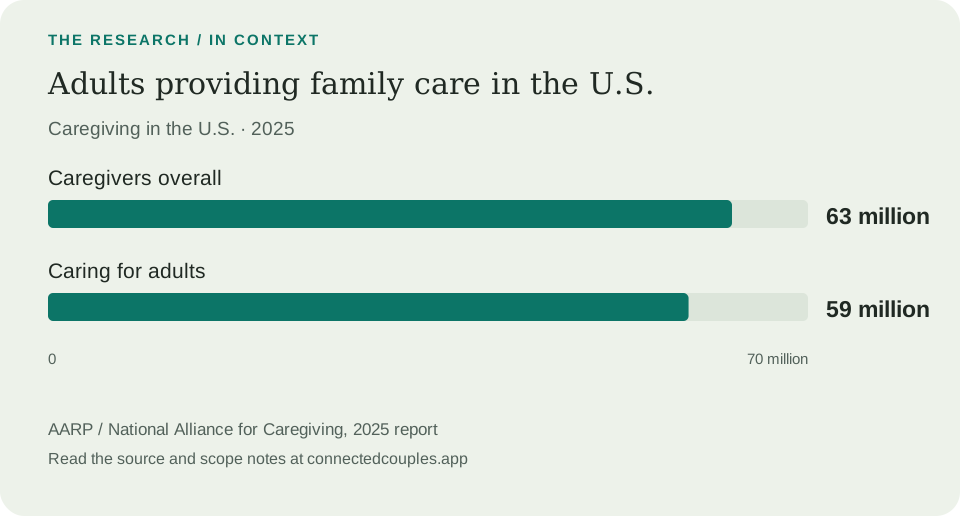
AARP / National Alliance for Caregiving, 2025 report. Caregiving in the U.S. · 2025. Chart by Connected Editorial Team, October 2, 2026. Please retain the source, date and scope when sharing.
Before you say yes to another request
A request can arrive as “Can someone take Dad to his appointment?” and become a recurring weekly commitment before either partner has discussed it. Before answering, identify what is actually being requested: transport, company, scheduling, note-taking or follow-up calls. These may be several jobs rather than one.
Ask your parent what help they want and what they prefer to keep managing. Agree on what information they want shared, with whom and for what purpose. Being a supportive partner doesn't automatically make someone the right recipient for every private detail.
If a situation involves an immediate safety concern, use appropriate local professional or emergency help. Don't make a couple-planning session the first response to an urgent need.
For a non-urgent request, a useful holding response is: “I want to help. I need to check what I can reliably commit to, and I will get back to you tomorrow.” Choose a response time that fits the actual deadline.
Who is making all the calls?
Start with a list of what happened in the last week. Include the visible tasks and the work surrounding them: arranging rides, comparing appointment times, reminding relatives, handling changes, checking supplies and remembering who needs an update.
The National Institute on Aging recommends identifying and sharing caregiving responsibilities and provides a coordination worksheet. That is a useful starting point when “helping out” has become too vague to organize. NIA on sharing caregiving responsibilities
For each task, ask who notices it, who arranges it and who completes it. One person doing the driving doesn't necessarily mean the other person has been relieved of the coordination. Connected's guide to the mental load in relationships explores this distinction more broadly.
Don't assume equal care means identical tasks. Distance, employment, disability, health, family history and existing responsibilities may affect what each person can do. The goal is an explicit arrangement both people can realistically sustain, with outside support where available.
“Don't ask only, ‘Can you help more?’ Name a task, who will carry it from start to finish, and what happens if that person can't do it. Caring for someone shouldn't depend on the same person remembering everything.”
Kayla Crane, LMFT
Write down the job and its limits
Use this worksheet to make the work visible. Involve the relevant family members and keep your parent's preferences in view. Leave a gap visible if nobody has agreed to cover it.

Read the graphic as text
Supporting an aging parent
Separate care needs from couple commitments
TASK: Name a specific care need. What is needed, with the parent’s consent? ______
LEAD: Agree who owns coordination. Name: __________ Responsibility: __________
BACKUP: Plan for unavailable days. Person or service: ________________________
LIMIT: Make capacity and boundaries explicit. What is outside this commitment? ____________
REVISIT: Name a review date or change trigger. We revisit when: _________________________
Keep the parent’s agency central. Do not assume a partner becomes a caregiver.
| Task | Lead | Backup | Limit | Revisit |
|---|---|---|---|---|
| Planned appointment rides | Named person | Confirmed person or service | Which days and notice needed | If appointments change |
| Grocery order | Named person | Confirmed person | Agreed scope and frequency | After first delivery |
| Scheduling and updates | Named person | Confirmed person | Who receives which information | If preferences change |
| Weekend visit | Named person | Confirmed person | Start and end time | Before extending the pattern |
| Finding extra support | Named person | Another researcher | What options to investigate | When information is available |
“Backup” should mean someone who has agreed, rather than a partner who will be told at the last minute. Check that a service is actually available and suitable before relying on it. If the only backup is “we'll figure it out,” the plan still has an open question.
Add one sentence beneath the map: “Before accepting a new recurring responsibility that affects both of us, we'll discuss the time, cost and alternative options.” This is a coordination agreement, not permission to veto a parent's needs or control a partner's relationships.
The appointment that takes the whole day
Here is a fictional example. Sam drives their mother to appointments twice a month. Riley handles scheduling because their work hours seem more flexible. Riley also confirms transport, sends reminders and reschedules work whenever the clinic changes the time.
Sam sees two driving days. Riley experiences an unpredictable stream of interruptions. Riley says, “I need more help.” Sam replies, “But I already do the appointments.” Both are counting a different part of the job.
They write down the work and find a narrower problem: no one owns scheduling from start to finish. With Sam's mother's agreement, Sam takes over booking and confirmation for the next appointment. Riley offers one planned grocery order a week and stops being the automatic scheduling backup. Sam asks a sibling whether they can cover a specific future ride; that slot remains unfilled until the sibling agrees.
They also protect a low-key evening after the appointment, with an explicit allowance for necessary changes. At their review, they will ask whether the plan worked in practice, not whether everyone tried hard enough. If the workload grows, they will investigate more support rather than quietly transferring it back to Riley.
Say what you can reliably take on
“What can you take on?” is easier to answer when it includes time and limits. Try these prompts:
- What can I reliably do this week without dropping another essential responsibility?
- What have I been doing that nobody realizes I am doing?
- Which task am I willing to own, rather than help with only after reminders?
- Where do we need a relative, community service or paid provider instead of another promise from each other?
- What will tell us that the current arrangement needs to change?
A useful limit might be: “I can cover Tuesday's visit, but I can't also be available every evening.” Another might be: “I can research services; I can't decide medical questions.”
The NIA's caregiver guidance recommends seeking help and making room for your own care. Its advice includes specific task support and breaks for the primary caregiver. In practice, that means agreeing on real coverage rather than simply telling an exhausted person to rest. NIA on taking care of yourself as a caregiver
Make room to talk about something besides care
A check-in doesn't need to become another performance requirement. Choose a manageable moment and ask two things: “What is weighing on you?” and “What would help from me right now?” The answer might be listening, practical help or some quiet time.
You can also reserve a small ordinary activity together: eating breakfast, walking around the block or watching something you both enjoy. Treat it as flexible contact, not a rule that makes either person feel guilty when care needs interrupt.
If you want prompts for that conversation, try Connected for daily questions and a weekly check-in. Keep your parent's private care information in the appropriate care-coordination setting; your couple conversation can focus on your own feelings, capacity and requests.
When the plan doesn't hold
A sibling gives advice but takes no task. Offer a specific request with a clear scope. “Can you call these two transport providers and send the availability by Thursday?” is easier to act on than “You should help more.” If they decline, plan around that answer rather than assigning imagined help.
Your parent wants only you. Acknowledge that preference, then explain the limit honestly: “I can come on these days. We need another arrangement for the others.” Ask appropriate professionals or local support services for help exploring options; a partner can't always fill the gap.
Your partner says you're choosing your parent over them. Ask which concrete impact needs attention: cancelled plans, money decisions, exhaustion or repeated last-minute requests. Discuss that impact without demanding a ranking of who matters more.
Requests keep expanding. Return to the written scope. Connected's guide to boundaries with parents can help with the wider conversation, while your care map handles the actual work.
Try it on a difficult day
When the named backup has never actually said yes
Fictional example
A couple's calendar lists a sibling as backup for an appointment, but nobody asked them. The sibling cannot leave work. The partner with the more flexible schedule is again expected to fill the gap.
- Mark the coverage as unconfirmed until the person agrees. A name on a spreadsheet does not create capacity.
- With your parent's consent, check the actual alternatives with the clinic, local support service or other willing relatives. Avoid sharing more health information than coordination requires.
- Update the task's limit: how much notice is needed, who will make the calls and which commitments cannot move.
The useful review: If the same person keeps becoming the emergency backup, review the whole care arrangement rather than just the calendar entry.
Make it yours
Make a care task handoff
Start with one task and respect your parent's preferences and consent. Leave out medical details that do not belong in a shared planning note.
Your entries stay in this tab and are not sent by this worksheet. Download your draft before closing or reloading; it is not saved automatically.
Your draft to discuss together
Check that both people agree before treating this as a commitment. Blank items remain open questions.
Common questions
Should caregiving be divided equally between partners?
There is no universal split. Start with willingness, capacity and the parent's preferences. Review the total load, including existing household work, and avoid treating marriage or cohabitation as automatic consent to an unlimited caregiving role.
What if we can't afford paid help?
Investigate local community and public-service options and ask relatives or trusted people for bounded tasks. Availability varies. Keep unmet needs visible and raise them with relevant care professionals rather than claiming your plan covers more than it does.
When should we revise the plan?
Revisit it when needs, schedules or willingness change, when a backup falls through, or when one person can't keep the agreement. When the arrangement stops being manageable, change it. You don't need to wait until someone is exhausted enough to justify asking.
Sources & editorial notes
Published by the Connected Editorial Team, with a quote from Kayla Crane, LMFT. Examples are fictional. The worksheets and graphics are original editorial planning aids, not validated assessments or a substitute for professional care.
- AARP / National Alliance for Caregiving, 2025 report
Caregiving in the U.S. · 2025. The overall estimate also includes care for children with complex conditions or disabilities. It is not a count of people caring only for aging parents, and some family caregivers receive pay.
- NIA on sharing caregiving responsibilities
NIA recommends identifying and sharing tasks and provides a coordinating-care worksheet.
- NIA on taking care of yourself as a caregiver
NIA guidance includes seeking help, specific task support and breaks.