 Connected
The quick answer
Couples with different political views need to understand the practical meaning of the disagreement, not just their party labels. Separate factual questions, shared decisions and concerns about dignity or safety. A respectful conversation may clarify a workable agreement or reveal a serious incompatibility. Staying together does not require treating every belief as harmless.
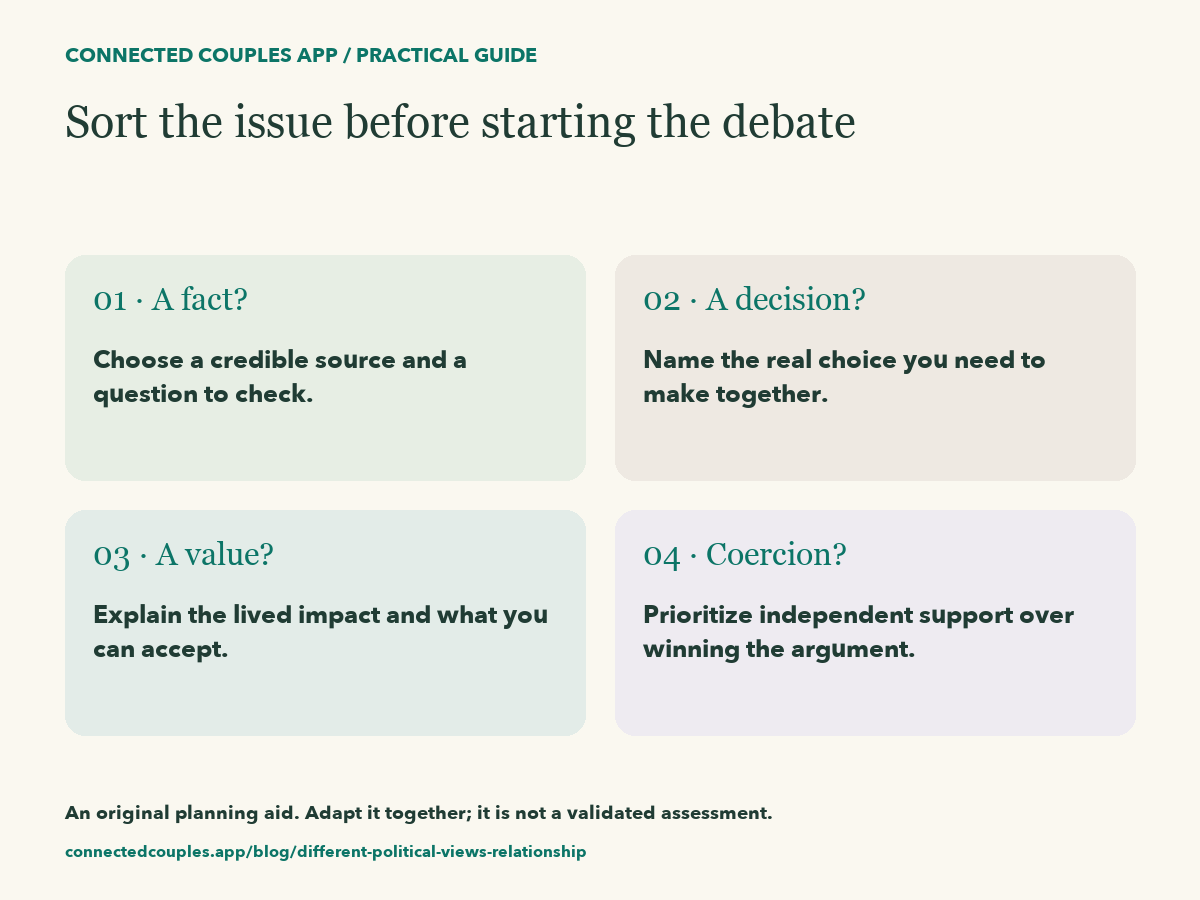
Sort the issue before starting the debate
- A fact?
Choose a credible source and a question to check.
- A decision?
Name the real choice you need to make together.
- A value?
Explain the lived impact and what you can accept.
- Coercion?
Prioritize independent support over winning the argument.
Try it together · Free tool
Choose the conversation you actually need
Identify the part of the disagreement you want to address. No party, vote or personal answer is sent to us.
Your answers stay in this page. They are not saved by us or sent to your partner. Refreshing clears the draft; download it if you want to keep it. Basic tool-use analytics contain no answers.
Your conversation draft
Ask what the disagreement would change
A headline appears during dinner. One of you laughs. The other goes quiet. Within minutes you are arguing about an entire worldview, although neither of you has said why this particular issue feels personal.
Start there: “What does this issue mean in your life?” The answer might concern public spending. It might concern a family member’s safety, the right to make a healthcare decision or how you would raise a child. Those require different conversations.
Do not assume a disagreement is minor because its consequences do not fall on you. Do not assume a party label tells you every position your partner holds either. Ask for the specific belief and its practical implications.
Four questions that prevent a circular argument
| Question | Useful next action | What it cannot do |
|---|---|---|
| “Is this claim accurate?” | Check an original source, date and context. | Settle a moral disagreement automatically. |
| “What do we need to decide?” | Name the choice and who is affected. | Make either person agree by default. |
| “What can I live with?” | Explain a boundary and its real-life meaning. | Force the other person to change their beliefs. |
| “Can I disagree freely?” | Notice threats, punishment or control. | Make coercion safe through better wording. |
A factual argument often hides a values question. Even after you agree what a policy says, you may disagree about its fairness. Acknowledge the remaining difference instead of collecting another dozen links.
Have one bounded conversation
Choose a moment when neither of you is cornered, rushing or trying to sleep. Ask whether the other person is willing to talk. Name the purpose: understanding a view, checking a claim or deciding something practical.
Try: “I am not asking us to settle every political disagreement tonight. I want to understand what your position on this would mean for the decision we are making about our family.”
Each person explains their view without interruption. The listener then describes what they heard in terms the speaker recognizes. You can say, “I understand that this is what you believe,” while still disagreeing with it. Understanding is not endorsement.
The APA’s guidance on political disagreement emphasizes avoiding personal attacks and hostile language. In an APA interview, psychologist Tania Israel discusses the importance of the goal you bring to a dialogue. Decide whether you are trying to understand or simply win before asking your partner to participate.
Move from a slogan to a household decision
Illustrative example: A couple repeatedly argues about education policy. The immediate decision is where their child will attend school. One wants to debate national politics; the other wants to know whether a particular school can meet the child’s needs.
They make a list of decision-relevant questions: services, distance, cost, environment and what the child needs. They can investigate those together even if a broader disagreement remains. If a belief leads one partner to reject something the other considers essential for their child, they must address that directly.
The improvement is not pretending their politics do not matter. It is identifying where the difference actually enters their shared life.
Set limits that describe your participation
“I will discuss this without insults. If the conversation becomes personal, I will stop and we can decide whether to try again tomorrow.” That is a limit on your participation.
“You are not allowed to think that” is not an agreement you can enforce. You can decide what you will accept in a relationship, including beliefs you find incompatible with your values. You cannot make genuine agreement happen by demanding the correct answer.
Avoid using children, relatives or friends as an audience for humiliating your partner. Also avoid treating “keep the peace” as a reason someone must sit through demeaning comments about their identity or loved ones.
When respect does not resolve the difference
You can speak calmly and still discover that you want incompatible lives. Ask what the difference would mean in foreseeable decisions: raising children, money, religious practice, friendships or support for family members.
Be specific about what you cannot accept. “I need a partner who respects this part of my life” gives more information than another argument about which side is worse. You do not owe an endless debate before recognizing a limit.
If disagreement brings threats, surveillance, financial restrictions or fear, seek independent support. A joint exercise or app is not the right response to coercive behavior. For ordinary but persistent conflict, a qualified couples therapist may help you clarify whether an acceptable way forward exists; the goal need not be forced agreement.
Common questions
Can a relationship survive different political views?
Some can, but a party label alone does not answer the question. Look at how the views affect daily choices, respect, family plans and each person’s freedom. You may discover either workable differences or an incompatibility you cannot accept.
Should politics be off limits at home?
You can agree on times or places for discussion and decline repetitive debates. Avoiding every conversation is less useful when the disagreement affects a decision you must make together.
What if my partner says I am too sensitive?
Ask them to address the specific impact rather than judge your reaction. If they repeatedly dismiss your dignity, threaten you or punish disagreement, this is more than a debate over ideas.
How do we check a disputed claim?
State one factual question, agree what kind of evidence would address it, and examine the original source in context. A source can clarify a fact; it cannot decide your values for you.
Sources & editorial notes
Written by the Connected Editorial Team. The examples are illustrative, and the scripts, visual guide and planning tool are original editorial resources. They are not validated assessments, individualized advice or a substitute for professional care. Source notes explain the scope of the supporting material.
- APA: Managing conversations when you disagree politically
General guidance on respectful discussion and choosing whether to engage.
- APA interview with Tania Israel, PhD
Expert discussion of motivation and understanding across political differences; not a test of romantic compatibility.
- One Love Foundation: Political differences
Relationship education about respectful disagreement.
Published September 7, 2026. Send a correction or tell us what would make this guide more useful.