 Connected
The quick answer
Before moving for a relationship, compare what each person gains and gives up, how the move will be funded, and how the relocating partner will build an independent life. Agree on support, a review date and what happens if the arrangement does not work. An unresolved concern is a reason to gather information or delay, not a failure to commit.
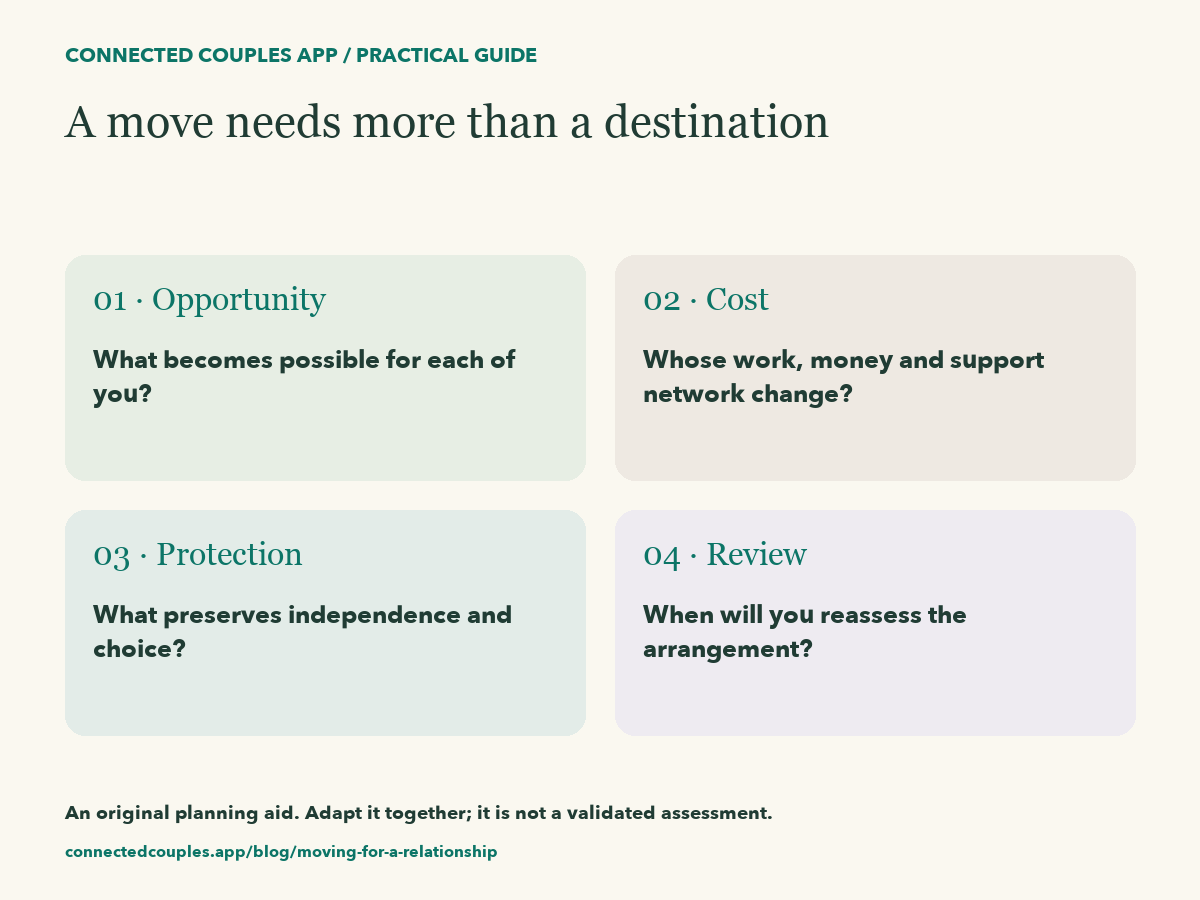
A move needs more than a destination
- Opportunity
What becomes possible for each of you?
- Cost
Whose work, money and support network change?
- Protection
What preserves independence and choice?
- Review
When will you reassess the arrangement?
Try it together · Free tool
Find the conversations you still need
Check only the topics you have both discussed concretely. This identifies gaps; it does not score your relationship or tell you whether to move.
Your answers stay in this page. They are not saved by us or sent to your partner. Refreshing clears the draft; download it if you want to keep it. Basic tool-use analytics contain no answers.
Your conversation draft
Separate wanting a future from choosing this move
You can want a life with someone and still be unsure about moving to their city. Those are two different questions. Collapsing them into “If you loved me, you would come” makes a practical decision much harder to discuss honestly.
Put more than one option on the table: moving now, moving later, trying a temporary arrangement, living in a third place, or continuing at a distance while you gather information. Some will be impractical. You can discover that together rather than treating the first proposal as the only loyal answer.
Write the reason for the move in ordinary language. “Your training starts in January and you cannot complete it here” is clearer than “This is the next step.” It helps you see what is fixed and what can still change.
Map the costs that do not fit in a moving quote
| Area | Questions for each partner |
|---|---|
| Work and purpose | What happens to my job, qualifications, study, care role or daily structure? |
| Money | What costs begin immediately? What income is certain, possible or unknown? |
| People | Who can I see without arranging a trip? Who will I miss? |
| Independence | Can I travel, access money, obtain care and make choices without relying on my partner for everything? |
| Opportunity | What could this place offer me that is genuinely mine? |
Do not force every answer into dollars or give each category an arbitrary score. Losing a professional license’s portability or leaving a support network cannot be cancelled out by a nicer apartment. Identify what needs an answer before anyone gives notice.
Turn appreciation into something observable
A study of 229 people who had relocated for a partner’s work or schooling examined how perceived gratitude and willingness to sacrifice related to relationship functioning. It offers a reason to take the accompanying partner’s experience seriously, not proof that gratitude makes every move worthwhile. Read Murphy and colleagues’ study abstract.
In practice, “I appreciate what you gave up” should sit beside practical support. That might mean protecting job-search time, sharing the work of building local connections, planning visits to old friends or changing a budget so the relocating partner is not left asking for every purchase.
Ask: “What would make the cost you are taking on feel recognized in our daily life?” Then name who will do what. Appreciation is not a repayment plan, and a move should not create a permanent debt either person uses in arguments.
Compare two versions of the same move
Illustrative example: Dani receives a job offer in another city. Lee would leave an established job and nearby friends.
In the vague version, they agree that Lee will “find something” after arriving. Dani starts a demanding role. Lee is home alone, managing the unpacking and wondering when it is acceptable to spend money.
In the concrete version, they first check Lee’s employment options, list transition expenses and agree how both will access money. They protect time for Lee’s applications, identify a weekly activity outside the relationship, and choose a review point before the next major housing commitment. If work does not materialize, they discuss options already on the list rather than blaming Lee for struggling.
The second version does not guarantee a happy move. It makes hidden assumptions visible while they can still be changed.
Write a review plan before you need one
- When: choose a date, plus a reason to review sooner.
- What: discuss work, money, independent support and the relationship separately.
- Evidence: bring actual experiences, not a demand to be settled by now.
- Options: identify what can change without moving again and what would require a bigger decision.
- Practical fallback: discuss where each person could stay and how travel or moving costs would be handled.
A fallback does not predict a breakup. It preserves the freedom to make an honest choice later. If residency, employment rights, property or a lease is involved, get advice for your jurisdiction before relying on an informal understanding.
If you have already moved and feel resentful
Try naming the loss before accusing your partner of causing every unhappy moment: “I am glad we live together, and I miss having people I can call for a last-minute coffee. I need help making this place feel like my life too.”
Then ask for one concrete change. Your partner can support a friendship-building plan without becoming responsible for all your social needs. They can acknowledge a career cost without being able to fix the local job market.
If discussion is met with pressure, threats or restrictions on your money, documents or contact with others, treat that as a separate concern from ordinary adjustment. Seek independent support rather than using this checklist to negotiate away your freedom to leave.
Common questions
Should I move for my boyfriend or girlfriend?
Consider the actual arrangement rather than the relationship label: whether the choice is mutual, the costs are manageable, and your housing, work, money and support will remain viable. A move should not be the only way you are allowed to prove commitment.
What if I regret moving for my partner?
Name which part is not working: the place, the practical setup, the loss of support or the relationship. Ask for specific changes and revisit the original agreement. Regret is information; it does not automatically settle whether to stay or leave.
How long should we try the new city?
Choose a review date around real constraints such as a lease, job search or school term. There is no universal adjustment deadline. Review sooner if independence, safety, housing or essential needs are at risk.
Should the partner whose job caused the move pay more?
Discuss the unequal costs explicitly, including lost earnings and career disruption. The arrangement may involve unequal contributions, but it should preserve both people’s access to money and decision-making. Seek professional advice for consequential financial or legal arrangements.
Sources & editorial notes
Written by the Connected Editorial Team. The examples are illustrative, and the scripts, visual guide and planning tool are original editorial resources. They are not validated assessments, individualized advice or a substitute for professional care. Source notes explain the scope of the supporting material.
- Murphy et al. (2022): Relationship functioning following a large-scale sacrifice
Study of 229 people who relocated for a partner’s job or schooling. Perceived partner prosociality was relevant to relationship functioning; this is not a relocation success calculator.
Published September 7, 2026. Send a correction or tell us what would make this guide more useful.