 Connected
When one partner owns a business, agree on dependable time together, what genuinely requires an interruption, and who owns the household responsibilities around the work. Make any help with the business a clear, voluntary agreement. Review what happens in practice so that “a busy season” does not quietly become the permanent shape of your relationship.
You can be proud of someone's business and tired of waiting for them at the same time. The owner can care deeply about the relationship and still underestimate how often work changes the plan. Both experiences need room in the conversation.
We are looking at the relationship around the business: when you can count on each other, what help is welcome, and how home life gets handled. Business strategy, formal ownership, and investment decisions need their own conversations and appropriate advice.
Evidence, with the context kept in
Weekend work can be part of the business-owner schedule.

What this does and doesn't tell us: This covers main-job work. Incorporated business owners are classified with wage and salary workers. It is not a count of every business owner or evidence that any particular interruption was necessary.
Put it to use: Protect time that fits the business's actual demands, and agree what a genuine exception requires afterward.
Get the chart, data and citation
The numbers come from the source linked above; Connected created the chart. These are published statistics, not an original Connected study.
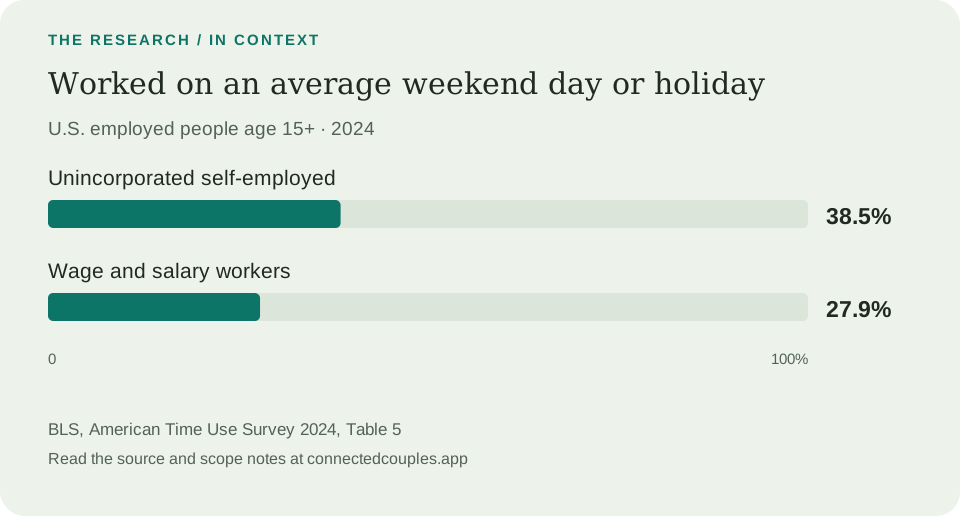
BLS, American Time Use Survey 2024, Table 5. U.S. employed people age 15+ · 2024. Chart by Connected Editorial Team, October 2, 2026. Please retain the source, date and scope when sharing.
Describe the pattern without judging the ambition
Choose a recent example with an observable effect: “We planned dinner on Tuesday and Thursday, and both times I ate alone without knowing when you would finish.” That is easier to work with than “Your business always comes first.”
Ask the owner to explain which demands are predictable, which are genuinely unexpected, and which are habitual. A late customer message may feel urgent without requiring an immediate reply. Other events may truly need attention. You need the distinction to make a workable plan.
NIOSH researchers describe both sides of work flexibility: it can help people meet personal needs, while blurred work boundaries can create difficulties at home. Their work concerns workers broadly, so use it as context while you figure out your own arrangement. Read the NIOSH discussion of work flexibility.
Avoid assuming ownership means complete freedom. Equally, owning a business does not automatically make every other person's time flexible. Put both partners' actual constraints on the page.
“Ask what your partner can actually count on this week. A small promise you can keep gives you something to build on; ‘I will be less busy soon’ leaves the other person waiting.”
Kayla Crane, LMFT
Make a plan for the time you can count on
Start with a small amount of protected time that is realistic enough to keep. Specify when it begins, what being available means, and what happens if it changes. Use the sample below as a starting point and change the details to fit your week.

Read the graphic as text
When one partner owns a business
Make work boundaries concrete
PROTECTED TIME: What time is ours?. Agree work-free windows and how they are signaled.
TRUE INTERRUPTION: What cannot wait?. Name a specific exception, not every work notification.
HOUSEHOLD OWNER: Who owns which task?. Make the handoff explicit rather than assuming availability.
RETURN AND REPAIR: How do we reconnect?. Acknowledge the disruption and agree a return time.
If business spillover becomes routine, renegotiate the boundary together.
| Part of the agreement | Question to answer | Illustrative choice |
|---|---|---|
| Protected time | When can we count on each other's attention? | Wednesday dinner and a Sunday walk |
| True interruption | What can interrupt that time? | A situation requiring immediate action, defined beforehand |
| Household task ownership | Who completes the whole task, including planning? | The owner handles groceries and replenishes household supplies |
| Return and repair | What happens when a plan breaks? | Give an honest update and propose a replacement time |
Discuss ordinary contact separately. You may want a brief arrival message but not continuous replies throughout the workday. Neither person should have to monitor the other to know whether the agreement exists.
If your schedules have little overlap, use the guide for couples with different work schedules to find realistic windows. Here, the additional question is whether an available window stays available once a business request arrives.
Define an interruption before the phone rings
“Only emergencies” is not specific if one person treats every notification as an emergency. Consider categories together: a safety issue, an active operational failure that the owner must handle, a routine customer question, or an idea that can be written down for later.
The owner should work out the appropriate business response with the relevant people at work. Their partner does not need to become the business's gatekeeper. The couple's agreement concerns the effect on shared time and responsibilities.
During a genuine interruption, offer useful information without pretending to know the unknowable: “I need to deal with this. I do not know how long it will take; I can update you after I understand the problem.” Then give the promised update. If you cannot return, acknowledge the missed plan and take responsibility for arranging another.
If interruptions are frequent, review their causes. NIOSH-funded researchers studying small businesses heard leaders describe staffing shortages and competing priorities during coaching. Those are organizational constraints a couple cannot resolve through reassurance alone. Read the researchers' small-business study lessons.
The practical implication is to examine the work arrangement as well as the conversation at home. Do not claim a partner could solve every problem by being more patient.
Make support voluntary and specific
“Support my business” can mean listening to a story, attending an event, proofreading a page, answering customer messages, or taking over the household. Those requests differ in effort and consequence. Name the actual request.
Try: “Would you look at this short description tonight?” rather than “If you believed in me, you would help.” The other person can say no or offer a different amount of help.
If occasional favors become regular work, stop treating the arrangement as self-explanatory. Discuss the role, hours, ability to decline, and appropriate professional advice about any formal arrangement. Do not assume partnership makes someone an unpaid employee or gives them authority to act for the business.
Emotional support also needs a shape. Ask, “Do you have room to listen to a work problem?” The listener can respond, “Yes, but I cannot brainstorm tonight.” A partner can care without being the only source of advice, encouragement, or stress relief.
Keep household responsibility visible
Look beyond who performs a task when reminded. Who notices supplies are low, arranges an appointment, checks the calendar, and follows through when something changes?
A temporary redistribution may be mutually acceptable. Write down which tasks move, why, and when you will review it. Leave room for the other partner's busy periods too. Their work, caregiving, rest, and personal commitments deserve attention regardless of income or title.
For a fuller discussion of planning and follow-through, read the mental load in relationships. Within your business-boundary plan, the key is to give each task a real owner and a fallback when that person is unavailable.
Thursday keeps getting canceled
Consider Morgan and Ellis, a fictional couple. Morgan runs a small repair business. Ellis works elsewhere. Thursday has become their default evening together, but Morgan keeps booking jobs that run into it. Ellis waits to eat and rearranges chores, while Morgan assumes they can start later.
They stop calling Thursday “flexible.” Morgan chooses a different protected evening that better fits the business and tells Ellis before accepting work that would affect it. They define urgent interruptions and stop treating ordinary booking messages as automatically urgent.
Morgan also takes complete responsibility for groceries, choosing a shopping time that works with the work schedule. Ellis no longer holds dinner indefinitely: they agree on an update time and a clear fallback.
At the next review, they ask whether the evening happened and whether groceries still required Ellis to remind, list, or rescue. If the agreement repeatedly fails, the next conversation is about capacity and work decisions. It is not another promise that next week will somehow be quieter.
When the arrangement keeps failing
The busy season has no end. Ask for a review point and a description of what will change. “After this launch” is incomplete if another deadline immediately replaces it. You are allowed to discuss whether the ongoing arrangement meets both people's needs.
One person feels policed. Review observable agreements rather than demanding proof of every work activity. “Can I rely on our plan?” is a different question from “Show me every message.”
One person calls every request unsupportive. Return to the concrete request and its impact. Wanting dependable time or declining business work does not settle how much someone cares. If guilt or intimidation makes refusal unsafe, seek confidential support rather than negotiating alone.
There is genuinely no spare capacity. Simplify commitments where possible and seek appropriate outside help. A check-in cannot create hours that do not exist. Persistent distress may warrant professional relationship support if both people can participate safely and freely.
Try it on a difficult day
When every customer request becomes an exception
Fictional example
Three protected dinners in a row have been interrupted. Each message felt urgent to the business owner, but none met the couple's written definition. The agreement is no longer describing what actually happens.
- Review the last few interruptions by what happened and what waiting would have cost. Avoid arguing only about whether someone cares enough.
- Decide whether the promised window is realistic. If it is, consider an operational change the owner can actually make, such as published response hours or existing staff coverage.
- If it is not realistic, agree on a different dependable commitment. Do not replace a failed promise with a larger promise that the same conditions will break.
The useful review: Check whether interrupted time was actually restored. An open-ended 'we'll make it up' leaves the repair work with the waiting partner.
Make it yours
Make a business-interruption agreement
Include what happens after an interruption. A definition of urgent is incomplete without a return plan.
Your entries stay in this tab and are not sent by this worksheet. Download your draft before closing or reloading; it is not saved automatically.
Your draft to discuss together
Check that both people agree before treating this as a commitment. Blank items remain open questions.
Common questions
Should I help with my partner's business?
Only through an agreement you can freely accept. Clarify the task and limits before it becomes an expectation. Revisit regular work as a real role, including any need for independent professional advice.
How much time together is enough?
There is no universal quota. Start with contact you both find meaningful and can depend on. Then review whether either person is chronically waiting, isolated, or carrying a workload they did not agree to.
What should we talk about at a weekly review?
Ask what was dependable, which interruptions happened, and whether household responsibilities stayed fair. Keep room for interest in each other beyond performance against the plan. If you want a prompt to begin, try Connected, which offers daily questions and weekly check-ins. Use the conversation to refine your agreement, not to grade how supportive a partner has been.
Sources & editorial notes
Published by the Connected Editorial Team, with a quote from Kayla Crane, LMFT. Examples are fictional. The worksheets and graphics are original editorial planning aids, not validated assessments or a substitute for professional care.
- BLS, American Time Use Survey 2024, Table 5
U.S. employed people age 15+ · 2024. This covers main-job work. Incorporated business owners are classified with wage and salary workers. It is not a count of every business owner or evidence that any particular interruption was necessary.
- NIOSH Work Flexibility and Worker Well-being
NIOSH researchers describe both advantages of flexibility and challenges from blurred boundaries; general workers, not proof of a couple routine.
- NIOSH Lessons from Small+Safe+Well small-business study
Researchers directly report small-business leader accounts of staffing shortages and competing priorities; no unsupported benefit claim.