 Connected
The quick answer
Couples working different schedules can start by protecting sleep, finding genuinely available overlap, and separating household handoffs from time to connect. Use a short message when live time is impossible, and agree when you will next speak. A missed evening together is a scheduling problem to solve together, not proof that either partner cares less.
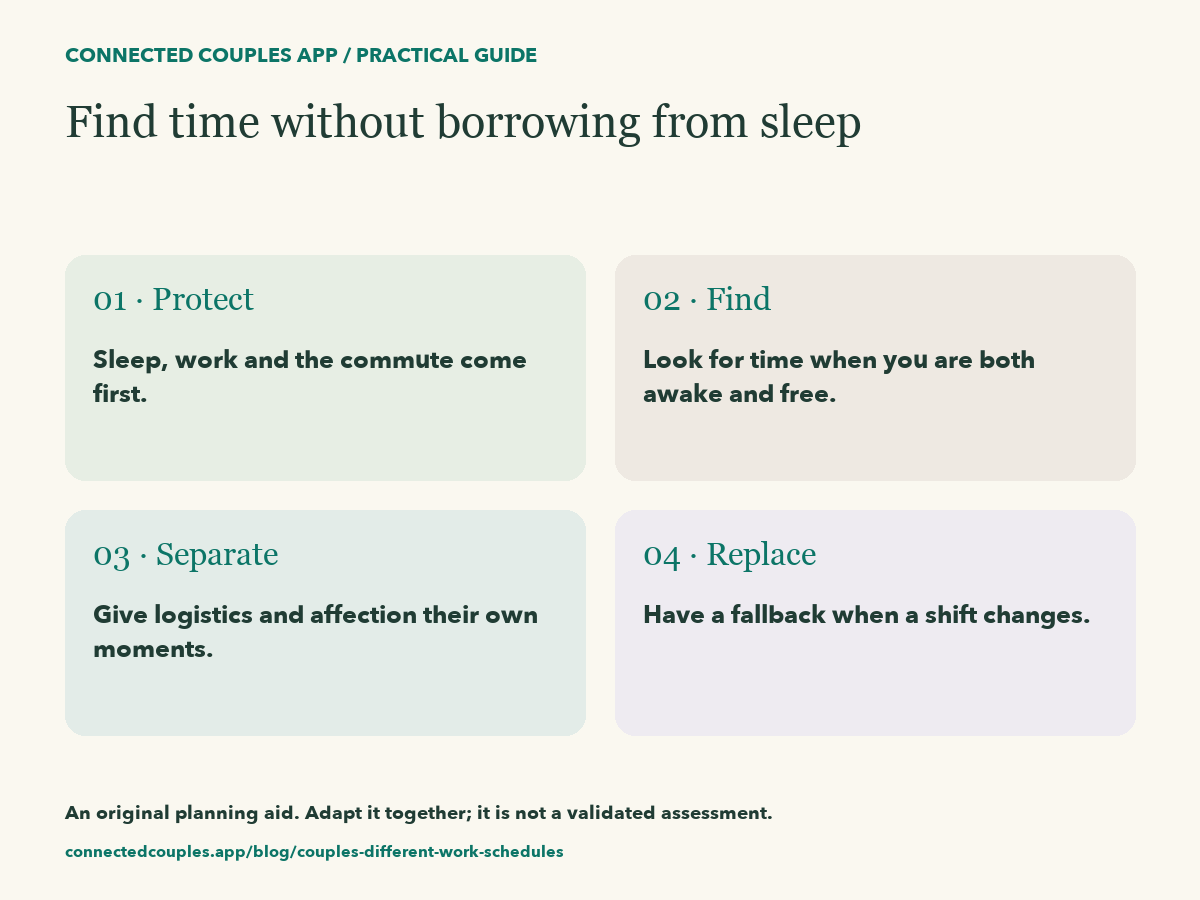
Find time without borrowing from sleep
- Protect
Sleep, work and the commute come first.
- Find
Look for time when you are both awake and free.
- Separate
Give logistics and affection their own moments.
- Replace
Have a fallback when a shift changes.
Try it together · Free tool
Find your shared awake time
Enter one genuinely free window for each of you in the same local time zone. Exclude sleep, work, driving and care duties. Overnight windows are supported; this compares a repeating 24-hour day, not a dated calendar.
Your answers stay in this page. They are not saved by us or sent to your partner. Refreshing clears the draft; download it if you want to keep it. Basic tool-use analytics contain no answers.
Your conversation draft
Start with the week you actually have
It is 7:10 a.m. One person wants to tell a story from work. The other is looking for a clean shirt and calculating whether there is time to eat. Neither is doing anything wrong. They are having two different moments in the same kitchen.
If your hours overlap but you share the same workspace, use our guide to working from home together to agree on quiet space and interruptions.
Before deciding you need to try harder, put both schedules on paper. Include the parts a work calendar hides: the drive home, getting ready, unwinding, sleep and responsibility for children or relatives. A blank square is not automatically free time.
NIOSH advises families to help protect a shift worker’s sleep and reduce expectations during recovery time. That is a useful starting constraint for your plan. Read the NIOSH guidance.
Take turns marking your own unavailable time. Do not assign your partner a sleep window because it happens to suit dinner. Then ask: “Where is there enough energy for a little contact, even if this is not the time of day we imagined?”
Give three kinds of contact different jobs
| Moment | What belongs here | Example agreement |
|---|---|---|
| Household handoff | Information the next person needs | Before leaving: pickup time, dinner location, one unfinished task. |
| Small connection | Affection or interest, without a meeting agenda | After waking: one voice note about something that happened. |
| Longer conversation | Decisions and topics needing attention | Sunday after breakfast, after both have slept. |
These are planning examples, not research-backed time requirements. A two-minute handoff may be enough on Tuesday and hopelessly short on Friday. The distinction matters more than the timer: if every interaction contains a list of things that went wrong, you can start dreading your only overlap.
Try an opening like: “Two things you need before I leave, then I want to hear the end of your story.” If the story has to wait, say when. “Later” is much less reassuring than “when I wake up this afternoon.”
Make the handoff usable for a tired person
A good handoff answers three questions: what happened, what is next, and who owns it. “The washing machine is broken” creates another investigation. “The washer will not drain; I called the repair service; they will text me tomorrow” gives the next person a complete picture.
- Separate urgent information. Put a changed pickup time at the start of the message.
- Close the loop. If a task is handled, say so. Silence should not require your partner to check.
- Use one place. A shared note or calendar is easier to follow than texts scattered across three apps.
- Do not require replies during work or sleep. Agree how a real emergency will be handled.
If you share care duties, name who is responsible during each window. Being physically home after a shift does not make someone automatically available. Equally, the other partner’s uninterrupted work or rest matters too. If neither person has the capacity, the answer may be help, a simpler routine or a work discussion.
A plan for a night-shift household
Illustrative example: Alex works nights and sleeps through much of the day. Sam works daytime hours. Their first plan is to eat dinner together daily. It falls apart because Alex is either rushing out or still asleep.
They replace it with one flexible meal on a day off, a brief conversation before Alex leaves when possible, and a voice note that Sam can answer after work. They also move the discussion about bills away from the doorway. When overtime removes the conversation, neither has to invent a replacement: the voice note is already their fallback.
The useful question at the end of the week is not “Did we do every item?” It is “Did we know when we would hear from each other, and did either person pay for the plan with sleep or extra unpaid work?”
When the plan keeps falling apart
The available time is too exhausting. Switch from a decision-heavy talk to quiet company, or move it. Do not use a tired yes as agreement to something important.
If business demands repeatedly interrupt the time you found, discuss boundaries when your partner owns a business, including dependable availability and voluntary help.
One person always initiates. Assign the next invitation in advance. “You choose our next free window when the roster comes out” is clearer than hoping your partner notices the imbalance.
A missed message feels like rejection. Agree what a delay usually means. “No reply during a shift means I am working; I will check after I get home” reduces guesswork without promising constant availability.
You genuinely have no sustainable overlap. Look beyond the relationship routine. Discuss whether either employer offers schedule predictability or flexibility, whether a commute can change, or whether care support is available. Those options may be limited. Naming the limitation together is more useful than accusing each other of not prioritizing love.
Review the arrangement after one real week
Keep the part that helped. Drop the part you both avoided. Ask each other for one adjustment, such as a quieter morning, an earlier roster discussion or a weekend without catching up on every chore.
Research on nonstandard schedules describes different experiences across couples and types of work. It does not mean opposite shifts doom a relationship. Mills and Täht’s study is useful context; your actual sleep, responsibilities and sense of connection are the things to review.
Common questions
Can a relationship work with opposite schedules?
Yes. The practical question is whether both people can get rest, dependable contact and a fair share of responsibilities. If the schedule makes those impossible, the problem may require changes to work or outside support, not more effort after midnight.
What if we have no free time together on workdays?
Choose an asynchronous message that needs no immediate reply, and name the next realistic time to talk. Keep urgent practical messages separate so neither partner has to scan a long emotional conversation for a pickup change.
Should I stay awake to see my partner after a night shift?
Do not make lost sleep the routine price of connection. Find time after rest or on a different day. Persistent sleep difficulty or severe fatigue deserves advice from a healthcare professional.
What if our shifts change every week?
Rebuild the plan when the roster arrives. Keep the same process rather than insisting on the same day: protect sleep, find overlap, divide the handoff and choose a fallback.
Sources & editorial notes
Written by the Connected Editorial Team. The examples are illustrative, and the scripts, visual guide and planning tool are original editorial resources. They are not validated assessments, individualized advice or a substitute for professional care. Source notes explain the scope of the supporting material.
- NIOSH: Help from family and friends
Occupational-health guidance on protecting sleep. It does not prescribe a couples schedule.
- Mills & Täht (2010): Nonstandard work schedules and partnership quality
Dutch couple data and interviews; associations vary by schedule and context, not a prediction for an individual couple.
Published September 7, 2026. Send a correction or tell us what would make this guide more useful.