 Connected
You're at the same kitchen table, but you're having different mornings. One of you has a gap between meetings and wants to talk. The other has finally found the sentence they need for a report. Then the doorbell rings, and you both wait for the other person to get up.
A useful starting point is a small workday agreement: where each person works, when interruptions are welcome, what counts as urgent and how you will reconnect afterward. You can enjoy having your partner nearby without making every working hour available to each other.
This guide is for couples sharing a home workspace. If your main challenge is being awake at different times, use our guide to couples with different work schedules.
Evidence, with the context kept in
Working at home is common. Availability still needs an agreement.

What this does and doesn't tell us: This includes partial days and extra work at home. It is not the percentage with fully remote jobs, and it does not measure couples.
Put it to use: Being at home tells you where someone is working. Agree separately on when they can talk.
Get the chart, data and citation
The numbers come from the source linked above; Connected created the chart. These are published statistics, not an original Connected study.
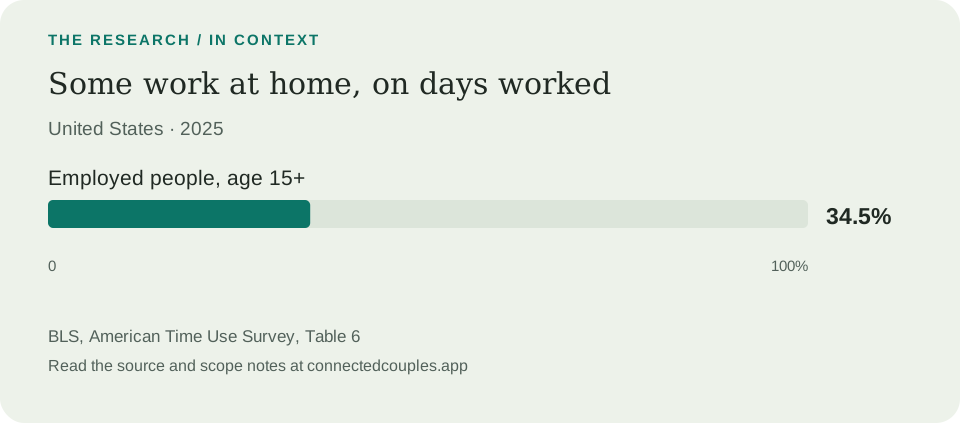
BLS, American Time Use Survey, Table 6. United States · 2025. Chart by Connected Editorial Team, October 2, 2026. Please retain the source, date and scope when sharing.
Start with what happened yesterday
Start with the last few workdays. What actually got in the way?
Perhaps a video call was interrupted by lunch questions. Someone always moved to the uncomfortable chair. A meeting ran late, and the other person assumed they would make dinner because they were already in the kitchen.
Describe the event without making it a character verdict: “When you asked about Saturday during the report, I lost my place” is easier to work with than “You never respect my job.” Ask your partner what was happening on their side, too. A request that felt casual may have arrived during their most demanding hour.
NIOSH's working-from-home guidance recommends boundaries around time and physical space, periods for focused work and detaching at the end of the day. Use those ideas to identify what each of you needs to get through the working day. Your agreement should fit your jobs and your home.
Who gets the room with a door
The person with the louder voice, higher income or earlier start should not automatically get the best workspace. Compare practical needs: confidential calls, equipment, accessibility, concentration and whether a meeting time can move.
If one room has a door, reserve it for a confidential interview or client conversation before giving it to ordinary email. If both jobs need quiet simultaneously, headphones may help with some noise, but they don't solve privacy. You may need to ask an employer about another workspace or a different meeting arrangement.
Check that both workstations are usable. OSHA's computer workstation guidance emphasizes fitting the setup to the person rather than assuming one arrangement suits everyone. A fair room schedule still needs adjustment if it leaves one partner uncomfortable all week.
In a small home, use time as well as space. You might alternate the table, put work equipment away for dinner or agree that one corner is visually off duty after a certain point. Avoid making a permanent office out of the only place your partner can rest without talking about it first.
Agree on three interruption signals
Choose signals you can both recognize. They can be words, a desk note or an agreed message. Headphones alone are ambiguous if one person wears them for music and the other for concentration.

Read the graphic as text
Working from home, together
An interruption agreement
FOCUS: Use a visible focus signal. Agree what the signal means and when contact can resume.
AVAILABLE: Choose interruption-friendly windows. Invite routine questions, chores, or a quick hello.
URGENT: Define a true interruption. Name what cannot wait. Reconnect after the interruption.
Fill in your own signals and times. Revisit when schedules change.
Use three clear signals. Focus means nonurgent questions wait until the next agreed opening. Available means brief conversation is welcome, with a fresh check before a longer discussion. Urgent means a safety issue or another clearly agreed time-sensitive need can interrupt either state. Each focus period also needs a realistic point for contact to resume.
Define urgent together. A leaking pipe is different from deciding what to order for dinner. A care responsibility can be urgent, but repeatedly calling it an interruption may hide a missing care plan. Name who is responsible during each period rather than assuming the person at home is always on call.
The signals should protect both people. “Focus” cannot mean one partner is exempt from all household coordination for the foreseeable future.
“Being in the next room doesn't mean you're available. A good workday agreement lets you ask for quiet without having to reassure your partner that you still want them around.”
Kayla Crane, LMFT
Write a one page workday agreement
Put these prompts in a shared note or write them on paper. Keep the wording ordinary enough that you'll actually use it during a busy morning.
| Part of the day | What to agree | Example wording |
|---|---|---|
| Workspace | Who needs which space and when | The room with a door is reserved for booked confidential calls |
| Focus | Signal and end point | My desk note means hold nonurgent questions until lunch |
| Availability | How to check before talking | Ask whether I have a minute before starting the story |
| Urgency | What justifies an interruption | Safety, an agreed care need or a time-sensitive delivery we both knew about |
| Shared work | Who owns daytime household tasks | Each person handles the tasks they accepted, including follow-through |
| Workday finish | How to signal the transition | Say whether work is finished or when the next update will be |
Complete the rows together. If you disagree, write a short trial rather than making an indefinite rule. Check it after enough ordinary days to encounter the actual problem.
Keep workplace confidentiality separate from relationship openness. Your partner does not need access to employer systems, messages or client information to believe you are working. Move private conversations out of earshot when necessary and follow your workplace's requirements.
One quiet room and two people who need it
Imagine Rowan and Ellis, a couple sharing one spare room. Rowan has unpredictable client calls. Ellis edits long documents and finds it hard to restart after interruptions. They both assume the spare room should solve their problem, but whoever gets there first stays all day.
They agree that booked private calls take priority for the room. Rowan shares only the time blocks needed, without confidential meeting details. Ellis reserves uninterrupted editing periods around those blocks. On a morning when two important needs collide, they discuss alternatives before work instead of asking Ellis to move mid-paragraph.
They also stop using “Are you busy?” as a guessing game. Ellis says, “I can talk at twelve. If this needs a decision before then, tell me the deadline.” Rowan saves ordinary questions in a note rather than delivering them one at a time.
After several days, they notice a new imbalance: Ellis is answering the door during every editing period. They change the delivery plan. The room booking wasn't the whole problem. They also needed to decide who would stop working when the doorbell rang.
Let each other know when work is over
Being in the same home all day does not guarantee that you have spent time together. A workday can end with plenty of proximity and very little attention.
Choose an ordinary transition. Close the laptop, change clothes, step outside or clear the table. Then check whether the other person has also finished. You don't need to finish at the same time to acknowledge the change.
Try: “I'm done for today. Are you free to eat at seven, or should I plan separately?” If work is continuing, offer honest information rather than repeatedly saying “just five minutes.”
Some days, you will want conversation. On others, you may want quiet. Our guide to alone time in a relationship can help you make that request without leaving your partner guessing. A work boundary and an evening need for solitude are separate agreements.
When the arrangement keeps breaking
One partner forgets the signal. Make it clearer and easier to notice. Then discuss repeated interruptions directly. A perfect color system cannot replace willingness to respect a request.
The job makes planning unpredictable. Use shorter planning horizons. Agree what happens when an unexpected call arrives and who updates the plan. Flexibility should be mutual, even if each day is uneven.
All the chores drift toward the more flexible worker. List the work that moved, including ordering, remembering and following up. Flexibility can make a task possible; it does not make that person its automatic owner.
You feel watched or managed. Remove productivity checks from the agreement. It is about sharing a home, not proving how hard either person works. A partner repeatedly monitoring screens, restricting work or punishing reasonable boundaries needs a different conversation and potentially outside support.
Try it on a difficult day
When both calls really are immovable
Fictional example
The shared calendar shows two confidential calls at 10 a.m. Both partners already promised to attend. Repeating the rule about booking the room will not solve today's collision.
- List the actual requirements: privacy, quiet, equipment and internet. A headset solves some noise problems, but not confidentiality.
- Check feasible alternatives before assigning the room: reschedule one call, use an employer-approved private space, or ask the employer about another arrangement. Do not assume a café is private.
- Record who needs first choice next time and when you will book the room. If collisions repeat, ask about schedule flexibility rather than expecting one partner to keep absorbing them.
The useful review: After a week, compare the interruptions you actually experienced with the exceptions you agreed. A signal that either person has to defend repeatedly needs changing.
Make it yours
Make tomorrow's workday agreement
Choose one recurring collision to solve first. Each person should confirm the commitments before you treat this draft as agreed.
Your entries stay in this tab and are not sent by this worksheet. Download your draft before closing or reloading; it is not saved automatically.
Your draft to discuss together
Check that both people agree before treating this as a commitment. Blank items remain open questions.
Common questions
Should couples take every work break together?
Only if you both enjoy that. A break can be social, quiet or used for a personal errand. Ask rather than treating every break as reserved couple time.
What if we cannot afford separate workspaces?
Start with scheduled access to the best available space, clear interruption signals and a way to put equipment aside. If the arrangement cannot meet essential privacy or accessibility needs, explore what help your employers can provide.
What is the smallest change worth trying tomorrow?
Choose one recurring interruption, agree how it will be handled and name when you will reconnect. A narrow agreement is easier to evaluate than a complete household overhaul.
For a small point of connection after the laptops close, try Connected and answer a daily question together. Let the answer begin a conversation when you are both available, outside the focus time you agreed to protect.
Sources & editorial notes
Published by the Connected Editorial Team, with a quote from Kayla Crane, LMFT. Examples are fictional. The worksheets and graphics are original editorial planning aids, not validated assessments or a substitute for professional care.
- BLS, American Time Use Survey, Table 6
United States · 2025. This includes partial days and extra work at home. It is not the percentage with fully remote jobs, and it does not measure couples.
- working-from-home guidance
NIOSH occupational-health guidance supports focus periods, time/space boundaries and detachment; no claim this worksheet is validated.
- OSHA's computer workstation guidance
OSHA official workstation guidance supports fitting the setup to the user rather than one universal arrangement.