 Connected
The quick answer
There is no single amount of alone time that is right for every couple. A useful arrangement gives each person room to rest or pursue interests, keeps shared responsibilities fair, and leaves dependable time together. Explain what you need, propose a realistic window and say when you will reconnect. Review how it works for both people.
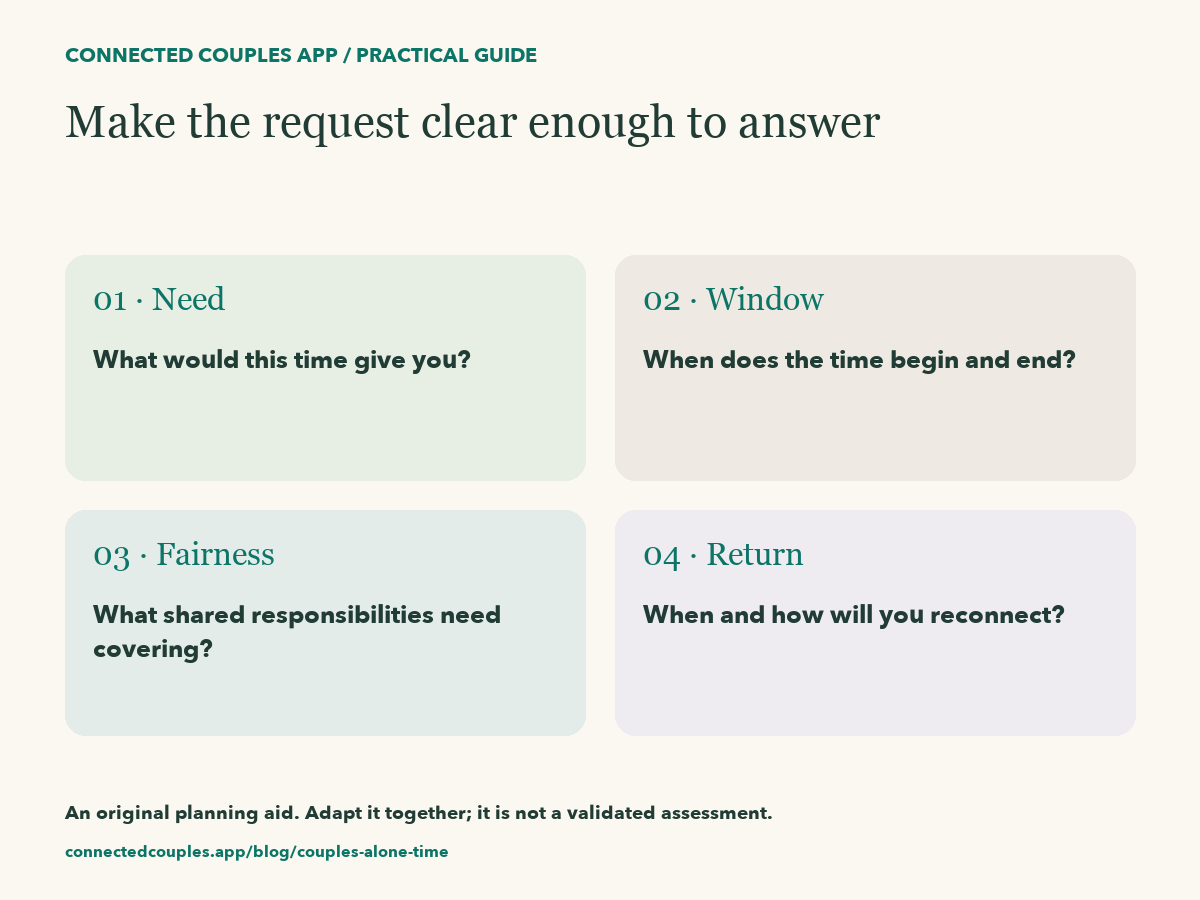
Make the request clear enough to answer
- Need
What would this time give you?
- Window
When does the time begin and end?
- Fairness
What shared responsibilities need covering?
- Return
When and how will you reconnect?
Try it together · Free tool
Write a clear alone-time request
Use ordinary language. Keep personal details out if you plan to download or share the draft. This is a request builder, not a message sent to your partner.
Your answers stay in this page. They are not saved by us or sent to your partner. Refreshing clears the draft; download it if you want to keep it. Basic tool-use analytics contain no answers.
Your conversation draft
Say what space means before your partner has to guess
“I need space” can mean an uninterrupted bath, a weekend with friends or uncertainty about the relationship. If you mean the first, do not leave your partner trying to decode the third.
Name the ordinary need: “I have been talking to people all day and want a quiet hour.” Then explain what you are asking for and when you expect to reconnect. You are not asking permission to have an inner life. You are coordinating a shared one.
If you are unsure about the relationship itself, say that in a separate, honest conversation. A promise to reconnect after a short break should not conceal a much larger question.
Replace the hour-counting argument with better questions
A 21-day diary study of 178 people explored daily solitude and well-being. It does not establish an ideal amount of time apart for romantic partners. Avoid borrowing a universal quota from a social-media graphic.
Instead, ask what the current arrangement produces in your actual life:
- Does alone time leave the person more rested or able to engage?
- Does each partner have a real opportunity for independent time?
- Are necessary conversations happening, even if they need scheduling?
- Do both people still have shared time they enjoy?
- Is someone quietly doing extra care or household work to make the arrangement possible?
One couple may enjoy separate hobbies most evenings and feel close over breakfast. Another may want more shared evenings. The goal is an arrangement you can discuss and revise, not matching someone else’s ratio.
Make a request with four concrete parts
The need: “I want some quiet time to read.” You do not need to present an argument proving you are exhausted enough.
The window: “Could I take Saturday morning until eleven?” A bounded request is easier to coordinate than disappearing whenever the day becomes difficult.
The responsibilities: “I will do lunch and give you the afternoon window we discussed.” If you share care duties, make the coverage explicit and realistic.
The reconnection: “I would like to have lunch together afterward.” Promise something you want and can do, not a compensatory date you will resent.
Try the request builder above. Read the draft aloud. Remove any wording that feels formal, defensive or unlike you.
Fair access matters more than identical activities
Illustrative example: Fin plays a sport on Saturday mornings. Lou stays home with their child and is told to “take time whenever you want.” But there is no identified window when Lou is actually free of responsibility.
They choose an afternoon block when Fin handles care from start to finish. Lou can go out or stay home without being the backup person. Fin’s sport does not need to disappear for the arrangement to become fairer.
The same issue occurs without children. If one partner’s hobby always leaves the other with meals, errands and cleanup, time apart may feel less like independence and more like a transfer of work. Address the transfer directly.
Make space in a small home
You may not have a spare room or money for separate outings. Define what quiet means in the space you have. Headphones, different activities in the same room, a walk or taking turns using the bedroom can be practical options.
Agree which interruptions are necessary. A genuine care need is different from asking where the charger is when you could look for it. If a quiet block is interrupted, discuss whether another window is possible instead of treating it as a failure of goodwill.
When space starts feeling like avoidance
| Restorative arrangement | Pattern that needs a different conversation |
|---|---|
| The purpose is understandable. | Silence is used to make someone anxious or compliant. |
| Shared commitments are covered. | One person repeatedly abandons agreed responsibilities. |
| Necessary topics are revisited. | Every difficult topic is postponed indefinitely. |
| Either person can express a need. | Only one person’s time and preferences count. |
A pause during conflict is a related but different issue. If you need help recognizing punitive withdrawal, read our guide to the silent treatment. Do not diagnose the pattern from one tired evening.
Keep the return ordinary and reliable
When you come back, acknowledge each other. You do not need to prove that alone time transformed you. “Thanks for the quiet hour. How was your morning?” is enough to reopen contact.
After trying the arrangement, ask what helped and what still felt difficult. Adjust the timing, coverage or amount of shared time. Independence and closeness are both easier when neither has to be obtained through guessing, guilt or a fight.
Common questions
How much alone time is healthy in a relationship?
There is no universal number of hours. Look at whether the arrangement feels chosen, restores the person taking it, covers shared responsibilities and leaves both partners with enough connection.
Does wanting space mean I do not love my partner?
Wanting time alone does not establish that. Explain what you want the time for and how it fits alongside the relationship. If you are actually uncertain about the relationship, address that honestly rather than disguising it as a short break.
What if we live in a small apartment?
Define a modest quiet period, use a room or corner in turns, or take separate walks when practical. You do not need a dedicated room, but you do need an agreement about interruptions and shared work.
How is alone time different from silent treatment?
Restorative time has an understandable purpose and does not use silence to punish or control. Withholding contact to force compliance or indefinitely avoiding necessary conversations is a different pattern. Context matters more than the number of minutes.
Sources & editorial notes
Written by the Connected Editorial Team. The examples are illustrative, and the scripts, visual guide and planning tool are original editorial resources. They are not validated assessments, individualized advice or a substitute for professional care. Source notes explain the scope of the supporting material.
- Weinstein et al. (2023): Balance between solitude and socializing
A 21-day diary study of 178 participants examining daily solitude and well-being. It is not a study establishing an ideal quota of time apart for couples.
- APA: The benefits of solitude
Researcher discussion distinguishing experiences of solitude; not a prescription for an individual relationship.
Published September 7, 2026. Send a correction or tell us what would make this guide more useful.