Understanding08
Rebuilding Trust Worksheet for Couples
Name the impact of a broken agreement, distinguish promises from observable actions, and plan a voluntary review of what happens next.
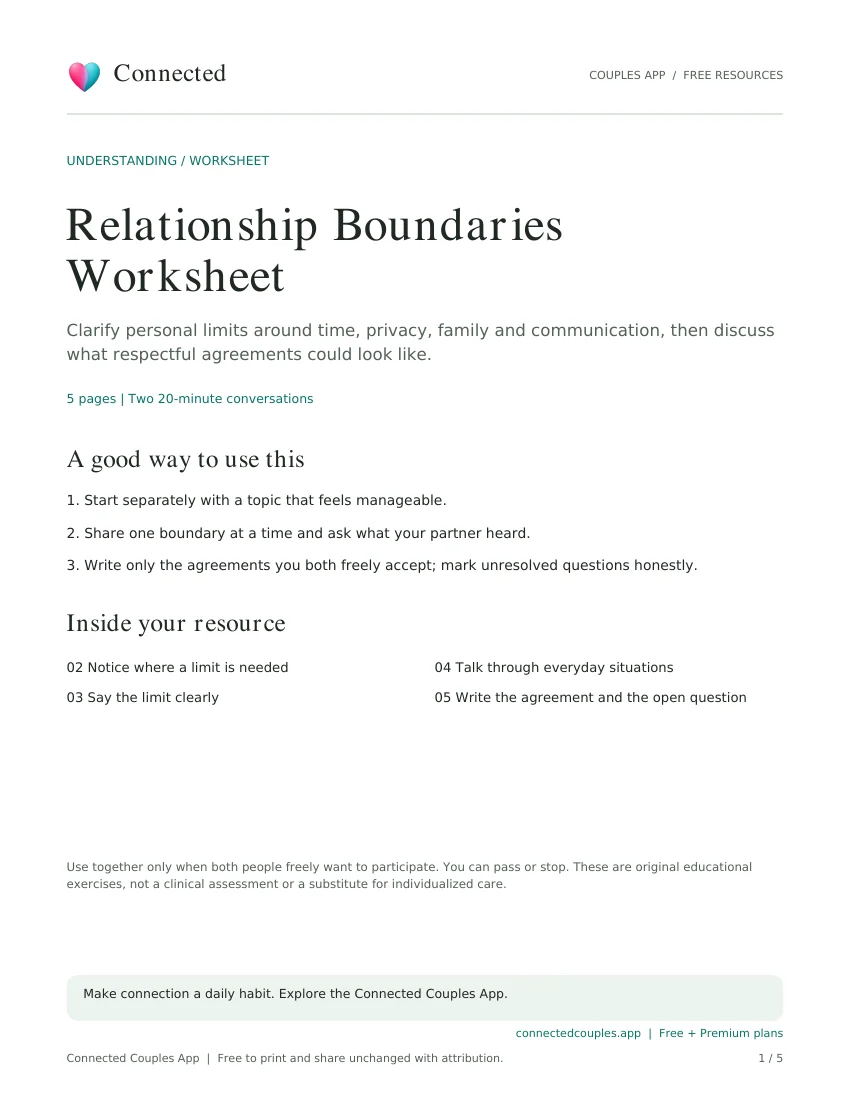
Preview & downloadClarify personal limits around time, privacy, family and communication, then discuss what respectful agreements could look like.
5 pages · Printable PDF · 347 KB
No signup. Two 20-minute conversations. Read the exercises below.
A boundary describes a limit around your own participation, time or access. An agreement is something both people choose together. This worksheet helps you tell the difference so a request for privacy does not become a demand to control your partner. You can understand a limit without having identical preferences.
Original educational resource by Connected Couples App. Published September 7, 2026.
Open a section to read it comfortably on your phone. The PDF includes the same exercises with space to write or printable cards.
Think about a situation where you often feel stretched, interrupted or uncomfortable. Your feelings are information to explore; they do not automatically tell you what another person must do.
Example"I need half an hour to decompress after work" describes a need. "You cannot talk to anyone after work" tries to control another person.
Answer separately, then take turns sharing. The PDF has writing space for Partner A and Partner B.
State what you are comfortable with and what you will do if the situation continues. Keep the action proportionate and within your control. A boundary is not a threat designed to make someone obey.
Example"I will not continue a conversation with name-calling. I will pause and discuss a time to return when we can speak respectfully."
Answer separately, then take turns sharing. The PDF has writing space for Partner A and Partner B.
Choose two topics from this list. Each person explains their preference before you try to make a shared agreement.
| Topic | Partner A preference | Partner B preference |
|---|---|---|
| Time alone and time together | Your notes | Your notes |
| Phones, messages and privacy | Your notes | Your notes |
| Visits or requests from family | Your notes | Your notes |
| Sharing personal stories with others | Your notes | Your notes |
| Money and joint decisions | Your notes | Your notes |
| Touch and affection | Your notes | Your notes |
No partner owes passwords, location access or physical affection to prove love. Consent and privacy remain relevant within a committed relationship.
It is okay to need time. An agreement should say what each person chooses, not only what one person has to stop doing.
Example"We will check with each other before inviting overnight guests. We still differ about visit length, so we will discuss that before the next invitation."
Use the writing space in the PDF for your shared notes or the named person’s response.
5 pages. Free to print and use together. Print at Actual Size on US Letter or Fit on A4.
It is a printable PDF with writing space or cards, not an interactive form. Print it or use the annotation tools in a PDF reader. The webpage version is available above for reading on smaller screens.
No. Share only what you freely choose. Either person can skip a prompt, stop, or suggest another time. These exercises are invitations to talk, not tests of commitment.
There are no answer forms on this page. Downloaded worksheets stay wherever you choose to save them. Website analytics measure resource-link and app-link clicks, not worksheet answers. See our privacy policy.
Name the impact of a broken agreement, distinguish promises from observable actions, and plan a voluntary review of what happens next.
Preview & downloadCompare the ways you each like to give and receive care, and turn a general preference into a specific, welcome gesture.
Preview & downloadPractice starting a difficult conversation, listening without preparing a rebuttal, and making a request your partner can actually act on.
Preview & download