 Connected
The quick answer
An introvert–extrovert relationship works better when partners negotiate specific activities, company and recovery time instead of treating personality labels as instructions. Agree which events matter, how long you will stay and whether leaving separately is practical. Neither partner should have to provide the other’s entire social life or give up all shared experiences.
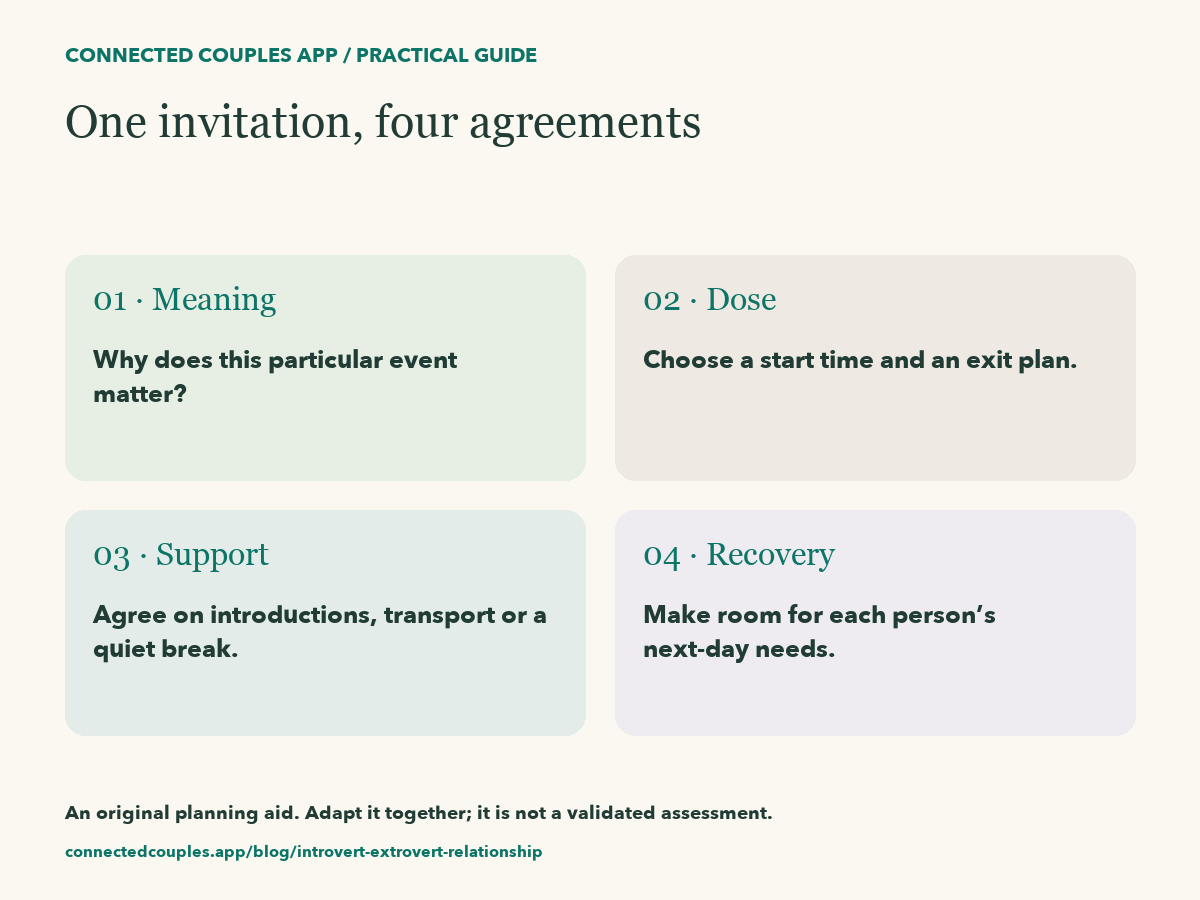
One invitation, four agreements
- Meaning
Why does this particular event matter?
- Dose
Choose a start time and an exit plan.
- Support
Agree on introductions, transport or a quiet break.
- Recovery
Make room for each person’s next-day needs.
Try it together · Free tool
Make an agreement for one event
Pick the situation you are planning around. Use the draft to start a conversation; it is not a personality test.
Your answers stay in this page. They are not saved by us or sent to your partner. Refreshing clears the draft; download it if you want to keep it. Basic tool-use analytics contain no answers.
Your conversation draft
Talk about the invitation, not the label
“You never want to do anything.” “You cannot spend one evening at home.” A conversation that began with dinner at a friend’s house has become a verdict on both personalities.
Try shrinking it back to the actual invitation. Is the difficulty the crowd, the late finish, the cost, the person hosting, or three consecutive evenings without a break? Those are different problems. You cannot solve all of them by telling someone to be more outgoing.
The American Psychological Association describes introversion as a trait on a continuum. You may enjoy a lively evening with close friends and dislike an open-ended work mixer. Your partner may want a crowd on Friday and silence on Sunday. Ask about today’s capacity.
Translate the complaint into a useful request
| If you are about to say… | Try a more specific request |
|---|---|
| “You always abandon me at parties.” | “Please introduce me to two people before you go catch up with your friends.” |
| “You ruin the fun by leaving.” | “This birthday matters to me. Could we stay through the cake, then decide?” |
| “You need constant attention.” | “I want to hear your story after I have had a quiet half-hour.” |
| “You never leave the house.” | “I miss doing things together outside home. Would a quiet breakfast out work?” |
These are original example scripts. Change the wording so it sounds like something you would say. A script is useful only if the commitment inside it is honest.
Make the agreement before getting in the car
First, name the meaning. Your partner’s cousin’s wedding and a casual drinks invitation do not carry the same emotional weight. Explain why your presence matters without making attendance a test of love. “I want you beside me because these people are important to me” gives more information than “A good partner would come.”
Next, choose a realistic dose. Agree on a departure time, an event milestone or a point when you will check in. An exit plan should not depend on the more tired person visibly falling apart. If transport, disability access or cost prevents separate departures, settle a shared plan in advance.
Then, define helpful support. Does someone want introductions, a quiet spot, permission to skip an activity, or simply no teasing about being quiet? Ask rather than treating them like a project. An adult partner does not need to be managed around the room.
Finally, look at the next day. Agreeing to Saturday night is easier when Sunday is not silently committed to another gathering. Make sure recovery time does not transfer all chores or childcare to the other person. Rest belongs in the schedule for both of you.
A wedding and the brunch afterward
Illustrative example: Morgan wants to attend a close friend’s wedding and the next morning’s brunch. Riley wants to celebrate but is dreading two days of conversation with strangers.
The first proposed compromise is that Riley comes to everything but can “take breaks.” That leaves Riley responsible for finding a place to retreat, explaining each disappearance and wondering whether Morgan is annoyed.
A clearer agreement: attend the ceremony and dinner together; Morgan makes introductions early; they check in after the first dance; Riley can take the booked ride home while Morgan stays. Brunch is optional, and they plan quiet time together later. If a second ride is unaffordable, they choose a shared departure before the wedding.
What changed? The agreement includes the meaning of the event, the practical limits and the moment each person can choose. Neither has to read the other’s face across a crowded room.
Let separate plans support the relationship
Some evenings can be different without becoming distant. One person might see friends while the other reads at home. The important follow-up is whether both still have companionship they enjoy, whether shared time remains dependable, and whether the household work is fairly covered.
Watch for a bargain that appears generous but is not: “Go whenever you want” while one partner always handles bedtime and cleanup. Or “Stay home whenever you want” followed by hours of sulking. Agree openly about the actual costs.
If one of you is lonely, add a specific shared activity rather than removing all independent plans. If one is exhausted, reduce an obligation rather than demanding a more positive attitude. For negotiating individual space, see our guide to alone time as a couple.
After the event, change one detail
Ask what helped and what was harder than expected. Perhaps the gathering was fine but the hour-long goodbye was miserable. Perhaps separate transport worked, but one person wanted a message when the other arrived home.
Use that detail for the next invitation. Do not treat one successful outing as proof your partner no longer needs recovery, or one difficult evening as evidence they can never attend again. The plan should learn from experience.
Common questions
Are introverts and extroverts compatible?
A label cannot tell you whether a particular relationship will work. Look at how you negotiate invitations, protect rest and respond when your partner wants something different.
Should the extroverted partner go out alone?
Going to some events separately can be a practical option if both people retain meaningful time together and shared responsibilities are covered. It should not require the other partner’s constant permission or leave them doing all the care work.
Is introversion the same as social anxiety?
No. Introversion is a personality trait. Distress or fear around social situations is a different issue and should not be diagnosed from a partner’s preference to stay home.
What if one partner never wants to attend anything?
Ask about the specific obstacle: fatigue, cost, accessibility, conflict with someone attending, or lack of interest. Then discuss which shared occasions matter. A personality label should not end every conversation.
Sources & editorial notes
Written by the Connected Editorial Team. The examples are illustrative, and the scripts, visual guide and planning tool are original editorial resources. They are not validated assessments, individualized advice or a substitute for professional care. Source notes explain the scope of the supporting material.
- APA Dictionary: Introversion
Defines introversion as a broad trait on a continuum, not a fixed category or diagnosis.
- APA: The benefits of solitude
A researcher interview about solitude and individual experience. It does not establish a compatibility formula.
Published September 7, 2026. Send a correction or tell us what would make this guide more useful.