 Connected
“After this deadline” sounds reasonable until another deadline arrives. One partner is preparing for exams, a thesis milestone or a demanding assessment. The other is trying to be understanding while wondering when ordinary life together is coming back.
To protect your relationship during an intense academic period, make the pressure visible and the temporary arrangement specific. Name the dates, protect essential study and rest, agree on household coverage and choose a small amount of contact you both genuinely want. Set a point to reset the arrangement, even if the wider program continues.
Start with the stretch of study in front of you. You'll need a plan that can change when an exam moves, a draft takes longer or the other partner has a difficult week too.
Evidence, with the context kept in
Long-hours culture is a reason to make the limits explicit.

What this does and doesn't tell us: Respondents were self-selecting. This is not a representative estimate for all graduate students, a required work schedule or a measure of relationship health.
Put it to use: Give temporary household changes a review date even if the degree itself has no nearby finish line.
Get the chart, data and citation
The numbers come from the source linked above; Connected created the chart. These are published statistics, not an original Connected study.
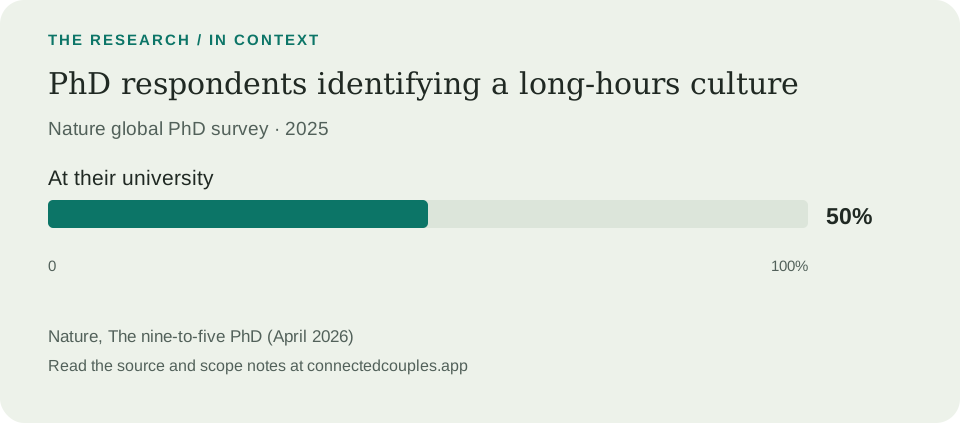
Nature, The nine-to-five PhD (April 2026). Nature global PhD survey · 2025. Chart by Connected Editorial Team, October 2, 2026. Please retain the source, date and scope when sharing.
Give this period a beginning and a review date
Replace “I'm going to be busy” with the actual milestones you know. Include exams, submission dates, presentations and expected high-demand periods. Mark uncertainties honestly instead of putting every possible hour on permanent reserve.
If the deadline itself can move, choose a review date anyway. “We will reconsider the arrangement after the exam” is different from “We will live like this until graduate school gets easier.”
Ask what is required and what has been assumed. Sometimes the student knows the workload but has not explained it. Sometimes neither partner knows whether an expectation comes from the program, a supervisor or their own anxiety about falling behind. Clarifying academic expectations belongs with the relevant academic contact, not with a partner guessing how much study should be enough.
UC Berkeley's Graduate Division guidance recommends realistic goals, boundaries and discussion of expectations with an adviser. Bring that clearer picture of the workload home, so your partner isn't left trying to work out what can move.
Plan around capacity rather than empty calendar space
A gap between classes is not necessarily a free afternoon. It may contain preparation, commuting, paid work or recovery. Equally, the nonstudent partner's evening is not automatically available to absorb everything academic work displaces.
Each person should identify protected commitments and reasonable rest. The student names study blocks; the partner names their own work, care needs and important activities. If both people study, put both sets of deadlines on the same view without ranking whose qualification matters more.
Protect sleep rather than treating it as the easiest place to find relationship or study time. The CDC's sleep guidance identifies attention, memory and emotional well-being among the functions supported by adequate sleep. Late-night catch-ups aren't a good default if either of you is losing needed rest. If either person is persistently unable to sleep or function, get appropriate healthcare support instead of trying to solve the problem solely through scheduling.
Create an exam season compact
Use one page to record the temporary arrangement. A compact is simply an agreement you can both see and revise. It is not a contract requiring your partner to stay cheerful or your work to go perfectly.

Read the graphic as text
The exam-season compact
A temporary plan for a demanding season
END DATE: Make the demanding window visible. Start: __________ Expected end: __________
STUDY BLOCKS: Protect specific study time. Focus windows: _________________________
HOUSEHOLD COVERAGE: Name essential tasks and owners. Owner: __________ Backup: _____________
SMALL CONNECTION: Choose contact that works for both. Our doable plan: ________________________
RESET DATE: Review the temporary arrangement. We will revisit on: ______________________
Temporary support should have a visible end or review point.
Write down five things. End date means the known milestone or the date when the current period will be reassessed. Study blocks identify protected work periods. Household coverage names who owns essential tasks and what can be simplified. Small connection identifies a realistic invitation to spend time together. Reset date is when you return responsibilities to the agreed baseline or negotiate the next phase.
| Prompt | Write an answer together |
|---|---|
| What period are we planning for | From ___ until ___, reviewed on ___ |
| Which study periods need protecting | The blocks that matter most are ___ |
| What else must be protected | Each person's work, rest and commitments are ___ |
| Who covers essential household work | ___ owns ___, including planning and follow-up |
| What can be simplified or postponed | For this period we will ___ |
| What contact would feel welcome | We would like ___, with ___ as a fallback |
| When does the arrangement reset | We will revisit responsibilities on ___ |
Leave enough room for an ordinary difficult day. If missing one meal together makes the whole plan feel broken, make the plan more forgiving.
Pick something you would both look forward to
Ask what would feel good now, not what would look impressive on a relationship checklist. You might want breakfast together, a short walk, a quiet meal or a few minutes of conversation before one person studies. Choose what fits; you don't need to add all of them.
If you choose a regular moment, decide how to cancel or move it kindly. “I need another hour tonight. Can we have breakfast together tomorrow?” is more informative than disappearing behind a laptop. The alternative needs to be something you can realistically keep.
Give attention to both lives. The partner who is not studying may have a difficult workday, a family concern or something exciting to share. A temporary reduction in shared time does not make their experience irrelevant.
Duke's guidance for graduate student couples specifically recommends communication before and during challenging periods, negotiation around irregular demands and attention to the partner's needs. That includes asking about the other person's day while the course materials are put away.
If you need help choosing what to ask when you do sit down, use a few relationship check-in questions. Pick the questions that fit this week rather than trying to complete a long list.
Make temporary household support genuinely temporary
Agree which tasks move and what ownership includes. “Can you handle food this week?” could mean shopping, choosing meals, cooking, cleaning up and remembering what is running out. Spell out the actual request.
Then discuss what the other person can reasonably offer. Simplifying a routine may be more sustainable than moving the entire routine onto them. You might repeat easy meals, postpone a nonessential project or accept a lower housekeeping standard for a defined period.
Support does not have to be repaid minute for minute, but an agreed reset matters. If a responsibility moves for exam week and never returns, the exam can become the explanation for a permanent imbalance. Our guide to sharing the mental load explores the wider issue of remembering and managing, as well as doing tasks.
“A busy season needs a review date, even when the degree is years from finished. Your partner should be able to ask when the temporary arrangement will change without feeling they're asking you to care less about your work.”
Kayla Crane, LMFT
The exam is urgent and the other calendar still counts
Imagine Noor has a qualifying exam in three weeks. Em has a work deadline during the middle week and a standing weekend commitment. Noor asks for “a little patience” but starts studying every evening, leaving Em to figure out meals and errands.
They replace the vague request with a dated plan. Noor identifies the study periods that matter most. Em explains that the middle week is not available for extra household work. Together, they simplify meals and postpone a nonessential home project. Noor keeps an existing task that can fit around study rather than treating all household work as impossible.
They choose two ordinary moments to spend time together, with a fallback if a study session runs long. Noor agrees to say when a planned moment will not happen. Em agrees not to interrupt protected study for questions that can wait.
They schedule a review after the exam. The review will cover the household arrangement and what each person needs next. It does not require Noor to feel instantly relaxed or celebrate on demand. Noor's exam stays important without making Em's work deadline disappear.
When the busy season keeps stretching
Every week is described as exceptional. Look at the next month together. If pressure is continuous, you need a sustainable baseline rather than a rolling emergency agreement. Consider discussing workload and available support with the program.
One partner keeps interrupting study. Make the protected block and its end point clearer. Ask whether urgent needs lack coverage or whether ordinary contact has disappeared entirely. These are different problems.
The student feels guilty whenever they stop. A partner can offer reassurance, but they cannot settle every academic expectation. It may help to clarify priorities with an adviser, academic support service or trusted mentor.
The other partner feels unable to raise a need. Agree how urgent issues will be handled and when less urgent concerns can be discussed. “After the exam” should not silence a serious concern or make someone afraid to speak.
The plan collapses after a setback. Adjust it to the information you now have. A disappointing result or delayed submission may call for comfort first and a new practical conversation later. Avoid treating a partner's reaction as another assignment to manage.
Try it on a difficult day
When the exam moves and the temporary plan becomes permanent
Fictional example
The exam is delayed by a month. The student assumes the household arrangement will continue. Their partner had agreed to three weeks, not an indefinite transfer.
- Treat the extension as a new request. List what each person can still offer and what has become unsustainable.
- Keep both people's fixed commitments visible. An academic deadline is important, but it does not erase the other person's job, health needs or study.
- Reduce scope where possible: simpler meals, fewer optional commitments, or help the couple can realistically access. Set another review even if the exam date remains uncertain.
The useful review: At the reset, explicitly return each transferred responsibility. A thank-you alone does not return the workload.
Make it yours
Build an exam-season compact
Include the nonstudent partner's fixed commitments too. The result is a draft to agree together, not permission to assign extra work.
Your entries stay in this tab and are not sent by this worksheet. Download your draft before closing or reloading; it is not saved automatically.
Your draft to discuss together
Check that both people agree before treating this as a commitment. Blank items remain open questions.
What changes after the exam
Ask what has actually ended and what remains. Return tasks you agreed to return. Thank each other for specific support, and hear what was difficult without responding that everything should be fine now.
Choose an ordinary way to reconnect before committing to an elaborate celebration. You may want sleep, quiet company, a meal or an outing. If another academic stretch is coming, make the next agreement explicitly rather than carrying the previous one forward by default.
What if both partners are students?
Protect both sets of deadlines and identify conflicts early. Neither person's work should be treated as automatically more important. Where both lack capacity, simplify, postpone or seek feasible outside support.
How much time should couples spend together during exams?
There is no universal quota. Look for an arrangement in which essential responsibilities are covered, both people can raise needs and the contact you agree on is realistic and welcome.
Can a short exam season plan help during a whole degree?
It can help with a defined high-demand period. A multiyear program also needs a sustainable everyday arrangement; repeated emergency plans are not a substitute for that wider discussion.
For a small conversation that is not another academic update, try Connected and answer a daily question when you both have room. Keep it an invitation, especially on the hardest study days.
Sources & editorial notes
Published by the Connected Editorial Team, with a quote from Kayla Crane, LMFT. Examples are fictional. The worksheets and graphics are original editorial planning aids, not validated assessments or a substitute for professional care.
- Nature, The nine-to-five PhD (April 2026)
Nature global PhD survey · 2025. Respondents were self-selecting. This is not a representative estimate for all graduate students, a required work schedule or a measure of relationship health.
- UC Berkeley's Graduate Division guidance
Berkeley Graduate Division provides primary institutional guidance on realistic goals, boundaries and adviser expectations; it is not an intervention study.
- CDC's sleep guidance
CDC official sleep guidance supports the limited claim that adequate sleep supports attention, memory and emotional well-being.
- Duke's guidance for graduate student couples
Duke Graduate School provides primary practical guidance on negotiation and partners needs during graduate study; no universal routine prescribed.