 Connected
Before posting a photo, video, announcement, or private story involving your partner, agree on the specific content and who can see it. Check captions, tags, and location details too. A yes to taking a picture is not automatic permission to publish it, and a past yes does not cover every future post.
For one person, an anniversary photo says, “I am happy to be with you.” For the other, it may reveal a relationship to colleagues, disclose a location, or simply share a moment they wanted to keep private. You can discuss both needs without making posting a test of love.
You can agree about what gets shared without handing over passwords or submitting an entire account for inspection. Keep the conversation focused on the images and information that involve both of you.
Evidence, with the context kept in
Public posting is not a universal relationship ritual.

What this does and doesn't tell us: This is a historical estimate, not a 2026 platform-use rate. It does not measure consent, commitment or the quality of a relationship.
Put it to use: Discuss what posting means to each of you. The absence of a post, by itself, cannot tell you how much someone cares.
Get the chart, data and citation
The numbers come from the source linked above; Connected created the chart. These are published statistics, not an original Connected study.
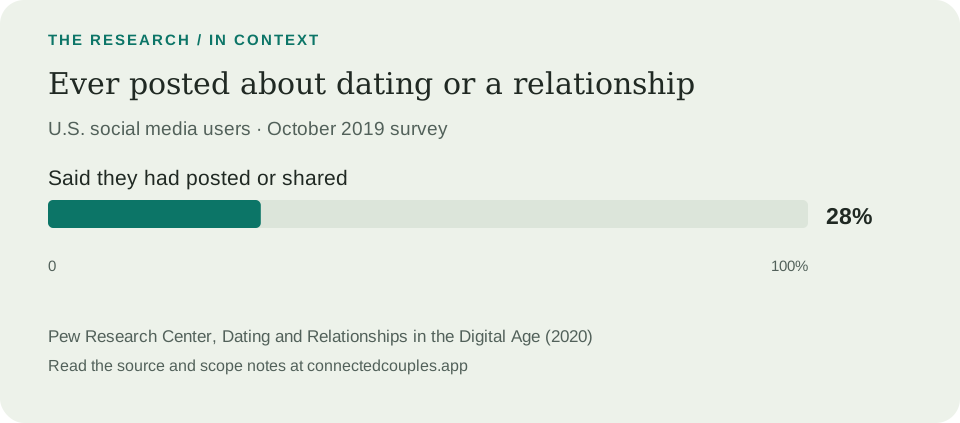
Pew Research Center, Dating and Relationships in the Digital Age (2020). U.S. social media users · October 2019 survey. Chart by Connected Editorial Team, October 2, 2026. Please retain the source, date and scope when sharing.
Ask about the post you actually want to share
“Are you okay with social media?” is too broad to settle much. Show the image or explain the story, and make the audience clear.
A useful request sounds like: “Can I share this photo in my story with my usual audience? I would tag you and say we are away for the weekend.” That gives your partner something specific to consider.
Australia's eSafety Commissioner advises asking before sharing someone's photo or video, and respecting a request to remove it even after consent was initially given. Its guidance also stresses that genuine agreement must be informed and freely given. Read eSafety's photo-sharing consent guidance.
Apply that principle to several separate choices:
- Capture: Are you comfortable being photographed or recorded?
- Content: Is this particular image, clip, or story okay to share?
- Audience: Which people or account followers can see it?
- Context: What caption, tags, and location details will accompany it?
- Reuse: May it appear again later, or in a different setting?
A yes to the photo and a no to the tag can coexist. If the edited version differs materially, show it again before posting.
Use a simple consent check before sharing

Read the graphic as text
Before you post a couple photo
An explicit consent check
ASK: Want to share?. Ask about this specific item and audience.
CLEAR YES: Agree the details, then share. Confirm the caption, tags, and location.
NO OR UNCLEAR: Do not post. No reply is not permission. Hold the item.
CHANGED MIND: Remove your copy. Discuss other copies and what cannot be recalled.
Consent to take a photo is not consent to share it.
Before sharing, ask about this item and audience. Wait for a clear yes, agree the caption, tags, and location, then stick to that agreement. If the answer is no, uncertain, or missing, leave it unposted. If your partner later changes their mind, remove your copy and discuss any other copies you know about.
Silence during a busy workday is not a deadline after which permission appears. “I knew you would say no” is a reason to respect the boundary, not to skip the question.
You can make a narrow standing agreement if both people want one. For example: “Ordinary photos of us at public events are okay in our family group, without live location details. Ask before posting publicly.” Make it easy to change. An agreement should reduce repeated administration without erasing choice.
“A photo can be meaningful to you and still feel too private to your partner. Show them the whole post, including the caption and audience, and leave room for an honest no.”
Kayla Crane, LMFT
Write a posting agreement for the situations you face
Fill in the situations that come up for you. If you mostly share photos with family, start there; you can discuss a public announcement when one is actually on the horizon.
| Content | Our current agreement | Check again when |
|---|---|---|
| Everyday couple photos | Ask about the specific image before public posting | The audience or caption changes |
| Relationship announcements | Agree on wording and timing together | Either person is not ready |
| Tags and live locations | Check separately from the photo | A post shows where we are now |
| Private conversations | Ask before sharing screenshots of ordinary private conversations | Confidential help for mistreatment or safety does not require permission |
| Old photos and reposts | Check before resurfacing something personal | The context or comfort level has changed |
Replace the examples with your actual choices. If one person prefers no identifiable photos, respect that preference while discussing other ways they are comfortable being acknowledged. Do not bargain for a public photo in exchange for ordinary affection or inclusion.
Look at what the image reveals beyond your faces. eSafety's online safety checklist notes that backgrounds, geotags, and tagging can reveal location. A private account does not remove every exposure risk. Read the eSafety online safety checklist.
Check settings together if that helps, but remember that other people may save or redistribute what they see.
Talk about what posting means to each of you
Try two questions before negotiating a frequency:
“What do you hope a post communicates?”
“What would feel uncomfortable or risky about being included?”
One person might want public acknowledgement after feeling absent from a partner's social life. The other might maintain a mostly professional account or dislike sharing personal milestones. Those answers require curiosity about this relationship; you cannot determine the motive from a feed alone.
If the real concern is whether people important to your partner know you exist, discuss that directly: “I would like to feel included in your life. What would that look like in a way we both feel good about?” A coerced photo will not answer all the questions underneath it.
For help distinguishing a request from an attempt to control the other person, read healthy boundaries examples. Your ability to say what happens to images of you does not give you blanket authority over your partner's friendships or account.
An anniversary post with more than one kind of permission
In this fictional example, Tessa has made a short anniversary video containing a restaurant clip, a screenshot of a personal message, and a caption about a difficult year. Robin is happy to appear in the restaurant clip but does not want the message or the private difficulty shared.
Tessa initially hears that as rejection: “I wanted to say something meaningful.” Robin explains, “I want the celebration too. I want those details to stay between us.”
They keep the approved clip, remove the screenshot, and agree on a simple caption. Robin also asks that the location not be posted while they are there. Tessa checks the final version before sharing it.
Neither person gets to define the other's feelings. Tessa can feel disappointed about changing the video; Robin can still decline the disclosure. Their agreement covers this post, not all anniversary content forever.
If something was posted without permission
Start with the action needed: “Please remove that video and the tag. I did not agree to having that conversation shared.” If you are the person who posted, remove your copy promptly rather than making deletion conditional on winning the argument.
Then clarify what happened. Was the audience misunderstood? Was a standing agreement assumed too broadly? Was a stated no ignored? Those are different problems, and an apology should match the actual behavior.
A useful response is: “I posted it without checking. I have removed it from my account. I know that does not guarantee nobody saved it. I will ask about the exact post next time.” If it was also sent directly to other people, discuss a reasonable request for removal without promising control over their copies.
Connected's guide to difficult conversations with your partner can help with the follow-up discussion. But if asking for removal could provoke threats or retaliation, prioritize confidential support and platform reporting options over a joint exercise. Intimate-image abuse requires specialist help; the ordinary posting worksheet is not enough.
Try it on a difficult day
When permission for a photo becomes a surprise announcement
Fictional example
A partner agrees to share a holiday photo with friends. The caption announces a move that they have not told their employer or family about. Permission for the image did not settle permission for that news.
- Hold or remove the post while you clarify the exact content. Do not argue about the caption while leaving the unwanted disclosure live.
- Separate the permissions: image, news, audience, tag, location and future reuse. Ask about each relevant part.
- If it has spread, discuss reasonable repair steps such as asking the account owner to remove it. Be honest that deletion cannot guarantee every screenshot or copy disappears.
The useful review: Make a short list of announcements that always need a fresh conversation. A standing agreement for casual photos should not silently cover private news.
Make it yours
Write consent for one specific post
Use this as a conversation prompt. Filling it in does not grant permission on behalf of the person pictured or described.
Your entries stay in this tab and are not sent by this worksheet. Download your draft before closing or reloading; it is not saved automatically.
Your draft to discuss together
Check that both people agree before treating this as a commitment. Blank items remain open questions.
Common questions
Is it a red flag if my partner never posts me?
That fact alone does not establish why. Ask about their general posting habits, privacy needs, and how you are included in their offline life. Consider the broader pattern rather than using a post count as a relationship score.
Can I talk about my relationship with friends?
You can seek support. Discuss privacy expectations where it is safe to do so, and avoid unnecessary screenshots or identifying details when describing an ordinary disagreement. You do not need a partner's permission to seek confidential help about mistreatment or safety.
Do we have to ask every time?
You may agree on specific routine situations where advance permission applies. Keep the audience and content limits clear, and ask again when something changes. Either person can revise their own consent.
What is a useful first conversation?
Pick one recent, low-stakes example and say what each of you would want checked. If you would like a regular opening for conversations about preferences and comfort, try Connected, which offers daily questions and weekly check-ins. Make the actual posting agreement directly with each other; an app prompt does not provide consent.
Sources & editorial notes
Published by the Connected Editorial Team, with a quote from Kayla Crane, LMFT. Examples are fictional. The worksheets and graphics are original editorial planning aids, not validated assessments or a substitute for professional care.
- Pew Research Center, Dating and Relationships in the Digital Age (2020)
U.S. social media users · October 2019 survey. This is a historical estimate, not a 2026 platform-use rate. It does not measure consent, commitment or the quality of a relationship.
- eSafety Consent for sharing photos and videos
Ask before image sharing, informed freely-given agreement, respect removal requests. Ethical guidance; no general legal claim.
- eSafety Online safety checklist
Backgrounds, tags and image metadata can disclose location; private accounts do not guarantee secrecy.