 Connected
The quick answer
Support a partner after job loss by asking what help they want, addressing urgent practical needs together, and keeping job-search decisions in their hands. Set a separate time to discuss money and changing responsibilities so every conversation does not become a progress report. The employed partner’s worry and workload also deserve support.
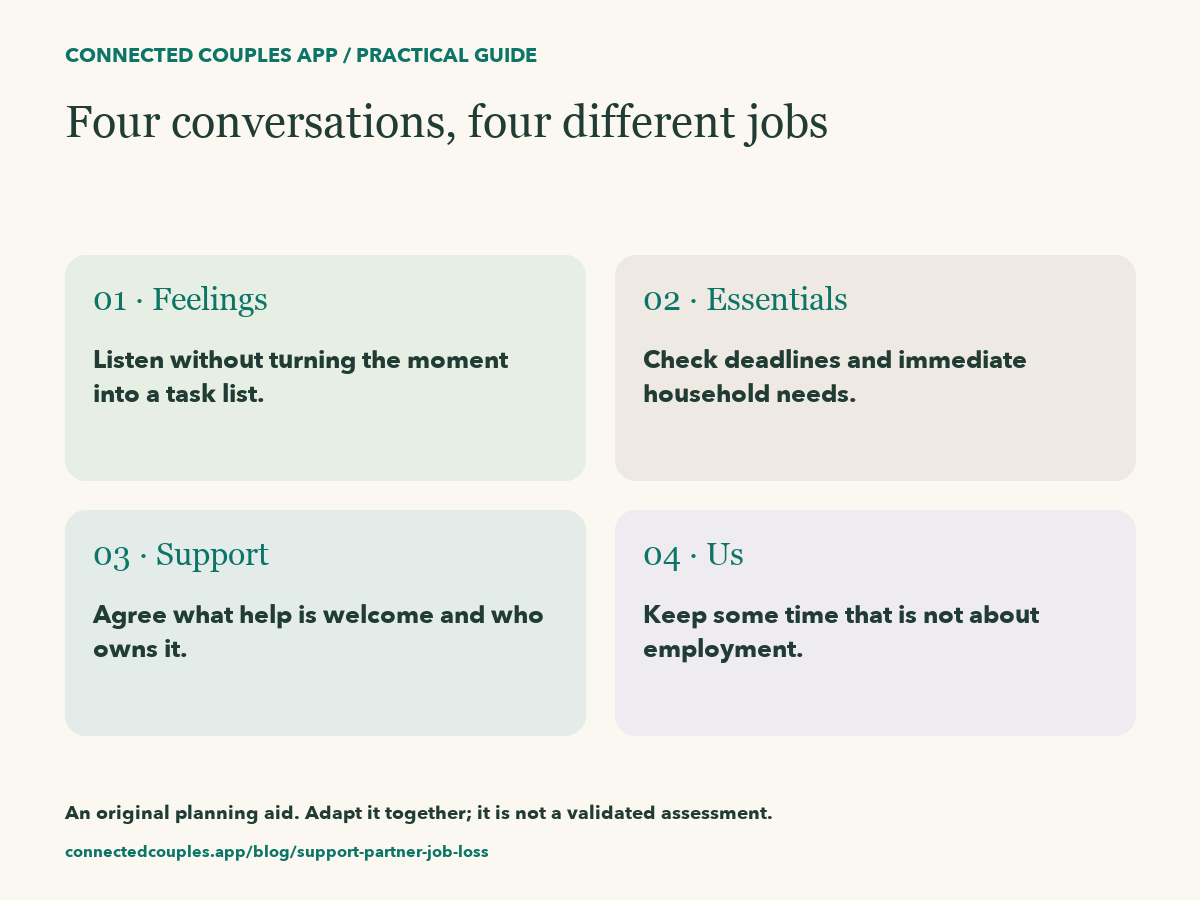
Four conversations, four different jobs
- Feelings
Listen without turning the moment into a task list.
- Essentials
Check deadlines and immediate household needs.
- Support
Agree what help is welcome and who owns it.
- Us
Keep some time that is not about employment.
Try it together · Free tool
Choose useful support for today
Select the immediate need. The draft helps you offer support without assuming what your partner should do.
Your answers stay in this page. They are not saved by us or sent to your partner. Refreshing clears the draft; download it if you want to keep it. Basic tool-use analytics contain no answers.
Your conversation draft
Do not make the first response a strategy session
Your partner says they lost their job. Your mind goes straight to rent, insurance and the car payment. You reach for your phone to send them an opening you saw yesterday.
Pause long enough to find out what just happened. Try: “I am sorry. Do you want to tell me about it, or would you rather have a quiet minute together?” You can address urgent deadlines without skipping over the person in front of you.
Avoid “Everything happens for a reason,” “At least you hated it,” or “You will find something better immediately.” You do not know the outcome. You can offer something more dependable: your attention and an honest plan for the next practical step.
Use the first week to separate the work
| Conversation | What to cover | What to avoid |
|---|---|---|
| What happened | What they want to share and what support feels useful. | Interrogating every decision that led here. |
| Immediate essentials | Known deadlines, bills, coverage and information to obtain. | Delaying a real deadline to avoid discomfort. |
| Help with the search | Whether they want a contact, a résumé read or no help yet. | Sending applications or sharing their news without permission. |
| Household adjustment | Which tasks and expenses change, and for how long before review. | Assuming unemployment makes someone available all day. |
Do not turn “give them space” into a universal waiting period before discussing money. If a deadline is tomorrow, address it today. If nothing is urgent, choose a calm time rather than opening the banking app in the middle of their first conversation about the loss.
Make the money conversation factual and shared
List the income you know about, essential expenses, upcoming deadlines and questions still unanswered. Keep possible benefits or future earnings separate from money already available. The purpose is a common picture, not proving who should have planned better.
For U.S. households, the Consumer Financial Protection Bureau’s job-loss guide offers a starting point for prioritizing bills, exploring coverage and contacting companies about payment options. Check current eligibility and obtain professional advice when a choice has significant consequences.
Discuss changes that apply to the household. If spending must shrink, do not treat only the unemployed partner’s small pleasures as optional while the employed partner’s spending remains unquestionable. Paying more does not confer extra votes on personal decisions.
Offer bounded help, with permission
“I can read one version of your résumé tonight if you want another pair of eyes” is a bounded offer. “I am going to fix your LinkedIn profile” takes over. Even a helpful introduction should wait for permission, because the person may not want a particular contact to know yet.
If the change is a voluntary career pivot, our guide to supporting a partner through a career change covers training, requested support and shared home responsibilities.
Ask how often they want to discuss the search. Some people like a brief update; others find daily questions exhausting. Agree on a time for shared financial decisions regardless of whether there is job news.
JFCS career-service guidance emphasizes listening, adjustment and maintaining support. Use that spirit without expecting the same timeline from everyone. A career transition depends on circumstances neither partner fully controls.
Replace the nightly progress report
Illustrative example: Every evening, Chris asks Taylor, “Any applications today?” Chris means “I am worried about us.” Taylor hears “Have you earned the right to relax?” Dinner becomes tense before either says what they actually need.
They move practical updates to an agreed conversation twice a week. Chris names the financial concern directly, and Taylor says which help is welcome. On other evenings, the opening becomes “How was today for you?” Taylor can discuss the search or something else.
The bills still matter. The relationship now has room for something beyond a measurable outcome. If the new arrangement does not meet Chris’s need for information, they revise it rather than quietly returning to daily interrogation.
The supporting partner gets to have limits
You may feel frightened, overworked or resentful. Find an appropriate place to discuss those feelings without exposing your partner’s private news to people they have not agreed to tell.
At home, make a specific request: “I cannot keep working late and doing all the meals. Can we agree on a temporary division that leaves time for your search and some rest for both of us?” Do not hide an unsustainable arrangement behind encouragement.
If either person is struggling to function, experiencing persistent distress or relying on harmful coping, consider professional support. You can be a caring partner without becoming a therapist, career counselor and sole financial problem-solver at once.
Choose one useful thing today
Offer one task, one conversation or one break you can actually provide. Keep the promise. Tomorrow may require something different; asking again is more useful than assuming the first offer will always fit.
Common questions
What should I say when my partner loses their job?
Start with acknowledgment and a choice: ‘I am sorry this happened. Do you want to tell me about it, have company, or work out one practical next step?’ Avoid promising a quick replacement job.
How can I motivate my unemployed partner?
Ask what is getting in the way and what support they would welcome. Agree on household decisions you share, while leaving applications and career choices with the person searching. Repeated reminders can easily become supervision.
Is it wrong to feel resentful about paying the bills?
The feeling is information about strain, not a complete verdict on either partner. Discuss the actual workload, spending and uncertainty at a planned time. Avoid turning income into authority over the other person.
What if my partner is not applying for jobs?
Ask about the reason rather than assuming laziness. You may need a concrete discussion of finances, responsibilities, barriers or professional support. You can set limits on what you can carry without taking control of their accounts or applications.
Sources & editorial notes
Written by the Connected Editorial Team. The examples are illustrative, and the scripts, visual guide and planning tool are original editorial resources. They are not validated assessments, individualized advice or a substitute for professional care. Source notes explain the scope of the supporting material.
- Consumer Financial Protection Bureau: Unexpected job loss
U.S. consumer guidance on immediate financial tasks and available options; eligibility and circumstances vary.
- JFCS Pittsburgh: Supporting a partner who lost a job
Career-service guidance on listening, practical adjustment and support. We do not rely on the older article’s job-search statistics.
Published September 7, 2026. Send a correction or tell us what would make this guide more useful.