 Connected
Your partner says they want to change careers. You can see how much the possibility matters to them. You may also be calculating what evening classes, a different schedule or a period of uncertainty would mean for your shared life.
You can be interested in the idea and worried about the disruption at the same time. Helpful support starts with understanding what they want to change, asking what kind of help they welcome and making the shared consequences discussable. They get to decide what work they want to pursue. You both get a say in commitments that use shared time, resources or household support.
This guide focuses on a voluntary career change. If the immediate issue is an unexpected dismissal or redundancy, our guide to supporting a partner after job loss addresses that different starting point.
Evidence, with the context kept in
An employer change is common; a career change is a separate decision.

What this does and doesn't tell us: These are wage and salary workers. Time with an employer does not count career changes, measure job satisfaction or tell someone when to leave.
Put it to use: Ask whether your partner wants a different employer, different working conditions or different work. Each may require a different experiment.
Get the chart, data and citation
The numbers come from the source linked above; Connected created the chart. These are published statistics, not an original Connected study.
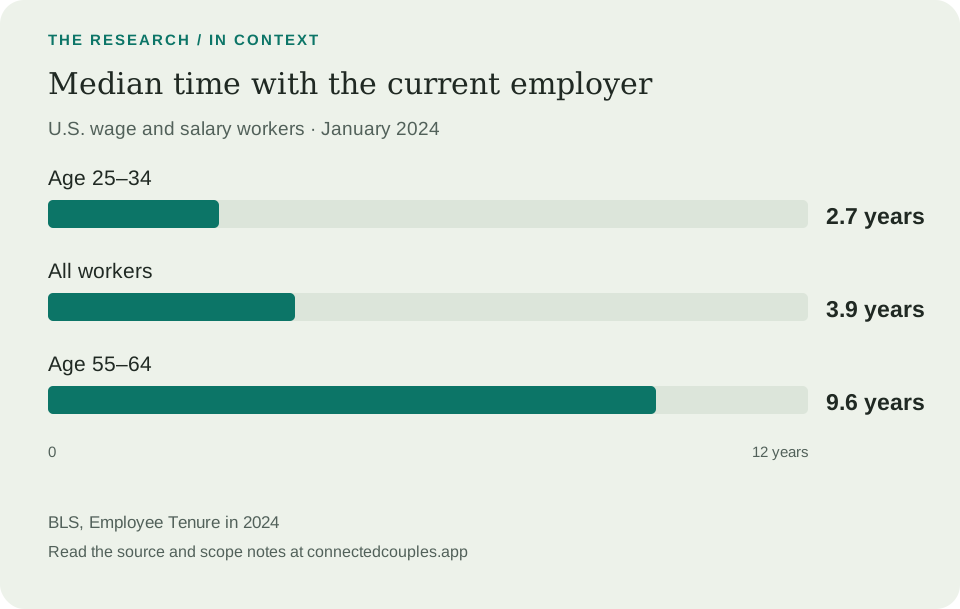
BLS, Employee Tenure in 2024. U.S. wage and salary workers · January 2024. Chart by Connected Editorial Team, October 2, 2026. Please retain the source, date and scope when sharing.
Find out what career change means this week
A conversation about changing careers can mean several things: admitting dissatisfaction, exploring a field, applying for training or making a concrete transition. Ask which stage your partner is in before responding as though a resignation has already happened.
Try: “Are you thinking aloud, researching possibilities or asking us to make a plan for a particular change?”
Then ask what they want to move toward. A different industry, more meaningful work, a manageable schedule and a better workplace are different aims. Some require a new occupation; others might be met through a different role or employer. You don't need to decide this for them. The question helps both of you understand what the exploration is for.
Avoid making your first response a forecast. “You'll be amazing” can feel encouraging but does not answer a practical concern. “That will never work” closes the conversation before you know the proposal. Start with what you understand: “You want work with more direct contact with people, and you are trying to find out what that would involve.”
Ask which kind of support would be useful
The kind of help that feels supportive can change from one conversation to the next. A partner may want room to talk after a difficult day, then want detailed feedback on a course application later.

Read the graphic as text
Support a career change
Ask what kind of support fits today
LISTEN: Hear the uncertainty. “Would you like me to listen before we look for answers?”
EXPLORE: Think through options. “Would mapping the choices together help today?”
PRACTICAL HELP: Choose one useful task. “What help would you welcome, and what will you own?”
REVIEW: Choose a check-in point. “When should we revisit this without making it our only topic?”
Support is a question, not a job assignment.
You can offer four kinds of help. Listen means understand the experience without taking over. Explore means help with a specific question if invited. Practical help means accept a defined task or temporary responsibility. Review means discuss how the arrangement is affecting both people. Ask which one would be useful today. The answer may change tomorrow.
| Support option | A useful offer | Keep this boundary clear |
|---|---|---|
| Listen | Would you like to talk through what appeals to you | Listening does not commit either person to a plan |
| Explore | Would comparing two course schedules help | The person changing careers owns the research decisions |
| Practical help | I can cover dinner on the two class nights we agree | The offer has a scope and a review point |
| Review | Can we check how this is affecting each of us | Review shared impact without grading motivation |
You can decline a support role without declining the person. “I can listen tonight, but I cannot review the application carefully before tomorrow” is more reliable than promising help you can't provide.
For broader ways to make support specific, see our guide to how to support your partner.
“You can believe in your partner and still need a plan for what their career change asks of you. Naming that cost early gives both of you a chance to make support sustainable.”
Kayla Crane, LMFT
Find out what the new work is really like
Before arguing over whether a career is realistic, identify what neither of you knows. What does an ordinary workday involve? Which qualifications are actually required? Does the field have roles with the schedule your partner wants?
CareerOneStop describes an informational interview as a conversation to learn about someone's work, rather than a request for a job. Your partner might use one to test assumptions about a new occupation. If they welcome your help, practice a few questions together; let them arrange and lead the actual conversation.
For U.S. occupations, the Bureau of Labor Statistics explains that its Occupational Outlook Handbook includes duties, work environment, entry requirements and outlook. These are useful starting points for research, not promises of a particular job, salary or training outcome. Local requirements and individual employers can differ.
Give each unknown an owner. You might research how class nights would affect a shared commitment while your partner checks entry requirements. Avoid silently doing all the career research, then feeling responsible for whether they succeed.
Talk about what would change at home
Set aside a conversation for consequences rather than attaching every concern to a moment of excitement. The topics may include training time, household work, location, care responsibilities, benefits and financial uncertainty. The goal here is to identify the questions and the agreements you need, not to prescribe a financial plan.
Be concrete about your limits. “I cannot cover every weekend for six months” gives you a problem to solve. “I guess my life doesn't matter” communicates pain but leaves the practical need unclear.
Use these prompts:
- What would change in an ordinary week during exploration or training?
- Which responsibilities can move, and which cannot?
- What information do we need before making a shared commitment?
- What can each of us offer without becoming depleted?
- What would tell us that the current arrangement needs changing?
Do not treat the person with a higher income as the automatic decision-maker. Nor should a meaningful ambition make all of its costs automatically acceptable to the other person. A supportive conversation needs room for both aspiration and limits.
Two class nights and an evening that already matters
Imagine Asha works in customer operations and is exploring a different field. A training program includes two evenings a week. Leon wants to help, but those evenings overlap with a standing commitment that matters to him.
Their initial argument is about whether Leon believes in Asha. They step back and identify the actual conflict: both assumed the other would rearrange their evenings.
Asha checks whether the training schedule has alternatives and speaks to people doing the work before committing. Leon looks at his calendar and offers one evening of household coverage, not both. They explore a different course schedule and simplifying meals on the remaining night.
They agree to review the household arrangement after the first part of the course. Asha owns the application and coursework. Leon does not check assignments or ask for daily proof of progress. In return, Asha updates him when the schedule changes instead of assuming that his availability is permanent.
Asha still has questions about the new career. But they now know what the course would ask of their evenings, and neither has to guess what the other promised.
Agree on updates before asking for them
Agree on what updates would be welcome. “Tell me when there is a decision affecting our week” may work better than “What did you do about your career today?”
Ask permission before sending job listings, contacting someone in your network or editing a résumé. A useful lead can still feel intrusive when it arrives without context. Never send an application or represent your partner to an employer without their explicit agreement.
Protect some conversation from the transition. Ask about the funny part of their day, share your own news and spend time on interests that do not need to become productive. Your relationship does not have to turn into a career project.
Make room for your own uncertainty as well. You may be proud, worried and tired at the same time. Name the feeling and the need without presenting either as evidence that the career idea is wrong.
When support starts feeling strained
The idea changes every week. Ask whether this is exploration or a request for new shared commitments. It can be reasonable to explore widely while keeping existing responsibilities stable.
Every question sounds like criticism. Explain the purpose: “I'm asking about the schedule because I need to plan my responsibilities, not because I want you to give this up.” Then listen for whether the timing or tone needs changing.
You are expected to carry the transition indefinitely. Return to what was agreed, what has changed and what you can still offer. Repeatedly extending a temporary arrangement requires a fresh conversation.
The training or job outcome disappoints them. Acknowledge the disappointment before drawing lessons. Later, ask what they want to keep, change or stop. You don't have to find the lesson while the disappointment is still fresh.
If disagreements about the transition keep becoming threats, humiliation or restrictions on someone's ability to work, treat that as more than a planning problem. Seek appropriate individual support.
Try it on a difficult day
When helpful research starts to feel like supervision
Fictional example
You sent five job links and asked whether the application was finished. Your partner says the help is making them feel watched. Good intentions do not settle whether this particular kind of help is welcome.
- Stop the reminders long enough to ask which role they want: listener, sounding board, practical helper or none today.
- Offer one bounded task you can actually finish. For example: 'I can read one application on Sunday if you want comments.'
- Keep shared household decisions separate from application progress. You can discuss a proposed change in shared spending or care responsibilities without becoming the job-search manager.
The useful review: At the next check-in, ask whether the support reduced work or added pressure. Change the arrangement if the answer is pressure.
Make it yours
Choose a support role for this stage
Keep the next commitment small enough to describe and revisit. Your partner remains the owner of their career exploration.
Your entries stay in this tab and are not sent by this worksheet. Download your draft before closing or reloading; it is not saved automatically.
Your draft to discuss together
Check that both people agree before treating this as a commitment. Blank items remain open questions.
Common questions
Is it unsupportive to be worried about a career change?
No. Raise the specific consequence you are worried about and the information you need. Avoid presenting worry as a final judgment about your partner's ability or worth.
Should I keep reminding my partner to take the next step?
Ask whether reminders are wanted and what form would help. If they are not wanted, discuss only the shared commitments and deadlines you are responsible for together.
What if I cannot offer the support they want?
Say what you can offer honestly. A career adviser, mentor, training provider or peer may be better placed to handle a need you can't meet.
For conversation beyond the next application or class, try Connected and choose a daily question. Use it as an invitation to hear from the whole person, including the parts of life that are not changing careers.
Sources & editorial notes
Published by the Connected Editorial Team, with a quote from Kayla Crane, LMFT. Examples are fictional. The worksheets and graphics are original editorial planning aids, not validated assessments or a substitute for professional care.
- BLS, Employee Tenure in 2024
U.S. wage and salary workers · January 2024. These are wage and salary workers. Time with an employer does not count career changes, measure job satisfaction or tell someone when to leave.
- informational interview
CareerOneStop provides the purpose and practical use of informational interviews; article does not promise employment outcomes.
- Occupational Outlook Handbook
BLS describes what the Occupational Outlook Handbook contains; article distinguishes occupational information from personal job or salary guarantees.