Planning06
Monthly Relationship Goals Planner
Turn a shared hope into a goal with a first step, realistic responsibilities, and a review date.
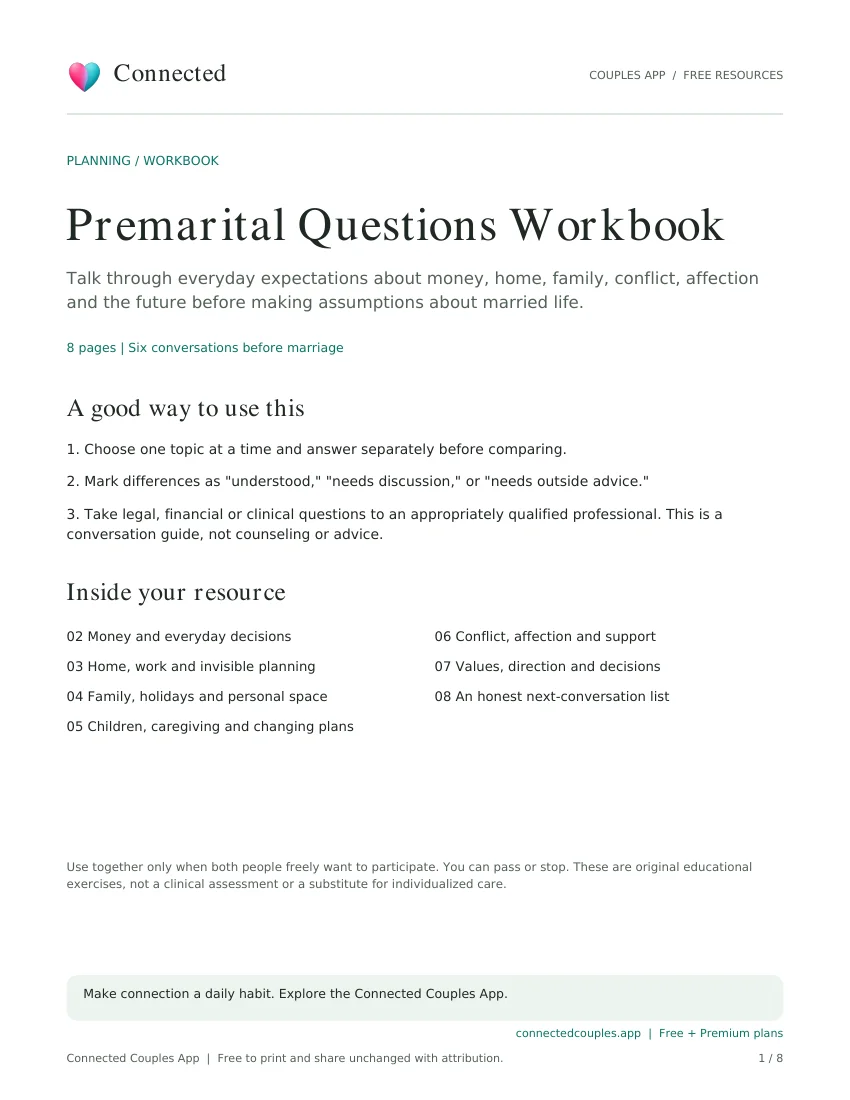
Preview & downloadTalk through everyday expectations about money, home, family, conflict, affection and the future before making assumptions about married life.
8 pages · Printable PDF · 355 KB
No signup. Six conversations before marriage. Read the exercises below.
Agreement on every topic is not the purpose of preparing for marriage. Knowing where you differ, which choices are yours to make together, and which questions need more discussion is more useful than a compatibility score. These prompts can also help established couples revisit expectations that have changed.
Original educational resource by Connected Couples App. Published September 7, 2026.
Open a section to read it comfortably on your phone. The PDF includes the same exercises with space to write or printable cards.
Talk about habits and expectations without assuming that one way of managing money is the only responsible choice. Do not write account numbers or passwords here.
Example"I am comfortable with separate personal spending, but I want us to agree on any ongoing cost that changes what we can afford together."
Answer separately, then take turns sharing. The PDF has writing space for Partner A and Partner B.
Discuss the noticing, arranging and follow-up behind household tasks as well as the visible work. Include different work hours, health needs and care commitments.
Example"Owning laundry means noticing supplies and putting clothes away, not only starting the machine. Let's define the task before splitting it."
Answer separately, then take turns sharing. The PDF has writing space for Partner A and Partner B.
Being a couple does not mean every family expectation becomes a shared obligation. Talk about what you each value and where a joint decision would affect both people.
Example"I want to see my family over the holidays, and I also want some quiet time for us. Could we compare the whole calendar before committing?"
Answer separately, then take turns sharing. The PDF has writing space for Partner A and Partner B.
Do not assume you already know the answer. Some differences affect major life choices and cannot be solved by promising to persuade the other person later.
Example"I am uncertain about becoming a parent. I want that uncertainty understood rather than treated as an eventual yes."
Answer separately, then take turns sharing. The PDF has writing space for Partner A and Partner B.
Discuss how you want to handle ordinary disagreement and how you each experience care. Marriage does not remove the need for consent, privacy or outside friendships.
Example"I want us to ask before assuming touch is comforting when someone is upset. Sometimes I need a quiet conversation first."
Answer separately, then take turns sharing. The PDF has writing space for Partner A and Partner B.
Imagine a few ordinary days in your future rather than only a wedding or a major milestone. Notice the values behind each picture.
Example"I value staying close to friends; you value trying life in a new city. Before deciding, we need to understand what each option would give and cost us."
Answer separately, then take turns sharing. The PDF has writing space for Partner A and Partner B.
You do not need to finish with everything resolved. Write what you learned and what needs another conversation or qualified advice.
| Topic / difference | What we understand now | Next step / when |
|---|---|---|
| An expectation we share | Your notes | Your notes |
| A difference we can work with | Your notes | Your notes |
| A major question still open | Your notes | Your notes |
| A question for a professional | Your notes | Your notes |
No total score, pass mark or promise is needed. A useful outcome is a clearer understanding of what each person is choosing.
8 pages. Free to print and use together. Print at Actual Size on US Letter or Fit on A4.
It is a printable PDF with writing space or cards, not an interactive form. Print it or use the annotation tools in a PDF reader. The webpage version is available above for reading on smaller screens.
No. Share only what you freely choose. Either person can skip a prompt, stop, or suggest another time. These exercises are invitations to talk, not tests of commitment.
There are no answer forms on this page. Downloaded worksheets stay wherever you choose to save them. Website analytics measure resource-link and app-link clicks, not worksheet answers. See our privacy policy.
Turn a shared hope into a goal with a first step, realistic responsibilities, and a review date.
Preview & downloadAgree on a realistic contact rhythm, plan visits, and handle missed calls without turning availability into a test of love.
Preview & downloadPut shared income, expenses and agreed contributions on paper, then use a calm monthly review to adjust the plan.
Preview & download