 Connected
An interfaith relationship needs practical agreements about what each person believes, practices and expects from a partner. Start with one real situation, such as attending a service or keeping a food practice at home. Explain its meaning, distinguish voluntary participation from support, and agree on what happens next. Neither partner should have to pretend to believe, promise conversion or accept pressure to keep the peace.
You may belong to different religions, or one of you may be religious while the other isn't. You may share a label and still practice very differently. The real work shows up in ordinary decisions. Is joining a service an invitation or an expectation? What happens at mealtimes? What will you say when a relative asks about conversion?
Evidence, with the context kept in
Different religious identities are part of many marriages.

What this does and doesn't tell us: These are current identities, not necessarily identities at marriage. Pew treats several Christian traditions as separate categories. Matching labels do not establish matching observance.
Put it to use: Ask about the particular service, meal or observance instead of assuming a religious label tells you how your partner wants to participate.
Get the chart, data and citation
The numbers come from the source linked above; Connected created the chart. These are published statistics, not an original Connected study.
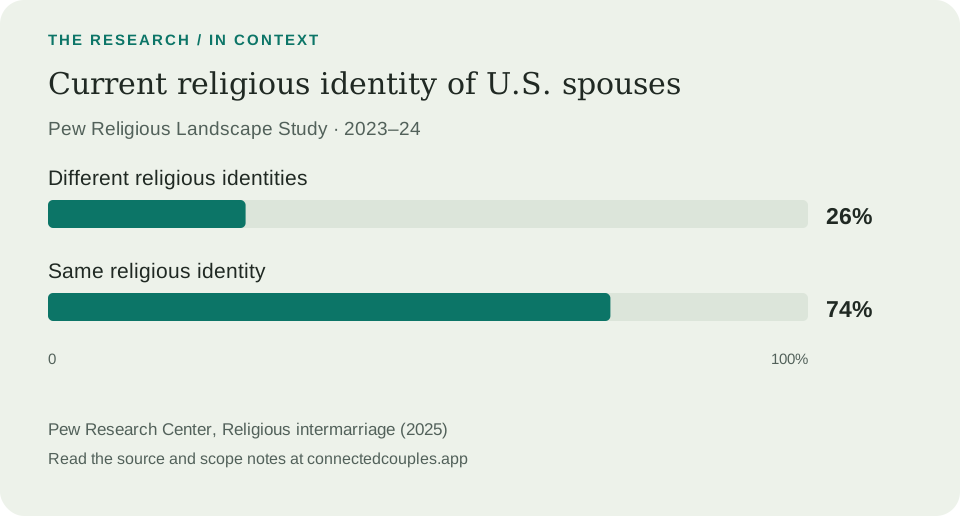
Pew Research Center, Religious intermarriage (2025). Pew Religious Landscape Study · 2023–24. Chart by Connected Editorial Team, October 2, 2026. Please retain the source, date and scope when sharing.
Ask what the practice means to your partner
“What does being religious mean to you this month?” is often more useful than “How religious are you?” One person may value private prayer; another may care most about community, dietary observance or a particular ceremony. Belief, identity and participation don't always line up neatly.
Pew Research Center's work on religious intermarriage measures the religious identities people report at the time of the survey. Its researchers explicitly note that a person's identity may have changed before or after marriage. So ask where your partner is now. The description they gave you when you first met may no longer tell the whole story. Pew Research Center
Try three questions, taking turns without debating the answers:
- Which practice feels important to you, and what would you miss without it?
- What do you want me to understand, even if I don't share the belief?
- Where have you assumed I would join in, abstain or eventually change?
The last question can feel uncomfortable. It is also more helpful than discovering an unspoken expectation after invitations have gone out.
Be clear about what you're asking for
These are three different requests. “Believe this with me” asks for a conviction. “Come with me” asks for participation. “Keep this time free” asks for practical support. A person might willingly offer the third while declining the first two.
Be specific about the invitation. Sitting beside a partner at a gathering may feel comfortable; reciting a statement of belief may not. A community may have rules about who can participate in a ritual. Ask an appropriate leader what is permitted rather than guessing or promising something on your partner's behalf.
A useful invitation sounds like this: “This service matters to me because I feel connected to my community there. Would you be comfortable attending as an observer? You can say no. If you come, I will check what the expectations are before we go.”
An equally useful answer might be: “I can attend this occasion, but I am not comfortable saying the prayer. Please introduce me without suggesting that I am considering conversion.”
After one visit, ask again next time. A yes to this occasion isn't an agreement to attend every week.
“A shared life doesn't require every spiritual experience to be shared. Ask for the kind of support you need, and give your partner room to offer it honestly, without pretending to believe.”
Kayla Crane, LMFT
Put one observance on paper
Choose one practice you expect to encounter soon. Use the following worksheet in writing or conversation. You're writing down an arrangement you can try, not deciding whose beliefs are right.

Read the graphic as text
Plan religious observances
Make room for meaning, choice, and logistics
PRACTICE: Name one observance. What: ______________ When: ___________
MEANING: Ask what it means to each person. For me: ____________ For you: __________
PARTICIPATION: Choose how each person takes part. Join, adapt, observe separately, or decline: ______
SUPPORT: Agree practical help without assuming belief. Travel, visitors, household plans: ______________
REVIEW: Check how the arrangement felt. What should change next time? _______________
Different levels of participation can coexist with care and respect.
| Agreement field | What to write | Example |
|---|---|---|
| Practice | The specific situation | Attending a monthly community service |
| Meaning | Why it matters to the person observing | Belonging and continuity |
| Participation | What the other person freely agrees to do | Attend occasionally as an observer |
| Support | Help that doesn't require shared belief | Keep the time free and ask how it went |
| Review | When to revisit the arrangement | Before the next invitation or if either person's comfort changes |
For practices that affect the shared home, add the actual logistics. Which food will you buy? Who prepares it? Is a space needed for prayer? Is there a quiet-time request? What happens when guests visit? “Be respectful” can't answer these questions on its own.
Be careful with arrangements that silently create extra work. If one person's observance requires a different meal, discuss shopping, preparation and cleanup rather than assuming the other person will handle them.
What attending without pretending could look like
Consider this fictional couple: Morgan has begun attending services again. Alex doesn't have a religious affiliation. Morgan wants Alex to come every week; Alex hears that request as the first step toward an expected conversion.
Their first conversation stalls around “You never support me.” They try again with a narrower question: “What kind of support are we each asking for?”
Morgan explains that walking into a community alone feels vulnerable. Alex says that attending a service is possible, but participating in declarations of belief would feel dishonest. They agree that Alex will attend one upcoming gathering as an observer after Morgan checks the participation expectations. Morgan will also build connections within the community instead of relying on Alex as the only companion.
Their agreement includes a small but important sentence: “This visit doesn't imply a promise about future attendance or conversion.” Afterward, they will discuss what felt welcoming or uncomfortable before accepting another invitation.
They still have bigger questions to discuss. For now, they know what this invitation means. If Alex had declined entirely, they would have needed a different form of support, not a campaign to change the answer.
Bring up the bigger questions before they become urgent
Some questions deserve their own conversation rather than a rushed answer during a family visit. Examples include a wedding ceremony, religious education if you plan to raise children, major rites of passage, or what happens if one person's observance becomes more central to daily life.
Ask, “What do you hope for, what do you consider essential, and what are you still deciding?” Write down uncertainties as uncertainties. Don't translate “I have not decided” into permission for your preferred plan.
If children are relevant, discuss who would teach or model practices, what participation would involve, and how you would respond to the child's questions. Avoid promising a relative an arrangement you haven't discussed together. For the wider range of future-life topics, use Connected's premarital questions guide separately from this observance conversation.
You may discover an important disagreement without finding an immediate compromise. A facilitator familiar with both perspectives can help you clarify the decision. For couples with a Jewish partner or background, 18Doors describes facilitated conversations about religious life, children and relatives. Check current availability and whether its particular approach fits you; it isn't a universal resource for every faith pairing. 18Doors Couples and Conversation
When the conversation keeps getting stuck
One person wants to debate whether the religion is true. Ask whether today's purpose is to exchange beliefs or decide a household practice. Both can be meaningful conversations, but solving dinner arrangements doesn't require settling a theological argument.
A relative keeps asking about conversion. Agree privately on what you want disclosed. A possible response is: “We are discussing our religious life together. Please don't ask either of us to make a conversion promise.” Connected's guide to boundaries with in-laws covers the broader family conversation.
An old agreement no longer fits. Ask what changed: conviction, community, time, comfort or a sense of belonging. Revisit the particular agreement without claiming that change proves the earlier promise was dishonest.
One partner says every request is non-negotiable. Clarify the consequence of each requirement. If one person requires a shared faith and the other doesn't want it, acknowledge that conflict honestly. More skillful wording can't manufacture consent.
Threats, punishment, isolation or forced religious participation call for a different response. Prioritize private support and safety rather than a joint worksheet if you're afraid of what will happen when you disagree.
Try it on a difficult day
When a relative changes the invitation at the door
Fictional example
You agreed to attend a gathering as a guest. Once you arrive, a relative asks you to lead a practice you do not share. Your partner may also feel caught off guard.
- Use the boundary you agreed: 'I'm glad to be here, but I won't be leading that part.' You do not need to settle a theological argument at the gathering.
- The partner whose relative made the request can clarify the arrangement if willing: 'We discussed this beforehand; joining the meal is how we're participating today.'
- Afterward, check whether future invitations need clearer wording, a shorter visit or a different way to show support.
The useful review: Judge the plan by whether each person had a real choice, not by whether relatives approved of it.
Make it yours
Plan one observance together
Separate an invitation to attend from an expectation to perform a religious practice. Either person can name a limit without having to defend their entire worldview.
Your entries stay in this tab and are not sent by this worksheet. Download your draft before closing or reloading; it is not saved automatically.
Your draft to discuss together
Check that both people agree before treating this as a commitment. Blank items remain open questions.
Common questions
Can an interfaith relationship work without shared worship?
Shared worship isn't the only possible arrangement. Some couples attend separately, some attend selected occasions together, and some offer practical support without participating. The important conversation is whether the arrangement is genuinely acceptable to both of you, including what each person expects later.
Do we need to combine our practices?
No. You can preserve separate practices, create shared ones where appropriate, or do both. Check the meaning and requirements of a ritual before adapting it, and avoid presenting a joint activity as a shared belief neither of you has agreed to.
What should we talk about first?
Start with the next real decision rather than every possible future conflict. Name the practice, its meaning, the invitation and the limits. If you want a regular opening for conversations about each other's lives, try Connected and choose a daily question or weekly check-in together.
Sources & editorial notes
Published by the Connected Editorial Team, with a quote from Kayla Crane, LMFT. Examples are fictional. The worksheets and graphics are original editorial planning aids, not validated assessments or a substitute for professional care.
- Pew Research Center, Religious intermarriage (2025)
Pew Religious Landscape Study · 2023–24. These are current identities, not necessarily identities at marriage. Pew treats several Christian traditions as separate categories. Matching labels do not establish matching observance.
- Pew Research Center
Describes current reported religious identities and notes conversion can occur before or after marriage. No causal relationship-outcome claim.
- 18Doors Couples and Conversation
Organization describes its own interfaith discussion program, including religious life, children and relatives. Program suitability and current availability qualified.