 Connected
The quick answer
To split holidays between families, first agree as a couple on meaningful traditions, travel limits, cost and rest. Then choose a workable pattern: alternate years, divide different holidays, celebrate on another date, host, or sometimes attend separately. Communicate one concrete plan early and revisit exceptions together rather than renegotiating under family pressure.
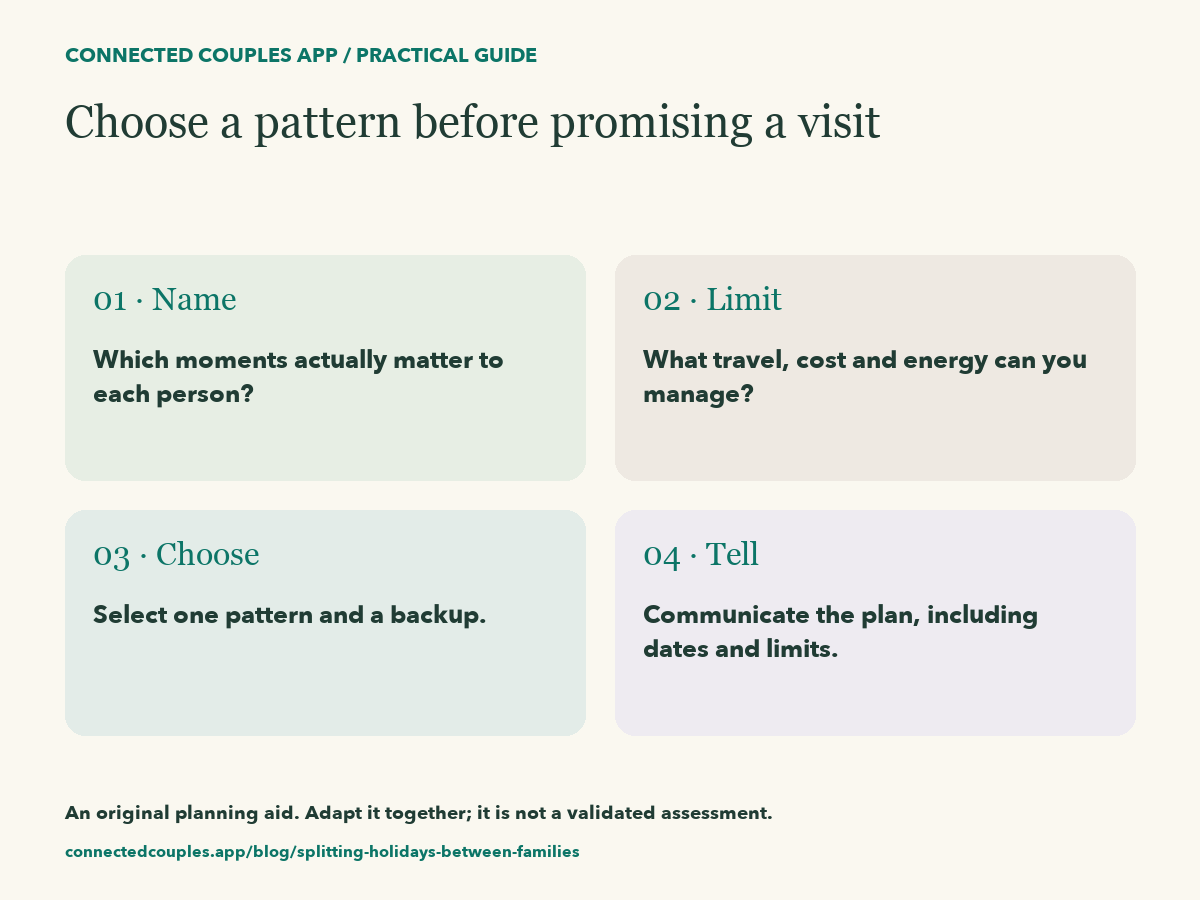
Choose a pattern before promising a visit
- Name
Which moments actually matter to each person?
- Limit
What travel, cost and energy can you manage?
- Choose
Select one pattern and a backup.
- Tell
Communicate the plan, including dates and limits.
Try it together · Free tool
Find a holiday arrangement to discuss
This is for couples coordinating family visits, not custody scheduling or legal agreements. Choose the constraints that fit this occasion.
Your answers stay in this page. They are not saved by us or sent to your partner. Refreshing clears the draft; download it if you want to keep it. Basic tool-use analytics contain no answers.
Your conversation draft
Make the first agreement with each other
One parent asks about dinner in August. You say “probably” to avoid an awkward moment. Your partner has already said the same thing to someone else. By November, two families believe they have a promise.
Before answering invitations, each name the part of the holiday you most want to keep. It might be a religious service, a meal with a grandparent, a family game or a slow morning at home. Knowing the meaningful moment gives you more options than arguing over who gets the entire day.
Include your own household as a real part of the plan. A couple’s tradition is not the leftover time after everyone else is satisfied.
Compare five arrangements
| Pattern | Best fit | Check before agreeing |
|---|---|---|
| Alternate years | Both families value the same date and travel is substantial. | What happens during an exceptional year? |
| Divide different celebrations | Important traditions occur on different days or holidays. | Are travel costs and preparation still manageable? |
| Celebrate on another date | Being together matters more than the calendar date. | Will the alternative feel like a real celebration? |
| Host with limits | You have space, energy and genuinely shared help. | Who cooks, cleans, pays and manages invitations? |
| Attend separately sometimes | Both want different visits and can manage the logistics. | Is the choice mutual, and when will you celebrate together? |
The couples’ arrangements collected by The Knot show there is more than one way to handle the calendar. Use examples as possibilities, not a rule that your family must follow.
Count the whole cost of a visit
Travel time is more than the drive between houses. Add packing, loading, traffic, accessibility needs, pet care, meals, recovery and getting home. With young children, a short visit can require most of the day’s available energy.
Put a limit on what you can manage before allocating time. “We can do one overnight trip this season” creates a different discussion from repeatedly asking which family matters more.
If hosting seems like the easy solution, list the work. Hosting everyone is not a compromise if one partner must shop, cook, clean and smooth over every disagreement. Choose named responsibilities and a realistic guest limit before inviting anyone.
A plan that looks unequal but works better
Illustrative example: Nia’s family celebrates late on Christmas Eve. Ben’s family gathers at noon on Christmas Day, three hours away. Their old plan gives each family a visit but leaves them exhausted and driving most of the holiday.
They choose Christmas Eve with Nia’s family this year, Christmas morning at home, and a full visit with Ben’s family the following weekend. Next year they review the pattern rather than promising a permanent rotation they have not tested.
Ben tells his family the alternative date and helps make that visit meaningful. Nia acknowledges that the date matters to Ben’s parents even though they cannot meet that expectation this year. The arrangement does not require everyone to be equally pleased.
Tell relatives the plan without blaming your partner
For a different date: “We will be at home on the holiday itself. We would love to celebrate with you on Saturday the 28th if that works. We can arrive at noon and stay through dinner.”
For an alternating year: “This year we are spending the day with the other family. We know you will miss us. We can call in the morning and plan a visit the following week.”
For a firm departure: “We can come from two until five. We will need to leave at five even if dinner runs late, so please do not hold the meal for us.”
For pressure to reconsider: “I understand you are disappointed. We have talked it through and this is what we can manage. The alternative date is still open.”
Use “we decided” when the decision is shared. “My partner will not let me” may end the call quickly, but it creates another conflict for your partner. If you are not actually in agreement, return to that conversation privately before making a joint announcement.
Plan for exceptions without creating a permanent debt
Illness, bereavement, work or a rare visit from someone overseas can make one year different. Name the exception and what it changes. Avoid “We did yours last year, so we are never changing the rotation,” when the circumstances are meaningfully different.
Also avoid a system where the loudest complaint always becomes an emergency. Discuss the facts together, decide what you can offer, and communicate the revised plan if needed.
For multiple households, interfaith families or traditions spanning several days, use the actual dates and meanings rather than assuming a two-family Christmas rotation fits everyone. Declining an unsafe or harmful gathering is a different decision from ordinary scheduling fairness.
Review before the next invitation arrives
After the season, ask: Which moment felt meaningful? Where did we overcommit? Who did work the other person did not notice? Write down one change while the experience is fresh.
If the conflict is mainly about relatives refusing to accept any decision you make together, our guide to boundaries with in-laws covers that broader pattern. This plan handles the calendar; it cannot make every relative approve of it.
Common questions
Should married couples alternate holidays between families?
Alternating is one option, especially when travel makes two visits unrealistic. It may work less well when traditions fall on different days or one family has a time-sensitive need. Choose a pattern that fits your actual constraints.
Is it okay to spend a holiday separately?
It can be, if both genuinely want that arrangement and practical responsibilities are covered. Discuss how it feels and plan some meaningful time together rather than assuming separate attendance is either required or a sign of trouble.
What if our parents say the plan is unfair?
Acknowledge their disappointment, repeat the concrete plan and offer an alternative you can actually manage. You do not have to change the decision every time someone dislikes it.
How do we divide holidays with divorced parents or several households?
Count all the commitments and travel before promising visits. You may need different dates, shorter visits or a rotation across years. This guide concerns family visits; legal custody arrangements require their own appropriate guidance.
Sources & editorial notes
Written by the Connected Editorial Team. The examples are illustrative, and the scripts, visual guide and planning tool are original editorial resources. They are not validated assessments, individualized advice or a substitute for professional care. Source notes explain the scope of the supporting material.
- The Knot: Splitting holidays between families
A collection of couples’ arrangements illustrating the variety of workable traditions; anecdotes are not a universal rule.
- APA: Managing conversations when you disagree
General guidance on respectful conversations and limits. It does not endorse a particular holiday arrangement.
Published September 7, 2026. Send a correction or tell us what would make this guide more useful.