Understanding07
Relationship Boundaries Worksheet
Clarify personal limits around time, privacy, family and communication, then discuss what respectful agreements could look like.
Preview & downloadCompare the ways you each like to give and receive care, and turn a general preference into a specific, welcome gesture.
5 pages · Printable PDF · 347 KB
No signup. 20 minutes, then one small experiment. Read the exercises below.
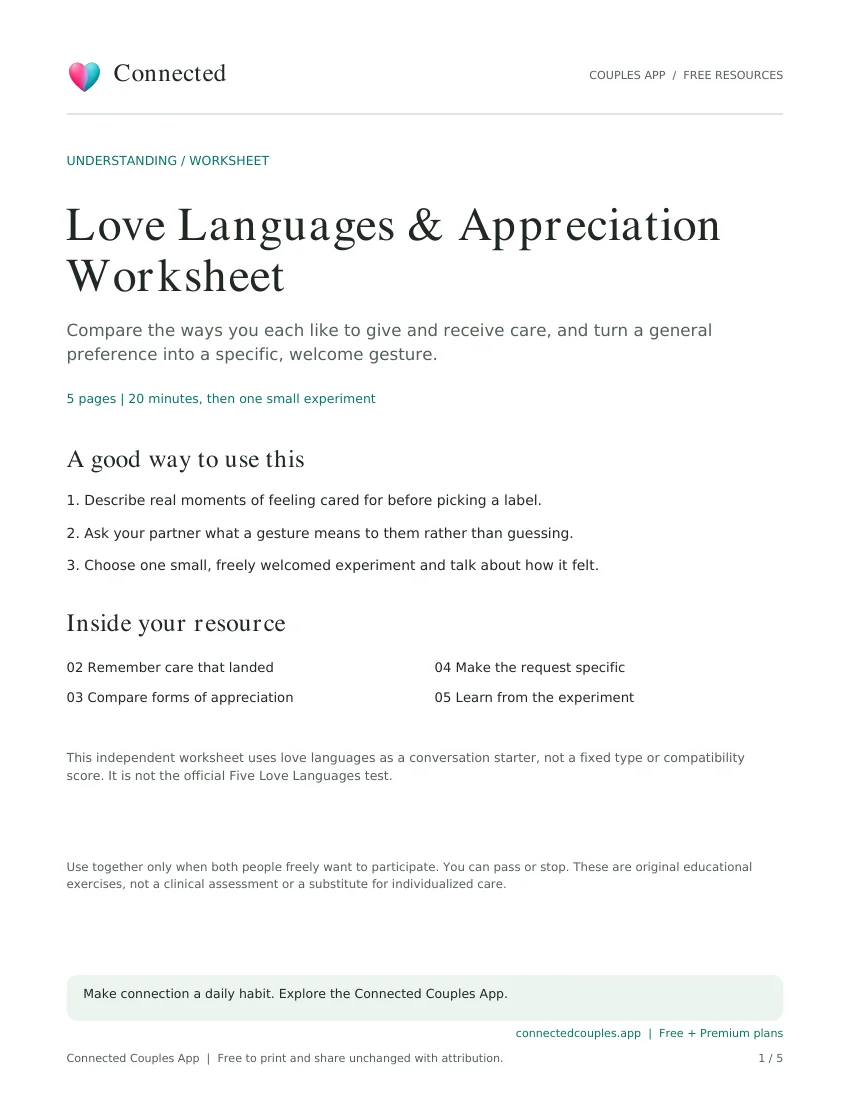
People often use "love languages" as a shorthand for what makes them feel appreciated. Use that idea as a conversation starter, not a fixed type, a compatibility score or a reason someone owes affection. This independent worksheet is not the official Five Love Languages test. Your preferences can be mixed and can change with context.
Original educational resource by Connected Couples App. Published September 7, 2026.
Open a section to read it comfortably on your phone. The PDF includes the same exercises with space to write or printable cards.
Start with something that actually happened. A small, specific memory tells your partner more than a category on its own.
Example"When you remembered my early appointment and made breakfast easy, I felt that my stressful morning was on your mind."
Answer separately, then take turns sharing. The PDF has writing space for Partner A and Partner B.
For each form of care, describe something you welcome and any conditions that matter. Leave room for forms not listed. This is not a ranking or test.
| Form of care | What A welcomes | What B welcomes |
|---|---|---|
| Encouraging words | Your notes | Your notes |
| Undistracted time together | Your notes | Your notes |
| Practical help | Your notes | Your notes |
| Thoughtful gifts or gestures | Your notes | Your notes |
| Affectionate touch, with consent | Your notes | Your notes |
| Another kind of care | Your notes | Your notes |
A preference for touch never creates an obligation to provide it. Practical help also does not replace a fair division of shared responsibilities.
Explain what you would enjoy in a way your partner can understand, and ask what is realistic for them. Avoid asking them to read your mind or prove devotion.
Example"Would you be up for ten minutes together without phones after dinner? If tonight is full, another evening would work."
Answer separately, then take turns sharing. The PDF has writing space for Partner A and Partner B.
After trying the gesture, share what it was like to give and receive it. You can appreciate the effort while asking for an adjustment.
Example"The walk meant a lot. I would enjoy it even more if we did the errands afterward so the conversation did not feel rushed."
Answer separately, then take turns sharing. The PDF has writing space for Partner A and Partner B.
5 pages. Free to print and use together. Print at Actual Size on US Letter or Fit on A4.
It is a printable PDF with writing space or cards, not an interactive form. Print it or use the annotation tools in a PDF reader. The webpage version is available above for reading on smaller screens.
No. Share only what you freely choose. Either person can skip a prompt, stop, or suggest another time. These exercises are invitations to talk, not tests of commitment.
There are no answer forms on this page. Downloaded worksheets stay wherever you choose to save them. Website analytics measure resource-link and app-link clicks, not worksheet answers. See our privacy policy.
Clarify personal limits around time, privacy, family and communication, then discuss what respectful agreements could look like.
Preview & downloadName the impact of a broken agreement, distinguish promises from observable actions, and plan a voluntary review of what happens next.
Preview & downloadPractice starting a difficult conversation, listening without preparing a rebuttal, and making a request your partner can actually act on.
Preview & download