Put this into practice: Download the free Monthly Relationship Goals Planner, with practical exercises and space to use together.
Quick answer
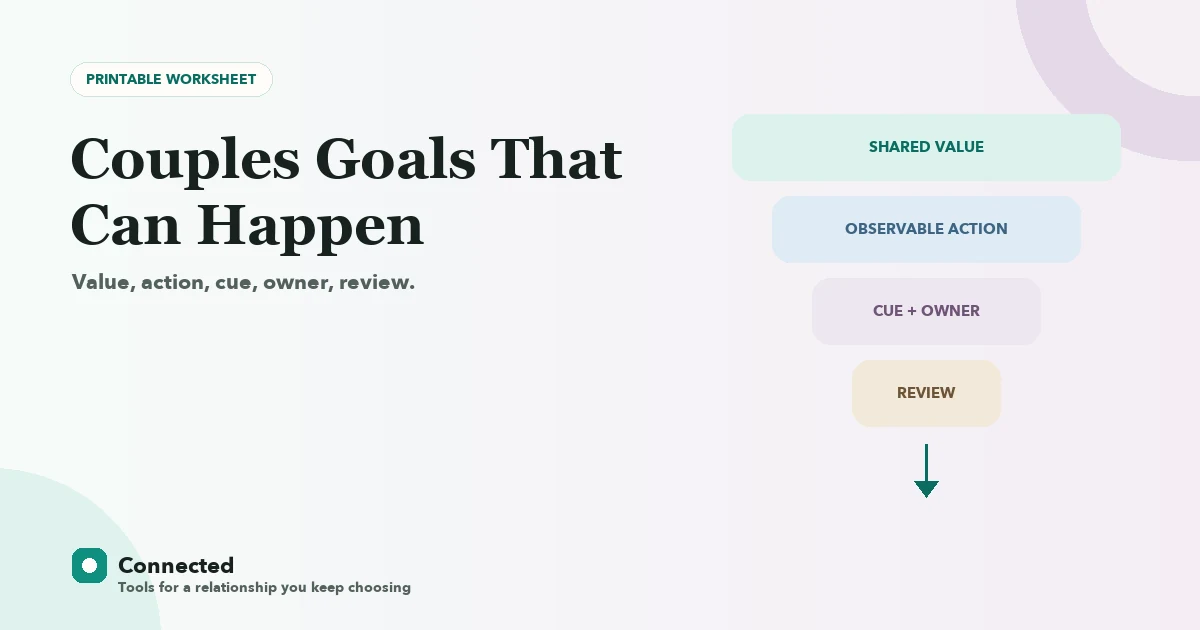
A workable couples goal has five parts: a shared value, one observable action, a repeatable cue, clear ownership, and a review date. Set one or two goals, not twelve. Use the builder below, then print the worksheet if you want to complete it together.
Relationship goals fail differently from individual goals. If you forget your own morning walk, you are disappointed. If one partner forgets the weekly check-in the other partner proposed, the missed behavior can become evidence about love, priority, or fairness.
That is why a couples goal needs more than specificity. It needs consent, autonomy, and coordination. Research across romantic relationships finds that responsive and practical partner support is associated with goal progress, while controlling or negative support can get in the way.
Build one shared goal
Nothing you type here is saved or sent. Keep the action small enough for a difficult week.
To save a private digital copy, choose “Save as PDF” in your browser’s print dialog.
Move from meaning to something that can happen on Tuesday
Each layer removes a different source of friction.
Implementation-intention research supports specifying when and how an action begins. Couple research adds coordination, autonomy, and responsive support.
The fastest way to turn a relationship goal into resentment is to make one partner the visionary, reminder system, and quality-control department. If the goal is shared, the remembering and initiating must be shared too. Write the ownership down before you discuss motivation.Kayla Crane, LMFT, licensed marriage and family therapist and co-founder of Connected
12 relationship goals rewritten so they can work
| Good intention | Observable version | Cue and ownership |
|---|---|---|
| Communicate better | Use one 15-minute check-in weekly | Sunday after coffee; alternate who starts |
| Have more fun | Try one new shared activity monthly | First Saturday; each partner alternates planning |
| Stop fighting about chores | Assign full ownership for three recurring tasks | Review at month-end; no reminding inside the month |
| Be better with money | Review balances and one upcoming decision | Payday evening; open the same agenda |
| Feel closer | Put phones away for the first 20 minutes after dinner | When plates are cleared; both plug in devices |
| Improve intimacy | Share one preference or pressure-free affection request weekly | During Sunday check-in; either partner may pass |
| Support each other | Ask “listening, comfort, or ideas?” during stress | When either says work was hard; the listener asks |
| Date more | Protect one two-hour block twice monthly | Choose dates before the month starts; alternate plans |
| Be more appreciative | Name one specific action and its effect | Friday dinner; both answer |
| Repair faster | Use a pause with an exact return time | When either rates activation above manageable |
| Parent as a team | Align on one recurring decision before discussing it with children | Thursday evening; bring one issue each |
| Protect individual growth | Give each partner one uninterrupted personal block weekly | Placed on the calendar together every Sunday |
Notice that these are not promises to feel a certain way. They are experiments with observable behaviors. Emotion may follow, but neither partner is required to manufacture it on schedule.
If your goal is enjoyable time together, use our couples hobby finder to choose a manageable first session.
Take the reminding out of the relationship
Connected’s weekly check-ins give both partners the same prompt and a shared rhythm, so one person does not have to keep initiating.
The printable couples goals worksheet
Part 1: Choose the experience
Complete the first two prompts separately. The difference between your answers is useful data. A goal is not shared because one partner said “sure.” Look for an action both people can endorse and a support style that does not feel controlling.
Still choosing between options? Start with making a big decision together, then turn the decision you both accept into a goal.
How to review a goal without grading each other
Use four learning questions
- What happened more easily than expected?
- Where did the system create friction?
- Did the support feel helpful, controlling, or absent?
- Should we keep, shrink, redesign, or retire the goal?
A goal can be retired without the relationship failing. In a one-year study of 148 couples, coordination and progress were linked with life satisfaction, but that does not mean every shared target is wise or causally beneficial. Sometimes the most coordinated decision is to stop pursuing a goal that no longer fits.
Research and sources
We favored peer-reviewed research, professional associations, and primary clinical guidance. Source notes describe what each reference does and does not establish.
- Vowels and Carnelley, Partner Support and Goal Outcomes: A Multilevel Meta-Analysis (2022). The institutional full-text copy of a meta-analysis of 195 effects from 36 samples and 10,130 people in romantic relationships; responsive and practical support were associated with goal outcomes, while negative support hindered pursuit.
- Jakubiak and Feeney, Daily Goal Progress Is Facilitated by Spousal Support (2016). Two daily-diary studies with newlywed and older married couples linking responsive spousal support, goal progress, and next-day well-being.
- Rosta-Filep et al., Flourishing Together: Goal Coordination in Romantic Relationships (2023). A two-wave, one-year study of 148 cohabiting or married different-sex couples; findings support coordination and goal progress while limiting broad causal claims.
- Gollwitzer and Sheeran, Implementation Intentions and Goal Achievement (2006). The authors’ institutional record for a meta-analysis of 94 independent tests finding a medium-to-large effect for specific if-then plans on goal attainment across domains, not specifically relationship goals.
Frequently asked questions
What are good goals for couples?
Good couples goals describe a shared experience and one observable behavior, such as a 15-minute Sunday check-in, a monthly money meeting, or one device-free dinner each week. They are specific without controlling either partner.
How do couples set goals together?
Start with the value or experience you both want, ask what each person is willing to do, choose the smallest behavior, attach it to a cue, and decide who owns which step. Review the system rather than grading the person.
Should relationship goals be SMART goals?
Specific and time-bound can help, but relationship goals also need mutual consent, autonomy, and emotional meaning. A technically measurable goal can still create resentment if one partner chose it for the other.
How many relationship goals should we set?
One or two at a time. A long list creates coordination work and makes it hard to learn what helped. Keep a parking lot for later goals.
What if one partner does not complete their part?
Discuss the friction before assuming a motivation problem. The action may be too large, the cue may be weak, ownership may be vague, or the goal may not be genuinely shared. Redesign the system together.
Can I print this couples goals worksheet?
Yes. Use the Print worksheet button in the article and choose Save as PDF in your browser if you want a digital copy. The interactive fields stay in your browser and are not sent to Connected.
Kayla is a licensed marriage and family therapist and co-founder of Connected. This educational guide is not a diagnosis or a substitute for therapy.