 Connected
By the fourth conversation about a big decision, you may know your partner's arguments by heart. One partner brings more reasons to say yes. The other brings more reasons to wait. Soon you're debating who is supportive, responsible or brave, and the original choice gets lost.
To make a big decision together, agree on the question, hear what matters to each person, compare real options and decide what you still need to learn. Where possible, test a smaller version before making a harder-to-reverse commitment. Record the agreement and a review point so that neither person has to guess what was decided.
Use this process to talk through shared life choices. Bring financial, medical or legal questions to the appropriate professional, and leave room for either person to say no.
Evidence, with the context kept in
Shared decisions need more than a confident yes.

What this does and doesn't tell us: Participants were married or in a long-term relationship and living together. This is about money disagreements, not the success rate of a decision-making method.
Put it to use: For a decision with shared costs, write down each person's requirements before comparing the options.
Get the chart, data and citation
The numbers come from the source linked above; Connected created the chart. These are published statistics, not an original Connected study.
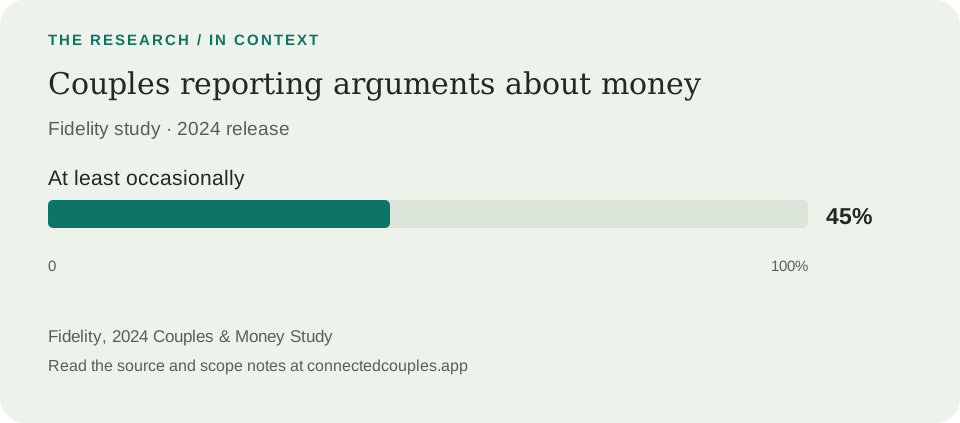
Fidelity, 2024 Couples & Money Study. Fidelity study · 2024 release. Chart by Connected Editorial Team, October 2, 2026. Please retain the source, date and scope when sharing.
First decide what you are actually deciding
“Should our life change?” is too broad. “Should we move closer to our families when our lease ends?” gives you something concrete to examine.
Write one sentence that includes the decision and the real deadline. Separate a deadline imposed by circumstances from one created by impatience. If you don't yet know the deadline, finding it may be the first task.
Then ask who is affected and who has authority over which parts. Your partner can care deeply about your career without owning your career. You can choose your own interests without unilaterally committing your partner's time, money or labor. Decisions with shared consequences need explicit discussion of those consequences.
For an individually owned choice, the useful conversation may be “How do we handle the impact?” rather than “Will you permit me?” For a shared commitment, both people need a meaningful chance to influence the plan.
Understand the reason behind each preferred option
Take turns finishing these sentences:
- The part of this possibility I most want is...
- The part I am worried about is...
- A cost I do not think we have fully considered is...
- Something I might be flexible about is...
Ask for clarification before offering a counterargument. If your partner wants to live near family, do they mean frequent practical help, cultural belonging, time with an aging relative or simply familiarity? Those needs may point toward different solutions.
The Gottman Institute describes accepting influence as taking a partner's perspective seriously while retaining your own judgment. Here, that means being willing to revise an option after hearing new information, rather than collecting objections to defeat.
If listening itself keeps getting lost, practice the shorter conversation in our guide to active listening for couples before returning to the decision.
Separate requirements from preferences and unknowns
Put your concerns in three categories.
Requirements are conditions you genuinely cannot agree to proceed without. Examples might include maintaining access to essential care or having a workable arrangement for dependents.
Preferences matter, but you can discuss different ways to satisfy them. A separate home office may be a preference; a confidential workspace during working hours may be the underlying requirement.
Unknowns need evidence. “The commute will be unbearable” becomes more useful when you identify the route, schedule and actual travel time you need to check.
The Gottman Institute's guidance on compromise similarly distinguishes core needs from areas of flexibility. The worksheet below gives you a place to record those differences before choosing an option.
Do not declare every preference nonnegotiable. Equally, do not argue someone out of a genuine limit by calling them inflexible. If a requirement rules out your preferred option, acknowledge that before attempting a workaround.
“Before you ask which option wins, ask what each person is trying to protect. You may disagree about the plan and still find something important you can protect together.”
Kayla Crane, LMFT
Compare more than yes and no
Try to identify at least one meaningful alternative to the original proposal. Depending on the decision, that could be a smaller version, a later start, a temporary arrangement or keeping the current situation while gathering specific information.
Remaining where you are also has consequences. Include them fairly. Do not describe change with all its costs and the status quo as though it were effortless, or reverse that framing to make change look inevitable.

Read the graphic as text
Make the decision together
A decision path, without rushing
01: Define. What is the decision? Name each person’s needs.
02: Compare. Include real alternatives and doing nothing for now.
03: Check constraints. Name the firm limits and the trade-offs.
04: Test. Try a reversible step if it can answer a key question.
05: Review. Agree who does what next and when to revisit it.
If either person feels pressured, pause before making a commitment.
Follow five steps: define the decision; compare realistic options; check each person's constraints; test what can be tested safely; and review the evidence before confirming the next commitment. Some decisions cannot be trialed, so use the testing step to gather information rather than pretending every choice is reversible.
Use this shared decision worksheet
Complete your own partner column separately, then compare your answers. Add options only if they are genuinely available.
| Decision question | Partner A | Partner B | What needs checking |
|---|---|---|---|
| What outcome matters most | |||
| What must be protected | |||
| What is flexible | |||
| Which option currently fits best | |||
| What downside worries you | |||
| What fact could change your view |
Below the table, write three closing lines: “The next step is...”; “The person responsible is...”; and “We will discuss the result on...”. These lines record the investigation, not an automatic agreement to proceed with the final decision.
Avoid making the table into a vote or an objective-looking score. A preference rated nine does not cancel the other person's serious concern. Use the answers to locate the real disagreement.
What moving closer to family might actually solve
Imagine Jules wants to move nearer to family and Casey wants to stay. Their first conversations stall because Jules hears “Your family does not matter,” while Casey hears “Your work and friendships are expendable.”
They define the actual decision: whether to relocate at the end of their current lease. Jules wants more regular family contact and less rushed visiting. Casey needs a sustainable work arrangement and does not want to agree to a location without knowing how everyday life would work.
They compare three options: relocate, stay and plan longer visits, or explore a different nearby area. They do not yet know whether Casey's role can support the proposed arrangement. Casey owns that question. Jules researches ordinary travel times and what family contact would realistically look like, without promising that relatives will provide help they have not offered.
They plan an exploratory visit if feasible. Its purpose is specific: experience a normal weekday, not judge the place by a holiday weekend. Their next conversation will use what they learned. They have agreed to research, not agreed to move.
Before booking anything, they say this out loud: the visit is a chance to learn, and either person may still decide the move doesn't work.
When one person wants an answer sooner
Ask what the urgency protects. An approaching deadline needs a plan. Anxiety about uncertainty deserves acknowledgment, but it does not make the other person ready to consent.
Choose the smallest next decision that can honestly be made. You might agree to request more time, gather one missing fact or rule out an option neither person can accept. Be explicit about what remains open.
If one partner keeps requesting information but no answer could ever be enough, name that too: “Is there something you already know you don't want, even if the practical details work?” A clear no is difficult, but endless research can conceal it.
What to do if you still disagree
Find the precise sticking point. Is it an unknown fact, competing needs, distrust about follow-through or a fundamentally different future? Each calls for a different next step.
A missing fact needs research. Concern about follow-through may need a smaller commitment with observable responsibilities. A major difference in life direction may need more time, candid discussion or a qualified couples professional. Sometimes the disagreement is about the future you each want. Give that question the attention it deserves.
Where there is intimidation, retaliation or fear about saying no, prioritize safety and individual support rather than trying to negotiate more effectively. Equal airtime is not enough if one answer carries a threat.
Try it on a difficult day
When the deadline arrives before agreement
Fictional example
One partner's job offer expires Friday. The other still has unanswered questions about moving. The employer's deadline creates a practical constraint; it does not create the other partner's consent.
- Ask which missing fact could genuinely change the decision. Get that answer first, rather than researching every possible neighborhood.
- Ask the employer whether an extension or later start exists. Treat an unconfirmed option as unconfirmed.
- If no mutually acceptable option remains, name the consequence of declining or accepting without a shared move. Do not describe silence or exhaustion as joint agreement.
The useful review: Record the reason for the decision as well as the outcome. Later, distinguish a reasonable choice with an unlucky result from a process that ignored someone's stated limits.
Make it yours
Draft a shared decision record
Write the decision narrowly enough that you can tell when it has been made. A blank or a disagreement is useful information, not a yes.
Your entries stay in this tab and are not sent by this worksheet. Download your draft before closing or reloading; it is not saved automatically.
Your draft to discuss together
Check that both people agree before treating this as a commitment. Blank items remain open questions.
Write down what you agreed
Once you agree, record the chosen option, what each person accepted, remaining uncertainties and the first responsibilities. If you need to turn that choice into daily action, use our couples goals worksheet.
Review the result without pretending you knew the outcome in advance. Ask whether you used the information available, respected each other's limits and carried out the agreed work. New information can justify revisiting a choice without making the original conversation a failure.
Does every decision need this much discussion?
No. Use the full process for choices with meaningful shared consequences. Agree which ordinary decisions each person can make independently so that everyday life does not become a series of meetings.
What if one partner usually says whatever you want?
Ask for their preference before presenting yours, and make room for disagreement without punishment. Do not assume silence means indifference or consent to a consequential commitment.
When the decision is settled, make room for a conversation that is about the two of you as well. Try Connected and use a daily question as another starting point beyond the option you have been debating all week.
Sources & editorial notes
Published by the Connected Editorial Team, with a quote from Kayla Crane, LMFT. Examples are fictional. The worksheets and graphics are original editorial planning aids, not validated assessments or a substitute for professional care.
- Fidelity, 2024 Couples & Money Study
Fidelity study · 2024 release. Participants were married or in a long-term relationship and living together. This is about money disagreements, not the success rate of a decision-making method.
- accepting influence
Gottman Institute explains accepting influence as openness to a partner perspective rather than compliance; this is primary practitioner guidance, not an effect-size claim.
- guidance on compromise
Gottman Institute compromise guidance distinguishes core needs and flexible preferences; the new comparison worksheet is editorial rather than validated.