 Connected
The quick answer
An empty nest changes a couple’s routines and roles, but it does not determine the future of the marriage. Start by naming what each person misses and welcomes, then rebuild ordinary shared time, individual interests and agreements about adult children. Keep early experiments small; you do not need to solve your whole next chapter in the first quiet week.
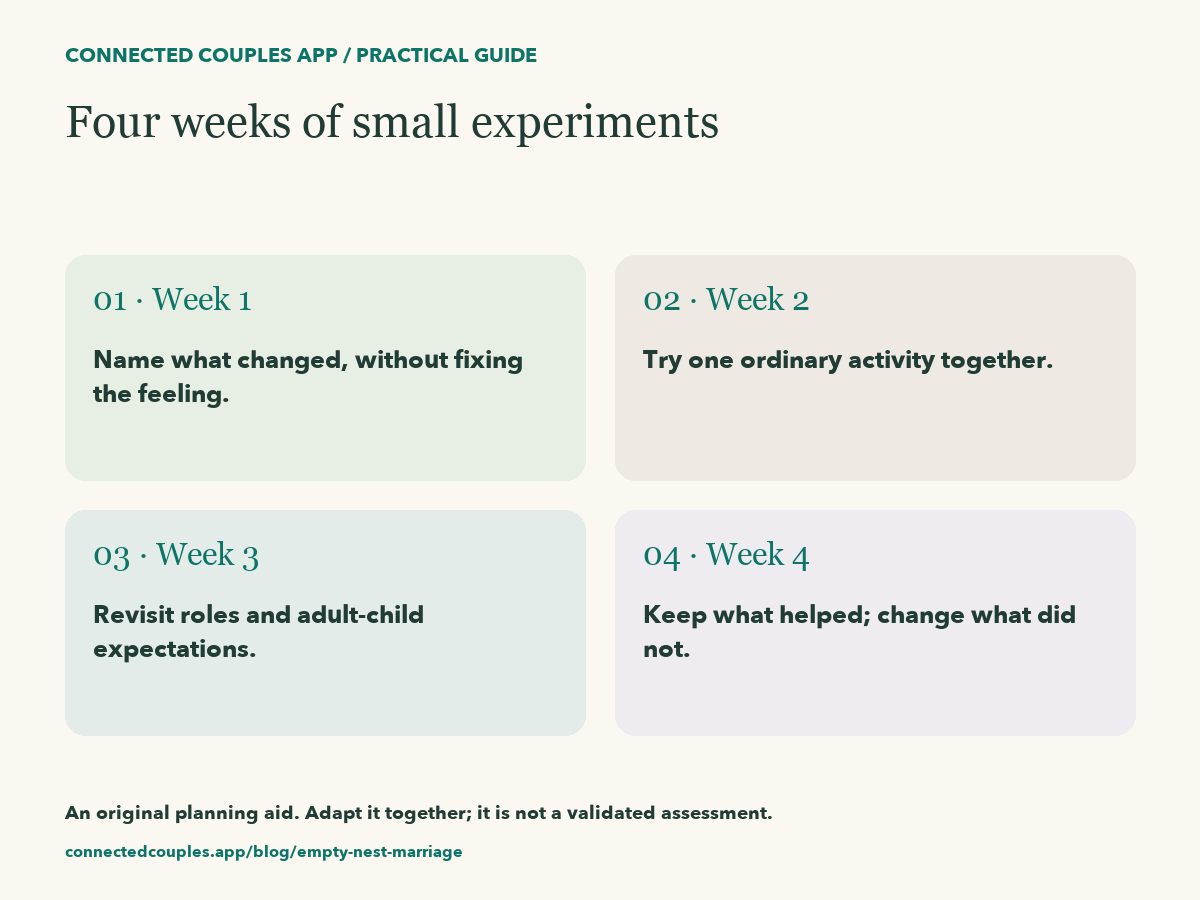
Four weeks of small experiments
- Week 1
Name what changed, without fixing the feeling.
- Week 2
Try one ordinary activity together.
- Week 3
Revisit roles and adult-child expectations.
- Week 4
Keep what helped; change what did not.
Try it together · Free tool
Choose your next small step
Choose the description that fits today. These are conversation prompts, not an assessment of your marriage.
Your answers stay in this page. They are not saved by us or sent to your partner. Refreshing clears the draft; download it if you want to keep it. Basic tool-use analytics contain no answers.
Your conversation draft
Notice what the quiet is bringing up
You finish dinner and nobody needs a ride. There is no game to attend, form to sign or last-minute school project. The freedom you pictured is here, and it feels strangely flat.
Or it feels wonderful, and your partner’s sadness makes you afraid to say so. The first useful conversation is not “How do we make this the best time of our lives?” It is “What is this change actually like for you?”
An empty nest does not mean parenting has ended. Adult children may still need support, and many couples also care for relatives or work demanding jobs. Start with the time and responsibility you actually have, rather than an imagined life of unlimited travel.
Week one: let your reactions be different
Set aside a short, quiet conversation. Each finish three sentences: “I miss…”, “I feel relieved about…”, and “I am not sure what to do with…” Let the other person finish before offering ideas.
If your partner says they miss being needed, resist “But you are still needed!” Ask what being needed gave them: structure, closeness, purpose, a way to show love. That answer is more useful than trying to erase the feeling.
If your partner is excited, do not make them defend it as if enjoyment betrays your child. “I am glad you feel that, even though I am not there yet” leaves room for a shared future without requiring matching moods.
Week two: try something ordinary together
Choose one low-cost activity you can leave or change easily. A walk, breakfast out, cooking something unfamiliar or visiting a local place you keep driving past can be enough. This is an experiment in company, not an audition for your next twenty years.
Take turns choosing. Ask afterward: “Would you do that again, change it, or choose something else?” If the activity was disappointing, you have learned something about an activity. You have not failed at reconnecting.
Utah State University Extension recommends both individual interests and shared experiences during empty nesting. Keep both on the calendar. More couple time need not mean doing every hobby together.
Week three: update the household and parenting agreements
| Topic | Ask each other |
|---|---|
| Contact with adult children | What contact does our child want, and are we respecting that rather than competing for closeness? |
| Financial help | What can we realistically offer, and which decisions need a conversation between us first? |
| The home | What stays the same for now? What change needs everyone affected to be consulted? |
| Household work | Which tasks disappeared, which remain, and have we noticed who is doing them? |
| Individual time | What do we each want to explore without needing the other person to join? |
Ask your adult child about their preferences directly and without guilt. An agreement between parents should not become a rule imposed on another adult’s availability. Equally, supporting a child does not require hiding commitments from your partner.
If leaving work is also changing your days, explore adjusting to retirement together as a separate conversation about company, personal space and household roles.
Week four: keep one thing and adjust one thing
Look back at the previous weeks. What made the house feel warmer? What created pressure? Keep one modest habit you both liked. Adjust one arrangement that still feels unfair or awkward.
Illustrative example: Pat loves the new freedom and starts proposing weekend trips. Robin misses the children and feels pushed to be cheerful. Their useful experiment is smaller: Saturday breakfast together, one question about the week, and no requirement to make it a special occasion. Robin keeps a weekly walk with a friend. Pat plans a solo interest without interpreting Robin’s hesitation as rejection.
After a few weeks, they can discuss a trip more honestly because it is no longer supposed to fix the whole transition. This four-week outline is a flexible editorial exercise, not a clinical program or a deadline for feeling better.
When the problem is more than a changed routine
Sometimes the quiet exposes longstanding resentment, hurt or a lack of affection that was easier to avoid while everyone was busy. A new hobby will not resolve an old betrayal. Name the specific issue and consider support from a qualified couples therapist when both partners can participate safely.
If sadness, loss of interest or other distress persists or affects everyday functioning, speak with a healthcare or mental-health professional. You do not need to wait until a transition becomes unbearable to ask for help.
When your adult child returns home, or caregiving expands, this plan can change again. The aim is a relationship that can discuss changing roles, not a perfectly empty house.
One question for tonight
“What is something about you that our busy family years did not leave much room for?”
There may be a surprising answer, or no answer yet. Let it become the beginning of a conversation rather than another task to complete. You have time to learn.
Common questions
Is it normal to feel distant after the kids leave?
A changed routine can reveal how much of your conversation revolved around family logistics. Distance is worth discussing, but it does not by itself tell you the marriage is over.
What if I am sad and my partner is relieved?
Make room for both experiences. Relief does not prove someone cares less about the children, and sadness does not mean they oppose your future together. Ask what each person misses and what they are looking forward to.
How long does empty nest adjustment take?
There is no universal deadline. Practical circumstances and feelings differ. Seek support if distress persists, daily functioning is affected or conflict is becoming difficult to manage.
What if our adult child moves back home?
Revisit the current arrangement rather than restoring every old role automatically. Discuss privacy, household contributions, space and the expectations of everyone living there.
Sources & editorial notes
Written by the Connected Editorial Team. The examples are illustrative, and the scripts, visual guide and planning tool are original editorial resources. They are not validated assessments, individualized advice or a substitute for professional care. Source notes explain the scope of the supporting material.
- Utah State University Extension: Marriage during empty nesting
Educational guidance on interests, shared time and support during this transition. Our four-week plan is an original practice framework, not a tested treatment.
- The Gottman Institute: Empty nest transition
A practitioner’s discussion of reconnecting during the transition; not evidence that all empty-nest couples follow one pattern.
Published September 7, 2026. Send a correction or tell us what would make this guide more useful.