 Connected
To adjust your relationship after retirement, talk about how each person wants ordinary days to work: time together, time alone, household responsibilities and commitments beyond the couple. Make a small, revisable plan instead of assuming that leaving work means spending every available hour together. If only one partner has retired, protect the other person's working time while giving the retired partner room to build their own routine.
Retirement can feel welcome, disorienting or both. It may be chosen or brought forward by circumstances. You don't need identical reactions to create a workable next chapter.
Evidence, with the context kept in
Partners may enter retirement with different timelines in mind.

What this does and doesn't tell us: These are different groups, not people tracked from expectation to retirement. The gap does not predict either partner's retirement date.
Put it to use: Make a daily-life plan that can adapt if one person's work ends earlier, later or in stages.
Get the chart, data and citation
The numbers come from the source linked above; Connected created the chart. These are published statistics, not an original Connected study.
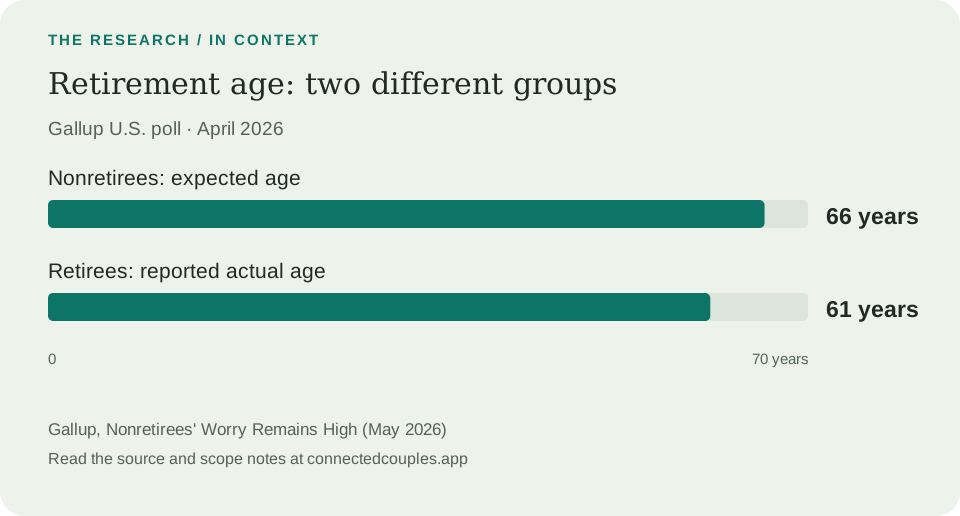
Gallup, Nonretirees' Worry Remains High (May 2026). Gallup U.S. poll · April 2026. Chart by Connected Editorial Team, October 2, 2026. Please retain the source, date and scope when sharing.
What do you miss about the old routine?
A job can supply structure, contact with other people, a sense of usefulness and a clear boundary between work and home. When paid work ends or changes, it is worth asking which of those things you miss and which you're relieved to leave behind.
Before making a schedule, finish these sentences separately:
- “I am glad I no longer have to…”
- “I miss having a reason to…”
- “I thought retirement would give us more…”
- “One part of my existing routine I want to keep is…”
Then compare answers without immediately assigning activities. “I miss feeling useful” isn't automatically a request for more chores. “I want quiet mornings” isn't necessarily a rejection of your partner. Understand the need before trying to fill the calendar.
The National Institute on Aging encourages older adults to participate in meaningful and enjoyable activities and offers options ranging from learning to volunteering and social groups. Use those ideas as possibilities, not a requirement to make retirement look busy. NIA on activities you enjoy as you age
“Before you fill the calendar, ask what each of you misses about the old routine. One partner may want more company while the other wants a morning that still feels like their own; you can plan for both.”
Kayla Crane, LMFT
Being home doesn't mean being on call
A couple can be in the same house all day without choosing much time together. They can also assume that a person at home is always available for a conversation, an errand or company.
Agree on a few practical signals. For example: “When I am reading after breakfast, please ask before starting a long conversation,” or “I would like us to decide about lunch in the morning instead of assuming we'll eat separately.”
In a small home, separate space may mean different activities at the same table, headphones by agreement, or taking turns using a quiet room. It doesn't require a spare office or a second home. Ask what a closed door, headphones or a walk alone means in your household rather than giving those signals an automatic emotional interpretation.
For a broader conversation about requesting solitude kindly, see Connected's guide to alone time for couples.
Start with an ordinary Tuesday
Instead of planning your entire retirement, map a week you could actually live. Include four kinds of time: chosen time together, individual time, protected commitments and open time. You're not aiming for a perfect split. You want a week that gives both of you something to look forward to and enough room to breathe.

Read the graphic as text
A new retirement rhythm
Sketch a week that has room for both of you
TOGETHER: Time you both choose. A meal, outing, project, or quiet ritual.
APART: Time for each person. Friends, interests, solitude, and personal routines.
PROTECTED: Work or commitments. Keep space for responsibilities that continue.
OPEN: Unplanned time. Leave breathing room. Notice what you want to adjust.
This is a planning sketch, not a target number of hours.
| Kind of time | Example to adapt | Question to agree on |
|---|---|---|
| Together | Breakfast, an outing or a shared project | Are we both choosing this? |
| Apart | Reading, a friend, a solo class or a walk | How do we make room without seeking permission? |
| Protected commitments | Paid work, care work, volunteering or appointments | When should interruptions wait? |
| Open | A free afternoon or an unplanned evening | Is this genuinely open, or has someone silently claimed it? |
Pick a review point, such as after trying the plan for two weeks. Two weeks is just a suggestion; choose a time that gives you a fair chance to try it. Ask what felt comfortable, what felt crowded and what went missing. Change one or two details rather than declaring the whole arrangement a failure.
Leave room for rest. If retirement follows a demanding job, a health change or family strain, a full schedule may be the last thing either person wants.
When one partner retires first
Different stages create different daily realities. One person may want spontaneous trips; the other may need to finish a demanding workweek. A person who works at home still has work boundaries. A person who has retired still has a say over how their time is used.
Discuss three assumptions explicitly:
- Household work. Which tasks will change hands, if any? Consider capacity and preference rather than automatically assigning everything to the person without paid work.
- Availability. Which work hours and breaks are genuinely protected? When can you reliably spend time together?
- Plans. Which activities can one person do independently? Which require both calendars to agree?
A helpful request might be: “I would enjoy more weekday company, and I know you're working. Could we choose one lunch together? I will make separate plans for the other days.”
You don't have to synchronize retirement dates to prove closeness. Decisions about whether and when to leave work can involve finances, benefits, health and personal goals. Seek qualified advice for those parts rather than making them a test of the relationship.
When one person wants company and the other has a meeting
Imagine Lee and Jordan, a fictional couple. Lee has retired; Jordan still works three days a week. Lee imagines leisurely breakfasts and afternoon errands together. Jordan has spent years using quiet mornings to prepare for work and feels watched when Lee asks about every meeting.
They first argue about interruptions. Once they compare expectations, they see that Lee wants dependable connection and Jordan wants a workday that still feels manageable.
They agree to breakfast together on Jordan's non-working days. On working days, Jordan's morning remains protected, and they choose an evening meal without work or household administration. Lee researches a local group and reconnects with a former colleague rather than waiting for Jordan to finish every afternoon.
They also redistribute shopping by agreement. Lee takes the weekly shop but doesn't become the default owner of every household task. After trying the plan, they discover that a shorter breakfast works better than a long outing. They keep what feels good and revise what doesn't.
Now Lee knows when to expect company, and Jordan can work without feeling that every closed door needs an explanation.
Keep people in your life besides each other
Your partner may be an important source of companionship without being your only source. A friend who shares an interest, a community group or a former colleague can meet different social needs.
The American Psychological Association notes that life changes, including retirement, can disrupt established social connections. It suggests seeking different kinds of support and using shared interests to make new connections. APA on strengthening your support network
Make these choices inviting rather than supervisory. “Would you like company trying that group?” leaves room for an answer. “You need a hobby so you stop bothering me” turns a real need into an insult.
If cost, mobility or transport makes an activity difficult, look for a more accessible version: a nearby gathering, an online discussion, a phone call or a project at home. The point is meaningful contact and choice, not a particular retirement lifestyle.
When you keep irritating each other
The argument is about tiny things. Name the recurring situation: noise during quiet time, a changed meal routine or an errand accepted without checking. Solve that situation before assigning a character flaw.
One person wants much more togetherness. Ask what kind of time they miss. Focused conversation may answer the need better than being in the same room for more hours. Connected's guide to how much time couples spend together offers a broader discussion.
Chores have become a running score. List the current responsibilities and agree on owners. Include planning and follow-through, then revisit the split when circumstances change.
Everything feels flat or difficult. Don't assume persistent distress is simply the price of retirement. If low mood, worry or conflict is interfering with everyday life, consider individual professional support or couples counseling where it is safe and mutually wanted.
Try it on a difficult day
When one person's new freedom lands inside the other's workday
Fictional example
The retired partner books a Tuesday outing as a surprise. The working partner has meetings. Both may feel rejected: one because the invitation cannot happen, the other because their work was treated as movable.
- Cancel or change the booking without making attendance a test of affection. Check what can actually be changed before promising a refund or alternative.
- Mark work and other fixed commitments first. Then each person offers an available window for shared plans.
- Build a separate source of weekday company for the retired partner, chosen by them, so the working partner is not the only possible companion.
The useful review: After two weeks, ask which parts of the week felt connected, crowded or lonely. Change a time block before assuming the whole retirement arrangement is wrong.
Make it yours
Sketch an ordinary week after retirement
Start with a normal weekday, including any paid work or care commitments that continue. Leave some time unassigned.
Your entries stay in this tab and are not sent by this worksheet. Download your draft before closing or reloading; it is not saved automatically.
Your draft to discuss together
Check that both people agree before treating this as a commitment. Blank items remain open questions.
Notice what is getting easier and what still feels difficult
Wanting individual time is a reasonable preference. Explain what you want to do and agree on some chosen time together too. Neither person needs to defend every separate activity as a benefit to the relationship.
There is no adjustment deadline that applies to every couple. Look for whether your arrangements are becoming more workable and whether each person can raise a concern. Seek help for persistent distress rather than waiting for an imagined adjustment period to expire.
For a first conversation, ask, “What would make an ordinary Tuesday feel good to you?” Compare the answers and choose one small change. If a regular prompt would help you keep learning about each other's days, try Connected for daily questions and a weekly check-in.
Sources & editorial notes
Published by the Connected Editorial Team, with a quote from Kayla Crane, LMFT. Examples are fictional. The worksheets and graphics are original editorial planning aids, not validated assessments or a substitute for professional care.
- Gallup, Nonretirees' Worry Remains High (May 2026)
Gallup U.S. poll · April 2026. These are different groups, not people tracked from expectation to retirement. The gap does not predict either partner's retirement date.
- NIA on activities you enjoy as you age
NIA provides meaningful activity suggestions including learning, volunteering and social activities. No health outcome promises used.
- APA on strengthening your support network
APA names retirement among changes that can affect social connections and recommends different support sources and shared interests.